
The Grain, the Flame, and the Two Pice: 5 Radical Lessons from a Modern Saint
In the mid-19th century, a young man of about sixteen years appeared under a Neem tree in the village of Shirdi. He was strikingly handsome, fair-skinned, and possessed a preternatural composure, yet he lived the life of a total mendicant. He practiced a hard penance, seemingly indifferent to the scorching heat or the biting cold of the Deccan plateau. To the casual observer, he was a “mad Fakir”—a penniless wanderer who lived on alms and owned nothing but a tin pot and a tattered robe.
Yet, this “Fakir” was a “precious Diamond” whose presence transformed Shirdi from a distressed village into a spiritual center, a Holy Tirth equivalent to the greatest pilgrimage sites of India. He never wrote a book and never traveled beyond a three-mile radius, yet he became a beacon for millions. By distilling the ancient wisdom recorded in the Shri Sai Satcharita, we find five radical lessons that offer a remedy for the speed, greed, and spiritual noise of modern life.
1. Your Daily Grind is an Act of Internal Alchemy
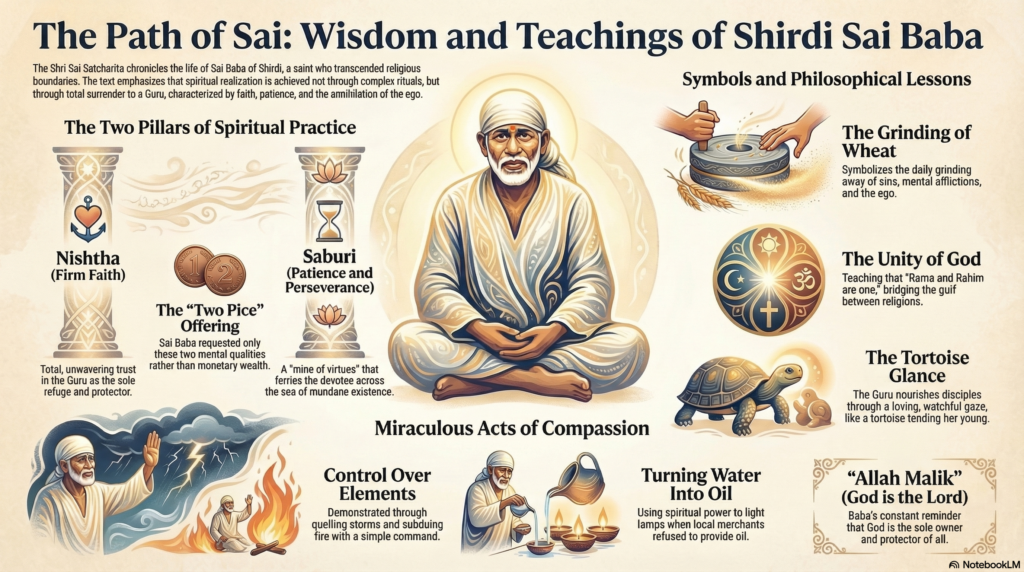
In 1910, a cholera epidemic gripped Shirdi. Amidst the panic, the villagers found Sai Baba performing a mundane, almost absurd task: grinding wheat in a hand-mill. He lived on alms and stored no food; he had no need for flour. When four women from the crowd forcibly took over the handle, thinking he intended to bake bread, Baba remained silent until the work was done. He then ordered them to scatter the flour at the village borders. Almost immediately, the epidemic subsided.
The villagers saw a physical cure; the philosopher sees a transformation of the soul. In this “internal alchemy,” the lower stone of the mill represents Karma (action) and the upper stone represents Bhakti (devotion). The handle—the point of leverage—is Jnana (knowledge). To reach the center, one must grind away the three gunas: Tama (ignorance), Raja (passion), and even Sattva (goodness). Why grind away goodness? Because even the “gold chain” of a virtuous ego is still a chain that prevents total self-realization.
“Knowledge or Self-realization is not possible, unless there is the prior act of grinding of all our impulses, desires, and sins; and of the three gunas, viz. Sattva, Raja, and Tama; and the Ahamkara (ego), which is so subtle and therefore so difficult to be got rid of.”
2. The Only “Currency” That Matters is Faith and Patience
We live in an age of transactional spirituality. We offer a ritual and expect a result; we follow a “life hack” and expect an immediate upgrade. Sai Baba shattered this commercial mindset. When an old woman, Radhabai Deshmukh, determined to fast until death unless he gave her a secret mantra, Baba shared the story of his own Guru. His teacher had never whispered a mantra in his ear; instead, he requested a Dakshina (remuneration) of just “two pice”—two small copper coins.
These coins were not monetary. They were Nishtha (Firm Faith) and Saburi (Patience or Perseverance). In a world obsessed with “crushing it” through sheer effort, Saburi is the radical act of waiting. It is the “manliness” required to stay unperturbed when the universe seems silent.
“Saburi is manliness in man, it removes all sins and afflictions… gets rid of calamities in various ways, and casts aside all fear, and ultimately gives you success.”
3. Radical Empathy Costs Something (The Story of the Burning Hand)
Modern empathy is often a low-cost performance—a “like” or a “share.” For the Saint of Shirdi, empathy was a visceral, physical burden. During a Diwali festival, as Baba sat near his Dhuni (sacred fire), he suddenly thrust his arm into the roaring flames. The smell of singed flesh filled the Masjid as his arm scorched instantly.
When his devotees pulled him back in horror, Baba remained in a state of divine calm. He explained that miles away, a blacksmith’s child had slipped into a furnace. By thrusting his own hand into the fire in Shirdi, Baba had reached across space to pull the child to safety. He did not merely “feel for” the child; he took the heat onto his own skin.
“I do not mind My arm being burnt, but I am glad that the life of the child is saved.”
This is the radical commitment of a true teacher: they do not just offer advice; they absorb the suffering of those they protect. It is a reminder that real connection often requires us to carry the weight—and sometimes the burns—of another’s struggle.
4. The Power of the “Tortoise Glance”
In the crowded marketplace of modern self-help, influence is measured by noise—by the “blowing of mantras” into as many ears as possible. Baba preferred the metaphor of the tortoise. A mother tortoise does not feed her young with milk; she sits on one bank of the river and nourishes her offspring on the opposite bank through her “loving looks” alone.
This “Tortoise Glance” is a form of silent mentorship. It suggests that the most profound sustenance doesn’t come from complex instructions or loud affirmations, but from the steady, focused attention of a source of wisdom. While “pseudo-gurus” rely on the noise of secret formulas, the true master provides nectar through presence.
“The tortoise glance is, to the young ones, a down-pour of nectar, the only source of sustenance and happiness. Similar is the relation, between the Guru and disciples.”
5. You Cannot Find Truth with a Closed Fist
The most stinging rebuke in the Satcharita was reserved for a wealthy man who came to Shirdi seeking “Quick Brahma-Jnana” (Divine Knowledge). He was a man of “Mammon,” obsessed with his own prosperity.
Baba tested him by sending a boy to various shopkeepers to borrow a paltry five rupees. As the boy returned empty-handed time and again, the rich man sat watching, despite having a bundle of 250 rupees in his pocket. He wanted the Infinite, but he could not part with a pittance. Baba revealed that the search for Truth requires specific qualifications, most notably Antarmukhata (turning the gaze inward) and Virakti (dispassion for worldly attachment).
“How can he, whose mind is engrossed in wealth, progeny and prosperity, expect to know the Brahma, without removing away his attachment for the same?”
The lesson is a paradox: you cannot acquire the Absolute while clutching the finite. Realization is not an accumulation; it is a letting go. To find Truth, one must first open the hand.
——————————————————————————–
Conclusion: The Wisdom of the Threshold
Sai Baba lived his life on the “threshold”—physically dwelling in a dilapidated Masjid he named Dwarkamai, yet welcoming all into a space that functioned as a temple. He was the bridge between the rich and the poor, the Hindu and the Muslim, the miraculous and the mundane.
In our fast-paced, fragmented lives, the “Wisdom of the Threshold” reminds us to live at the intersection of the spiritual and the material without losing our center. We are all “grinding” something today. As we navigate our daily struggles, we must ask ourselves: are we merely feeding our anxieties, or are we, like the Saint of Shirdi, turning our daily grind into a remedy for the world?