
1. Introduction: The Forgotten Blueprint of Reality
When we contemplate the universe, we often oscillate between the cold data of modern physics and the abstract metaphors of spirituality. However, ancient Vedic science offers a third path: Padartha Vigyan. This framework treats reality not as a collection of stories, but as a rigorous, mathematical classification of existence. In this system, everything—from the density of a stone to the flickers of human consciousness—is assigned a specific numerical value. By viewing the universe through this lens, we discover a world where perception is measured, and the soul itself has a definitive “math.”
2. The Quantitative Soul: Why Your Spirit has a “Number”
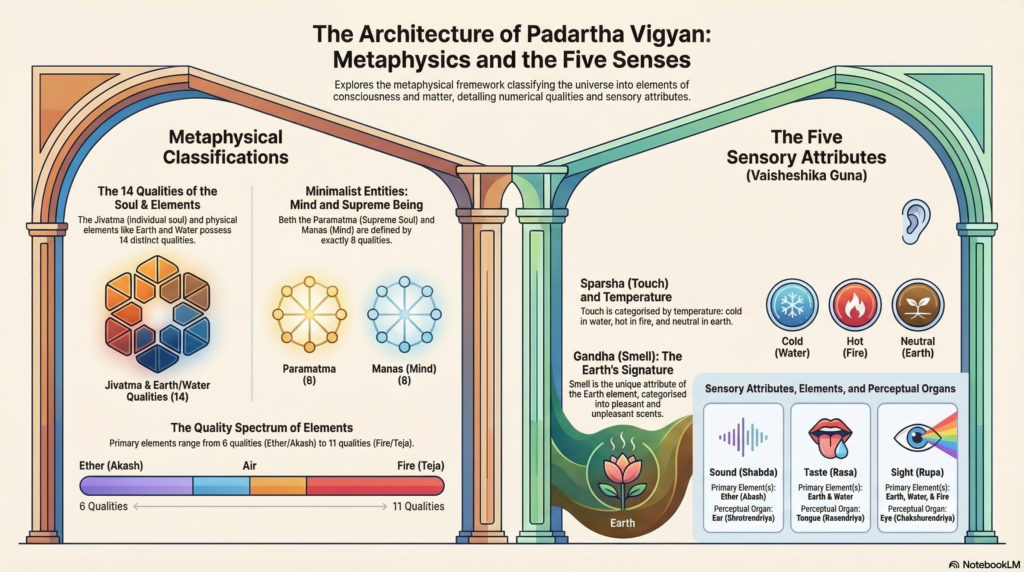
In Padartha Vigyan, consciousness is not a vague or formless entity. It is defined by its Gunas (qualities), and the count of these qualities reveals a surprising hierarchy. The individual soul, or Jivatma, is categorized as possessing 14 distinct qualities, while the supreme consciousness (Ishwar) and the mind (Manas) possess only 8.
The “weight” of the individual soul comes from the complexity of the human experience—specifically the inclusion of moral and emotional variables that do not apply to the supreme or the mechanical mind.
The Mathematical Breakdown of Consciousness:
- Jivatma (Individual Soul) – 14 Qualities: 6 Buddhi-adi (Intellect, Pleasure, Pain, Desire, Aversion, Effort) + 5 Sankhya-adi (Number, Magnitude, Distinctness, Conjunction, Disjunction) + Bhavana (Impression/Memory) + Dharma (Merit) + Adharma (Demerit).
- Ishwar (Supreme Being) – 8 Qualities: 5 Sankhya-adi + Buddhi (Universal Intellect) + Iccha (Will) + Prayatna (Effort).
- Manas (Mind) – 8 Qualities: 5 Sankhya-adi + Paratva (Priority) + Aparatva (Posteriority) + Vega (Velocity/Momentum).
This reveals a profound metaphysical truth: human life is “heavier” because of Dharma and Adharma. While the supreme being operates through pure will and intellect, the individual soul must navigate the complexities of merit, demerit, and the lingering impressions of past experiences.
3. The Monopoly of Sound: Why Space is a Solo Act
The ancient classification of sensory experience posits that each element has a signature quality. For Akash (Ether or Space), that quality is Shabda (Sound). Unlike other elements that share multiple attributes, sound is a “solo act”—it is the exclusive quality of space and can only be perceived through the Shrotendriya (the sensory organ of the ear).
The sophistication of this system is evident in how it distinguishes between types of sound:
- Dhvanyatmaka: Unstructured, non-linguistic sounds, such as the beat of a drum or a tabla.
- Varnatmaka: Structured, articulate sounds—specifically language produced by the human throat.
In this framework, space is not an “empty” void but a necessary medium. The ancient logic dictates that for sound to exist as a quality, it must have a substratum. Since sound does not reside in earth, water, fire, or air in its primary form, Akash serves as the unique carrier of all vibration, from the chaotic crash of thunder to the precise syntax of speech.
4. Beyond Hot and Cold: The Logic of “Neither-Nor”
Modern perception often views temperature as a linear scale. However, Padartha Vigyan classifies Sparsha (Touch) into three distinct categories based on the elemental composition of matter. This creates a “Neither-Nor” logic that challenges our colloquial descriptions of the world.
- Sheet (Cold): The inherent quality of Jal (Water).
- Ushna (Hot): The inherent quality of Tej (Fire).
- Anushnasheet (Neither Hot nor Cold): The neutral thermal state found in Prithvi (Earth) and Vayu (Air).
This classification offers a striking insight into Vayu (Air). While we might describe a “cold breeze,” the ancient physicist would argue that the air itself is neutral (Anushnasheet); it only carries cold or heat because of its conjunction with water or fire particles. This numerical precision extends to the elements themselves, which increase in complexity as they move toward the physical: Agni (Fire) and Vayu (Air) possess 9 qualities, Tej (Radiant Energy) has 11, and Aap (Water) reaches 14.
5. The Physicality of the Earth: 14 Layers of Complexity
The element of Prithvi (Earth) shares a unique mathematical bond with the human soul: both possess 14 qualities. This suggests a deep metaphysical symmetry between our internal consciousness and the physical world we inhabit.
Earth is the primary locus of Gandha (Smell), perceived through the Ghranendriya. This sense is divided into Surabhi (Fragrance) and Asurabhi (Malodor). Similarly, the experience of Rasa (Taste) via the Rasendriya (Tongue) is analyzed with clinical precision. The system distinguishes between:
- Mukhyaras: The primary taste that is perceived immediately upon contact.
- Anuras: The secondary taste or aftertaste that manifests as the substance is processed.
The scholar Nagarjuna emphasized the “Guna-pradhanya”—the primacy of these qualities—not as abstract ideas, but as the functional drivers of reality.
Nagarjuna’s 8 Factors of Quality Primacy (Guna-pradhanya):
- Sannishraya (Providing a stable residence for attributes)
- Rasannugraha (Favoring the manifestation of taste)
- Vipaka-karanatva (Determining post-digestive transformation)
- Sankhya-bahulya (Numerical abundance of qualities)
- Prayoga-bahulya (Wide range of practical applications)
- Upadesha (Alignment with traditional instruction)
- Apadesha (Specific designation)
- Anumana (Basis for logical inference)
6. Conclusion: A Universe Measured by Perception
The study of Padartha Vigyan demonstrates that the ancient world did not separate the “hard” science of matter from the “soft” experience of the soul. Instead, they recognized a universe where every object and every thought is a specific collection of mathematical attributes.
If you began to view your own mind not as a chaotic storm of emotions, but as a structure with exactly 8 qualities, and your soul as a vessel of 14, how would that change your sense of self? By embracing this ancient “mathematics of the soul,” we move closer to a reality that is both intellectually rigorous and profoundly connected.