On a Thursday afternoon in Greenville, South Carolina, the foundation of the NCAA Tournament didn’t just rattle—it underwent a 20-minute earthquake. For half of their East Region clash, the Siena Saints didn’t just hang around with the No. 1 overall seed Duke Blue Devils; they tore up the script, turning a supposed Durham “tune-up” into a living nightmare. Millions of brackets flickered on the edge of extinction as the mid-major underdogs from Loudonville sent seismic shockwaves through the Bon Secours Wellness Arena. While Duke eventually escaped with a 71–65 survival, what happened in Greenville was a definitive “One Shining Moment” for a program that earned every ounce of national respect.
Here are the five takeaways that defined the game the sports world won’t stop talking about.
1. The 11-Point Mirage: Shattering the #1 vs #16 Script
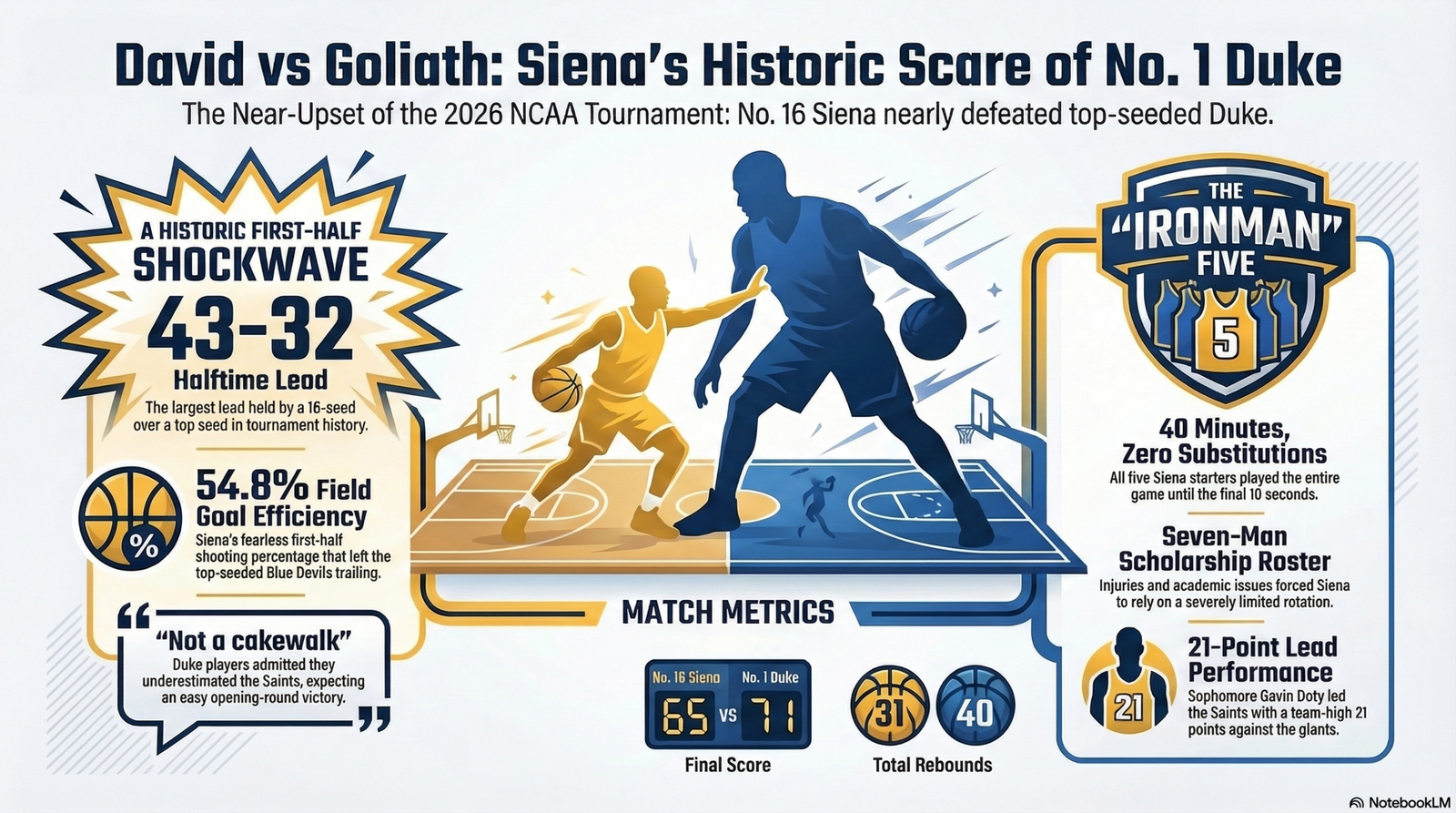
The halftime scoreboard read like a computer glitch: Siena 43, Duke 32. This wasn’t just a plucky underdog lead; it was historical. That 11-point cushion represented the largest halftime lead a No. 16 seed has ever held over a No. 1 seed in the history of the NCAA Tournament.
The Saints achieved this by ruthlessly exploiting Duke’s early-game lethargy. While the Blue Devils looked disjointed, Siena played with “surgical precision,” shooting a blistering 54.8% from the floor. Led by sophomore phenom Gavin Doty—the MAAC Tournament MVP who earlier this season set a school record by going a perfect 9-of-9 from the field—Siena hit five of their first 11 triples. They didn’t just out-shoot the blue bloods; they out-imagined them.
2. Forty Minutes of Fury: The Roster That Refused to Sub
In an era of deep benches and high-usage rotations, Siena Head Coach Gerry McNamara pulled off something nearly extinct: a pure “Iron Man” rotation. Hamstrung by season-ending injuries and academic issues that left him with only seven scholarship players, McNamara kept his starting five on the floor for essentially the entire 40-minute gauntlet.
Until a single substitution was made with just 9.1 seconds remaining, Justice Shoats, Gavin Doty, and the rest of the starters played without a single second of rest. This wasn’t desperation; it was a testament to a grueling conditioning program.
“We’re built for that,” said senior guard Justice Shoats. “It started from the beginning of the year. The way we were conditioned, the way we worked out in the weight room. We showed what we’re made of in this moment.”
3. The “Cakewalk” Confession: Out-Hustling the Giants
The psychological narrative of the game pivoted on a staggering moment of honesty. At halftime, Duke senior forward Maliq Brown admitted to CBS’s Tracy Wolfson: “We thought it was going to be a cakewalk going into this game.”
That entitlement was laid bare in the box score. Despite Duke entering as the second-tallest team in the nation (KenPom), the “undersized” Saints (ranked 275th in height) were the ones playing bully ball. In the first half, Siena actually outscored Duke in the paint 22–16 and outrebounded the giants 18–13. Siena wasn’t just surviving; they were the aggressors, punishing a Duke squad that spent too much time settling for contested jumpers.
4. Tactical Suffocation: How the 3-2 Zone Stalled a Miracle
Early in the second half, Siena stretched their lead to 13 points, and the “Upset Alert” sirens reached a deafening pitch. But the drama took a dark turn for the Saints when they missed three point-blank looks followed by back-to-back missed dunks—a clear sign that the “Iron Man” legs were finally turning to lead.
Jon Scheyer responded with the tactical move of the game, shifting Duke from man-to-man into a suffocating 3-2 zone. A zone defense is a death sentence for a fatigued team; it forces the ball to move and the offense to hunt shots from the perimeter on tired legs. The result was a “miserable” 23.5% shooting performance from Siena in the second half and a deafening six-minute scoring drought.
“It kind of bit us in the second half when we weren’t able to score or make a shot late,” McNamara noted after the game. The energy shift was punctuated by sophomore Isaiah Evans, whose back-to-back transition dunks acted as a “defibrillator to the chest” for the Blue Devils, sparking a decisive 11–0 run.
5. Survival is the Only Currency
When the miracle began to fade, Duke’s freshman phenoms took the keys. With veteran Caleb Foster sidelined, Cayden Boozer ran the show with ice-water poise, dropping a career-high 19 points and five assists with zero turnovers in 39 minutes.
His twin, Cameron Boozer, proved why he is a projected lottery pick. Though he struggled from the floor (4-of-11), he dominated through “bully ball,” living at the stripe and sinking 13 critical free throws. He finished with a massive 22-point, 13-rebound double-double. Along with Isaiah Evans’ 16 points and 10 boards, the Blue Devils proved that in March, style points are irrelevant—survival is the only thing that buys you a Saturday tip-off.
Cinderella’s New Address
The Saints’ season ends at 23–12, but the record hides the magnitude of the turnaround. In just his second year, Gerry McNamara engineered a nine-win improvement from last season and brought Loudonville its first tournament berth in 16 years.
McNamara, a Syracuse legend and former Associate Head Coach for the Orange, has seen his stock explode. As he heads into an offseason where his alma mater has a coaching vacancy, the national respect earned by his five-man rotation is undeniable. He didn’t just coach a game; he authored a manifesto on mid-major grit.
In an era of NIL and transfer portals, did the Siena “Iron Men” just prove that the mid-major Cinderella is more alive than ever? They may have lost the game, but they won the room—and left the college basketball world wondering what they could do with a full bench.