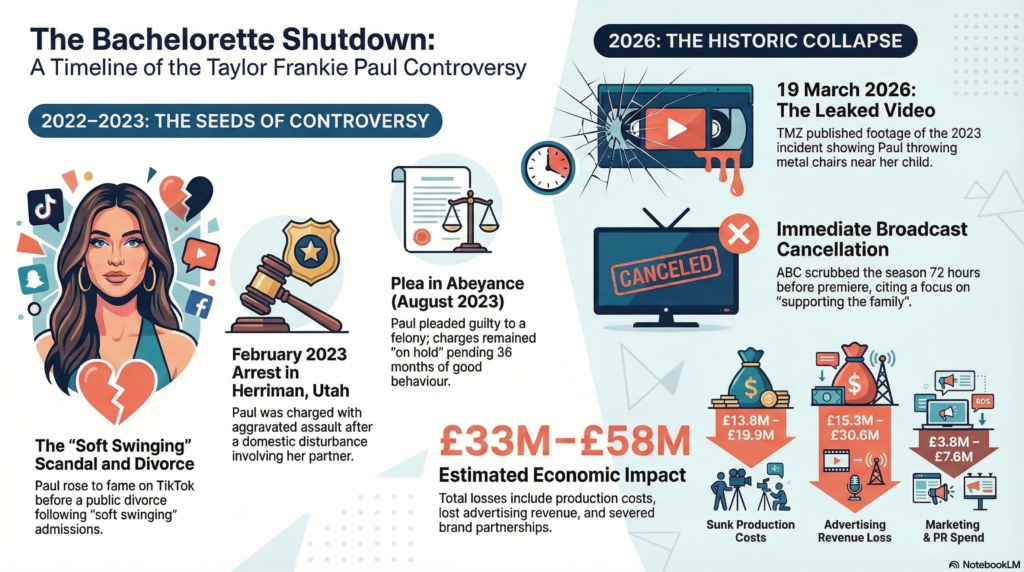
The Hook: A Premiere That Never Was On March 19, 2026, the executive suites at ABC executed a definitive rupture in the operational protocols of the Bachelor franchise. Just 72 hours before the scheduled March 22 premiere of Season 22, the network officially de-platformed its own production, scrubbing an entire season from the cultural calendar. This was no mere scheduling conflict; it was a desperate attempt at proactive risk mitigation. The decision highlights the intensifying friction between a corporate appetite for “authentic” volatility and the fragile nature of brand sovereignty. At the epicenter is Taylor Frankie Paul, whose rapid descent from “MomTok” royalty to a toxic asset contaminated the brand equity of a legacy Disney property in less than a week.
The Unprecedented De-platforming While the Bachelor universe has weathered storms before—from the casting of Lincoln Adim to the exit of Chris Harrison—this cancellation is historically unique. In the past, the network relied on the “redemption arc” or strategic editing to navigate controversy. This time, the sheer gravity of the reputational contagion forced a total erasure. Scrapping a fully filmed and edited season of a flagship property is an admission of a catastrophic failure in due diligence.
“In light of the newly released video just surfaced today, we have made the decision to not move forward with the new season of ‘The Bachelorette’ at this time, and our focus is on supporting the family.” — Disney Entertainment Television Spokesperson
The Graphic Power of Visual Evidence The “terminal” blow to the season was the public dissemination of a 2023 TMZ video that shattered the carefully curated MomTok aesthetic. For years, Paul’s brand was predicated on a “soft-swinging” transparency and Mormon domesticity. The leaked footage, however, revealed a brutal physical altercation with Dakota Mortensen, involving Paul throwing heavy metal barstools in a room where her five-year-old daughter was heard screaming in terror. The dissonance between the filtered, religious lifestyle and the raw violence of the footage created an immediate brand safety crisis. No amount of “contextualizing” could soften the image of a metal chair striking a child, rendering Paul an unmarketable liability for a family-oriented ecosystem.
The High Cost of the “Attention Economy” Casting an influencer with a documented history of domestic disturbances was a high-stakes gamble on what Professor Amy Pei identifies as the “attention economy.” The goal was to “ignite MomTok” and leverage Paul’s 6.1 million followers to revitalize an aging franchise. Instead, the failure of due diligence has led to a massive economic contraction:
- Production Sunk Costs: With a per-episode cost of approximately $2 million, the shelving of a 9-to-13 episode season represents a direct loss of up to $26 million in production alone.
- Marketing and Ad Revenue: Total estimated losses, accounting for national marketing campaigns and lost prime-time ad revenue, range from $43 million to a staggering $76 million.
- Distribution Fallout: Warner Bros. Unscripted TV now possesses a shelved asset that cannot be distributed internationally, leading to a complex legal dispute over which entity bears the financial responsibility for the vetting failure.
The Cinnabon Effect: When Sponsors Lead the Way In the economics of brand sovereignty, networks rarely pivot until the capital begins to exit. The swift abandonment by corporate sponsors, led by Cinnabon, forced ABC’s hand. On March 9, 2026, Cinnabon launched its “Swirled Soda” campaign, specifically designed to capture the viral momentum of the MomTok subculture. By March 19, that investment was a liability. The ten-day collapse from product launch to total brand decoupling illustrates a new corporate reality: sponsors now maintain a zero-tolerance policy regarding talent associated with child endangerment. When the money walked, the season died.
The Legal “Sword of Damocles”: The Plea in Abeyance The cancellation was also accelerated by Paul’s precarious legal status. In August 2023, she entered a “plea in abeyance” for a third-degree felony count of aggravated assault. This 36-month agreement acted as a legal “Sword of Damocles,” set to expire in August 2026. Had she remained law-abiding, the felony would have been downgraded. However, the February 2026 Draper City Police investigation occurred just six months before her record could be cleared. This new incident potentially triggers a felony conviction, making her presence on prime-time television a legal and ethical impossibility.
“After years of silently suffering extensive mental and physical abuse as well as threats of retaliation, Taylor is finally gaining the strength to face her accuser and taking steps to ensure that she and her children are protected from any further harm.” — Representative for Taylor Frankie Paul
The “MomTok” Domino Effect The fallout has destabilized the entire digital subculture Paul helped architect. Production on Season 5 of Hulu’s The Secret Lives of Mormon Wives is now on an indefinite pause. Crucially, the cast members—who were recently promoted to Executive Producers—now wield significant strategic weight. Led by Mikayla Matthews, the cast’s refusal to film with Paul has effectively paralyzed the production. This domino effect demonstrates how the consumer-facing volatility of a single influencer can jeopardize multimillion-dollar production ecosystems and the professional standing of an entire ensemble.
Conclusion: A New Standard for Talent Risk? The Taylor Frankie Paul saga serves as a forensic case study in the limits of the attention economy. It marks the end of an era where networks could “contextualize” violence for the sake of ratings. Moving forward, we should anticipate significantly more invasive vetting and ironclad morality clauses that treat talent not just as stars, but as high-risk corporate assets. This event forces a biting question: At what point does the human cost of turning domestic volatility into prime-time entertainment finally exceed the network’s tolerance for financial loss? For ABC, that number was $70 million.