1. Introduction: More Than Just Dirt
To the modern eye, the soil beneath our feet is often reduced to a mundane utility—a medium for agriculture, a site for construction, or the “dirt” we reflexively sweep from our floors. Yet, within the rigorous architectural framework of Vedic and Ayurvedic metaphysics, Earth, or Pruthvi, is far more than a physical substrate. It is a fundamental element defined by a sophisticated philosophical architecture that bridges the infinitesimal with the infinite. By shifting our gaze from the “soil” to the “substance,” we uncover Pruthvi not merely as a planet, but as the primordial principle of solidity and the very anchor of manifest reality.
2. The Olfactory Anchor: Why Earth is the “Smelling” Element
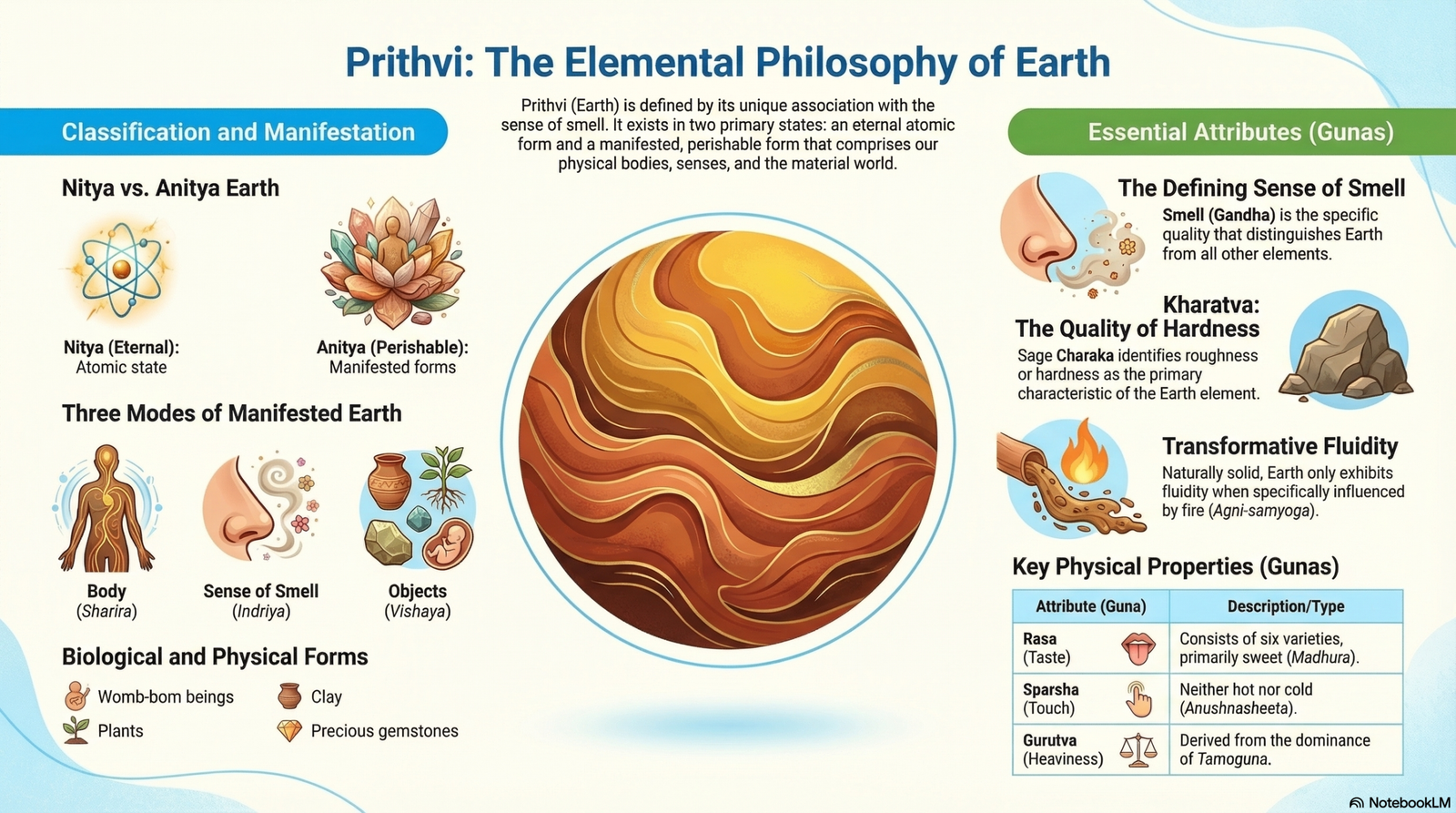
One of the most profound “aha!” moments in ancient metaphysics is the link between the solid ground and our sense of smell. While we often associate fragrance with the air that carries it, the tradition posits that the air is merely the vehicle; the source is always Earth. This relationship is codified in a precise definition:
“Earth is that which is endowed with the quality of smell (गंधी गुणाने युक्त ती पृथ्वी).”
In this system, Earth and the olfactory sense (Ghranendriya) share an ontological bond. This encompasses the entire spectrum of scent: Surabhi (the pleasant or fragrant) and Asurabhi (the malodorous or unpleasant). Where there is scent, there is the presence of the Earth element. To deepen this scholarly perspective, the sage Charak provides an additional asadharan lakshan (unique characteristic) for Pruthvi: Kharatva, or roughness. Whether through the textured grain of a stone or the microscopic particles that trigger our senses, Earth is the only element that anchors us to the world through both tactile resistance and olfactory signature.
3. The Two Faces of Reality: From Atoms to Mountains
The philosophy of Pruthvi operates on two distinct scales, creating a bridge between ancient “atomic theory” and our modern understanding of matter. Reality is divided into two states:
- Nitya (Eternal/Atomic): This is the Paramanu state. Here, Earth exists at the Anu (infinitesimal) scale. In this form, it is indestructible and eternal, serving as the immutable blueprint of the physical world.
- Anitya (Transient/Manifest): This is the Karyarupa—the functional world of form. Whether a pebble or a mountain range, these are Mahat (macro) manifestations. They are transient because they arise from the union (Samyoga) of atoms and eventually dissolve through their separation (Vibhaga).
This distinction invites us to see the macro-world not as a collection of static objects, but as a dynamic “functional form” arising from an invisible, eternal foundation. It is a vision of the universe where the indestructible micro-scale perpetually organizes itself into the visible grandeur of the macro-scale.
4. The Biological Earth: Why Plants are “Bodies” Too
Perhaps the most radical departure from modern classification is the definition of a “body” (Sharir). In the Vedic worldview, consciousness and “body-hood” are not restricted to mobile creatures but exist on a spectrum of the Earth element’s organization.
- Yonij: These are bodies born from a womb, including humans and animals.
- Ayonij: These are “non-womb-born” bodies. Most notably, this category includes Vanaspati (plants).
This classification suggests that a tree is a “body” of the Earth element just as much as a human is. This perspective shifts our relationship with the botanical world from one of utility to one of kinship. It challenges us to see the emergence of life not as a biological accident, but as the Earth element organizing itself into different modes of existence—some mobile and womb-born, others rooted and arising directly from the substrate.
5. The 14 Dimensions of Solidity
To define how Pruthvi interacts with the universe, scholars listed 14 Gunas (attributes). Earth is unique because it is the most “complex” element, inheriting properties from the elements that precede it (Space, Air, Fire, and Water).
- Thermal Equilibrium (Anushnasheet): Earth’s unique touch is neither hot nor cold. It represents a state of thermal neutrality or equilibrium, unlike the inherent heat of Fire or the cold of Water.
- Ecological Hierarchy (Paratva and Aparatva): The tradition offers a fascinating geographic insight, classifying Earth by its quality based on location. Paratva (superiority) is associated with Jangal Desh—arid, stable, and firm lands—while Aparatva (inferiority) is linked to Anup Desh, or marshy, unstable wetlands.
- The Weight of Presence (Gurutva): Driven by Tamoguna, this is the inherent heaviness that provides stability and “gravitas” to the manifest world.
- The Paradox of Fluidity (Dravatva): While Earth is naturally solid (Dhana), it exhibits Naimittik Dravatva (conditional fluidity) when it encounters fire (Agnisamyoga). This ancient observation of phase changes—such as the melting of gold into liquid—prefigures modern thermodynamics.
- The Principle of Identity (Pruthaktva): This is the quality of distinctness that allows Earth to remain perceptibly separate from other substances.
6. The Architecture of Objects: From Mud to Gemstones
The final category, Vishaya (Subject matter), illustrates the incredible versatility of the element. It organizes the physical world into a spectrum:
- Mrtika: The common clays and soils, representing the foundational, non-metallic forms of Earth.
- Pashan: The “stones,” which include Dhatu Ratne (metals and precious gems).
From a handful of mud to the crystalline lattice of a diamond, all are viewed as manifestations of the same Pruthvi element. Their varying beauty and value are merely different expressions of Earth’s 14 Gunas, specifically its Rupa (color—often white or variegated) and its inherent Madhura Rasa (sweet taste). This perspective fosters a unifying vision of the physical world, where the most precious jewel and the commonest clay share the same primordial essence.
7. Conclusion: The Ground Beneath Your Feet
The ancient study of Pruthvi offers a map of reality that is as rigorous as it is poetic. It reminds us that the sophistication of human observation did not begin with the invention of the microscope, but with a deep, intuitive understanding of the qualities that construct our existence. By perceiving the world through this elemental lens, we begin to recognize the “Sanctity of the Physical.”
How might our interaction with the environment change if we truly perceived every scent as a literal fragment of the Earth reaching out to us, or if we viewed the stillness of a forest as a vast community of “bodies” equal to our own? This ancient framework invites us to walk with more awareness, recognizing that the ground beneath our feet is not just a stage for our lives, but a living, breathing, and complex architecture of which we are an integral part.