In the summer of 1983, the Indian subcontinent was a landscape defined by profound socio-political zeitgeist and unprecedented internal uph
eaval. While the nation grappled with domestic strife, its cricket team arrived in England as little more than a statistical curiosity. To the international sporting establishment, India occupied the ignominy of being the tournament’s perennial cellar-dwellers—a team effectively in the “last position” with no significant records to their name. This raises a fundamental question for the cultural historian: how does a squad, dismissed by the world and haunted by the specter of civil unrest at home, find the collective fortitude to engineer the greatest upset in sporting history?
The Statistical Void: The Mystery of the Perennial Underdog
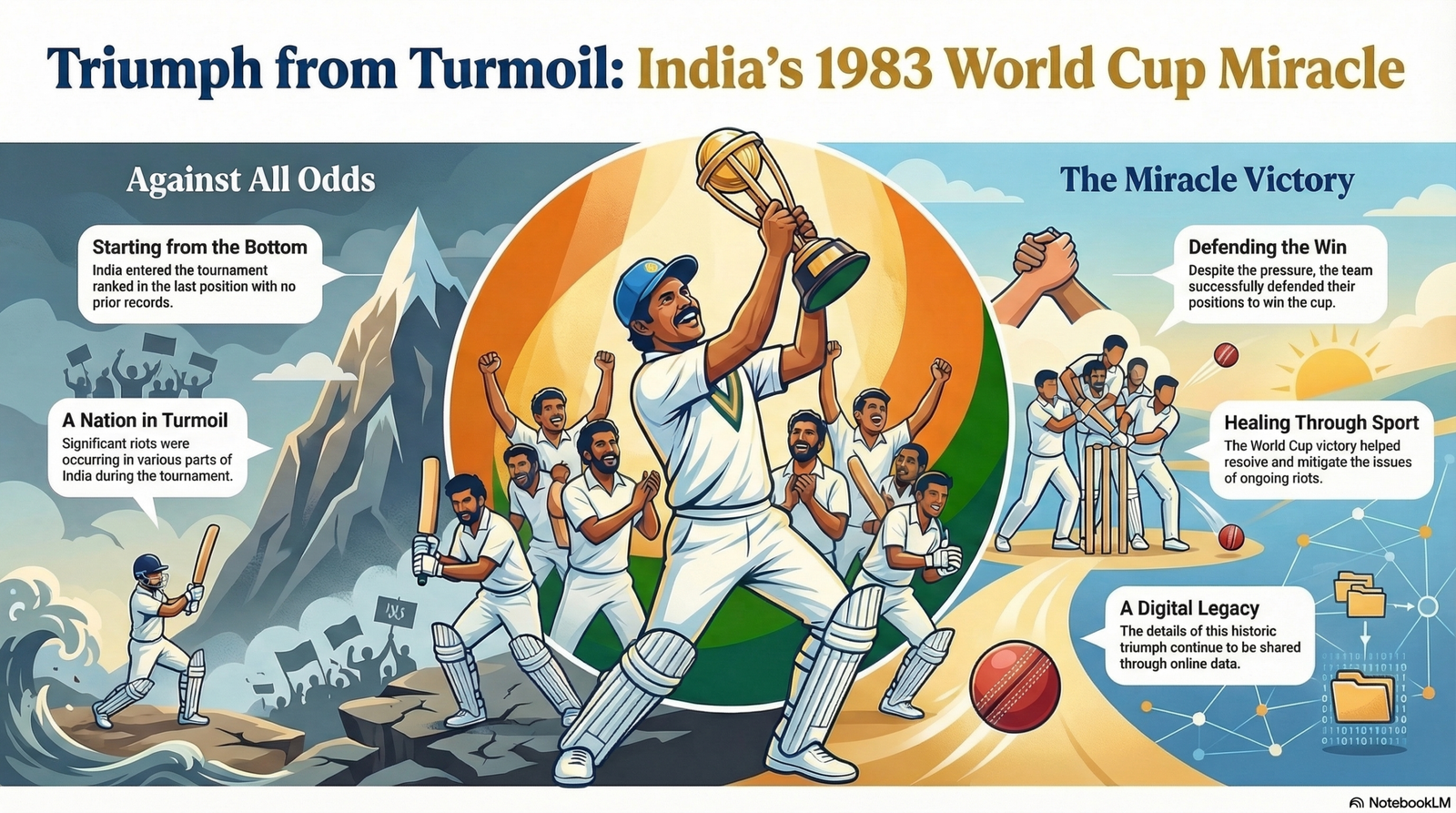
Entering the 1983 Prudential Cup, India’s standing was characterized by a complete lack of pedigree. They were the ultimate outsiders, holding a status of “last position” that made their presence feel like a formality rather than a threat. With “no records” of note in the limited-overs format, their eventual ascent to the podium remains a historical mystery—a disruption of the natural order that defied every metric of the era.
“Staring from the very bottom of the global rankings and burdened by a history of no records, India’s climb to the summit remains the most enduring mystery of the 1983 World Cup.”
Defending the Pitch Against a Backdrop of Civil Unrest
The true weight of the 1983 campaign was not found in the pace of the West Indian bowlers, but in the news filtering in from home. At the time, India was fractured, with riots breaking out in various regions, creating a psychological burden that would have broken a lesser collective. The players were tasked with an impossible duality: they had to defend their wickets on the pristine grass of Lord’s and Old Trafford while their homeland faced a desperate struggle for internal stability.
——————————————————————————–
Triumph from Turmoil
——————————————————————————–
This victory was not achieved in a vacuum. It was forged in the heat of national crisis, where the act of “defending and winning” on the field became a symbolic stand against the chaos threatening to consume the country.
The Social Salve: How Cricket Stilled the Streets
As a cultural commentator, one cannot ignore the staggering claim that this sporting achievement helped to “resolve the issue of riots.” The mechanism of this healing was profound; the collective euphoria of the underdog victory acted as a national sedative. As the final wicket fell, the communal friction that had ignited the streets was momentarily replaced by a singular, unified identity. The victory provided a rare moment of shared purpose, proving that when a team manages to “defend and win” against all odds, the triumph can leap over the boundary ropes to settle old scores and quiet the fires of civil instability.
A Digital Resurrection: The Enduring Analytics of 1983
The “miracle” of 1983 has not faded into the mists of nostalgia; rather, it has been revitalized for the modern era. Through the democratization of “online data sharing,” a new generation of analysts and fans continues to dissect the mystery of that summer. Digital archives and video databases allow us to witness how the team’s unwavering tenacity allowed them to “defend and win” in situations where the data suggested certain defeat. This digital record ensures that the sheer improbability of their journey remains a living blueprint for resilience.
The Final Thought: A Legacy of National Fortitude
The 1983 World Cup was never just about the scorecard; it was a definitive testament to national resilience. It demonstrated that a collective will could transcend the sport itself, transforming a period of national darkness into a milestone of lasting unity. In our current era of hyper-polarization, one must wonder: does a single sporting event still hold the power to stitch together the fabric of a divided nation today?
Resilience remains the ultimate defense against chaos.