1. Introduction: The Miracle of 1983
In the summer of 1983, India was a nation of jarring contradictions. On the streets of various cities, the air was thick with the acrid smoke of civil unrest; internal conflicts and riots threatened to tear the social fabric apart. Yet, thousands of miles away on the manicured lawns of England, a different kind of drama was unfolding. The Indian national cricket team arrived at the World Cup as the ultimate ghost in the machine—a side occupying the “last position” in the global hierarchy, possessing “no records” of note, and dismissed by critics as a mere footnote in the tournament’s history.
The “mystery” of the 1983 World Cup, however, transcends the boundary ropes. It was more than a sporting upset; it was a profound spiritual and national catalyst. As a cultural historian, one observes a rare alignment where the mechanics of a game achieved what the machinations of politics could not. It was a moment where a shared focus—aided by technology and ancient wisdom—transformed a fragmented population into a unified citizenry.
2. The Flight of the Phoenix: Winning from “Scratch”
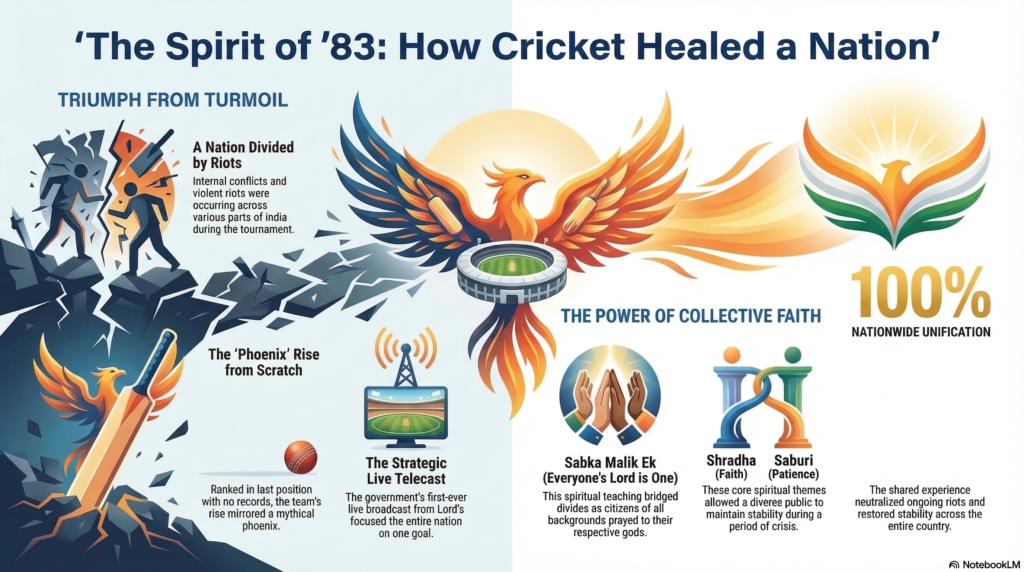
The ascent of the 1983 team is most aptly described as the “flight of a phoenix.” To understand the magnitude of this victory, one must acknowledge that India began the tournament from “scratch.” They were not merely underdogs; they were a team starting from a baseline of zero, rising from a highly disadvantaged position that offered no statistical reason for hope.
This rise was symbolically heavy. As the team fought its way through the brackets, it mirrored the resilience required of the nation itself. Just as the mythical phoenix is defined by its ability to rise from the ashes, the Indian team emerged from the “last position” to claim the world title. For a public witnessing the literal and metaphorical ashes of domestic turmoil, this sporting “flight” provided a narrative of renewal, suggesting that stability and greatness could be rebuilt even when starting from nothing.
3. A Strategic Peace: The Power of the Live Telecast
While the players battled at Lord’s, the Indian government executed a social strategy that was as tactical as any bowling change. In a landmark decision, the government launched the first-ever live telecast of the World Cup final. This was not merely a technological milestone; it was a deliberate attempt to neutralize the chaos of the streets.
The strategy was remarkably successful. The live broadcast acted as a powerful temporal buffer, drawing the public away from the sites of conflict and toward a singular, flickering screen. As the nation held its breath to watch the final in London, the riots effectively paused. The energy of the mob was redirected into the tension of the match. For those few hours, the communal focus on a shared goal replaced the divisions of the street, proving that a nationwide event could act as a cooling agent for a feverish country.
4. Sabka Malik Ek: The Divine Unifier
At the heart of this unification lay a spiritual infrastructure deeply rooted in the teachings of Shirdi Sai Baba. The philosophy of Sabka Malik Ek—”Everyone’s Lord is One”—became the invisible thread connecting a diverse and often divided public. As the match reached its crescendo, the traditional boundaries of religion and caste began to dissolve.
The scene across India was one of extraordinary pluralism: millions of citizens, though separated by their individual faiths, were united in a singular act of devotion. They were praying to their respective gods for the same outcome.
“The Indian public came together as one to watch the game and collectively pray to their respective gods for a victory… demonstrating that despite individual differences in worship, the citizens could unite under a single, unifying cause.”
This moment embodied the essence of Sai Baba’s teaching. The irony of a multi-religious nation converging into a single spiritual front to support a cricket team remains one of the most beautiful instances of national “oneness” in modern history.
5. Shradha and Saburi: The Spiritual Infrastructure of Victory
The victory was sustained by two other pillars of Sai Baba’s philosophy: Shradha (faith) and Saburi (patience). These were not just abstract virtues; they functioned as the psychological ballast for the nation during the final.
- Shradha (Faith): In a team with “no records,” the public’s faith was an act of collective will. This shared belief system bridged the divides that had previously fueled conflict, replacing suspicion with a common hope.
- Saburi (Patience): The temporal nature of cricket—specifically the slow, agonizing process of defending a low total—demanded a profound level of patience from the spectators. This Saburi acted as a social stabilizer. The hours spent waiting for each wicket provided the necessary time for the “heat” of the riots to dissipate, allowing for a return to national calm.
Together, faith and patience provided the stability needed to neutralize ongoing conflicts, proving that the spiritual discipline of the spectators was as vital to the peace as the performance of the players.
6. More Than a Game: Restoring Stability to a Divided Nation
The ultimate legacy of 1983 was the restoration of national integrity. On the pitch, the Indian team successfully defended their total against the giants of the game; off the pitch, this successful “defense” translated into a defense of the nation’s stability.
By winning from “scratch,” the team provided a blueprint for national recovery. The “oneness” achieved during those hours of prayer and observation did not vanish when the final wicket fell. Instead, the victory helped resolve the issue of the riots by replacing the narrative of internal strife with a narrative of collective triumph. The extraordinary power of the sport had bridged the country’s deepest divides, proving that a shared love for the game could serve as a permanent foundation for peace.
7. Conclusion: The Lasting Legacy of 1983
The 1983 World Cup remains the definitive case study of cricket as a “divine unifier.” It was a moment when the “flight of the phoenix” was not just a sporting metaphor but a national reality. Through the strategic use of media and the grounding influence of Sabka Malik Ek, a simple game of cricket managed to heal a fractured society and restore a sense of collective identity.
As we navigate a modern era that is hyper-connected yet increasingly polarized, one must wonder: could a sporting event ever again achieve such a profound level of socio-spiritual healing? The miracle of 1983 leaves us with a powerful takeaway: when a nation shares a singular focus and moves with Shradha and Saburi, it possesses the extraordinary power to bridge any divide, rising from the ashes of conflict to find its common ground.