1. Introduction: The Elemental Hook
When we observe a flickering candle or a roaring hearth, we are seeing only the most superficial mask of fire. In the rigorous framework of Padarth Vigyan (the science of categories), fire—known as Tejas (the fire element)—is far more than a chemical reaction. It is a fundamental building block of reality, a sophisticated energetic principle that permeates the very core of our biological and material existence.
According to ancient elemental philosophy, the same “fire-stuff” that powers the stars is hidden within the gold on your finger and the very mechanism of your eyesight. Tejas is defined by a unique ontological signature: heat and brilliance. By exploring this system, we find a world where the boundary between a lightning bolt, a gold coin, and a biological cell is thinner than modern intuition suggests.
2. The Eternal Atom vs. The Passing Flame
To grasp the logic of Tejas, we must first distinguish between its two modes of existence: the relationship between Nitya (permanent) and Anitya (temporary).
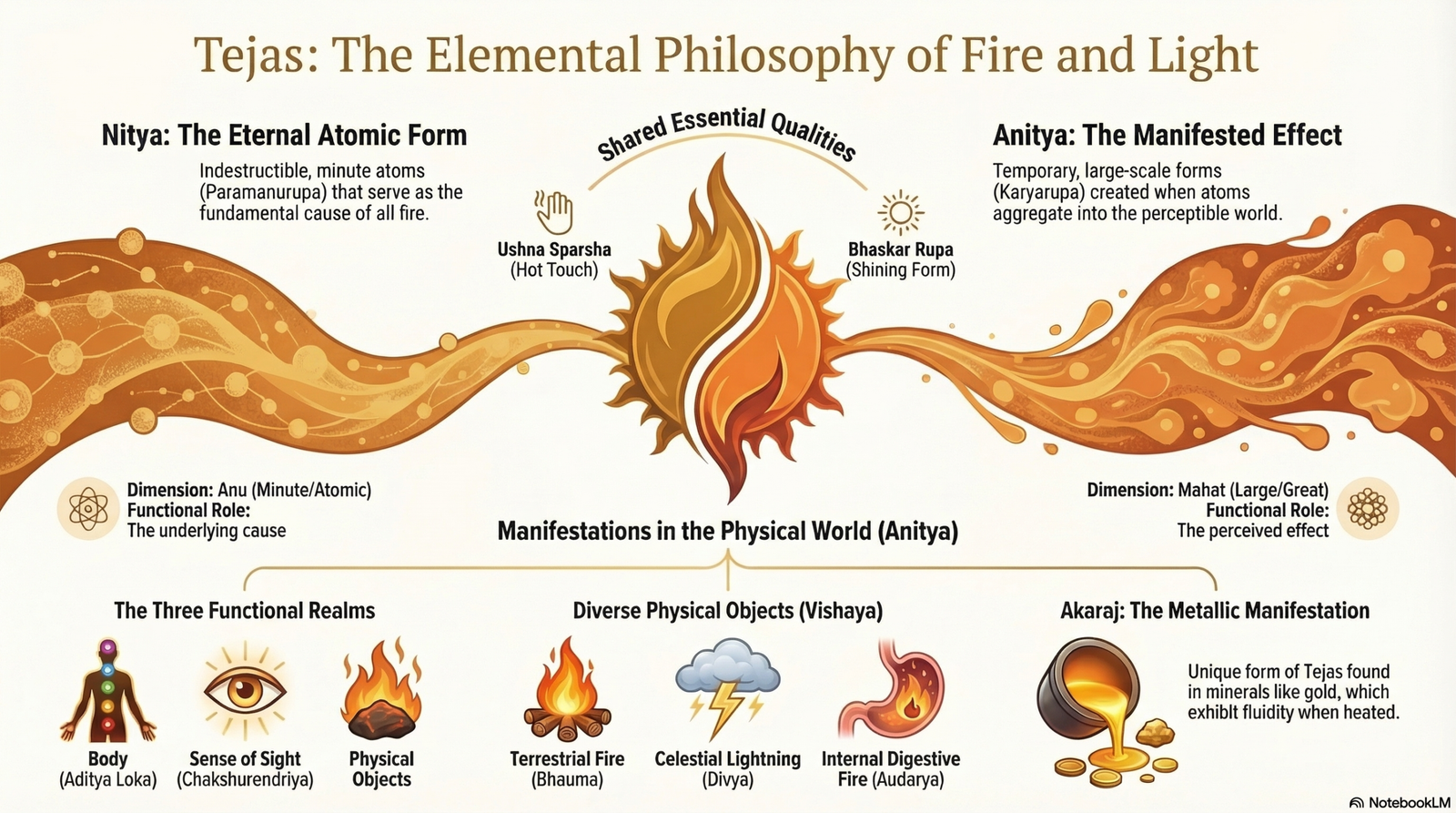
- Nitya (Permanent): This is the Paramanurupa (atomic form). These atoms are eternal, indestructible, and categorized as Anu (minute). In the language of ancient physics, these are the causal precursors to all manifest light and heat.
- Anitya (Temporary): This is the Karyarupa (effect form). When those eternal atoms aggregate into perceptible phenomena—a flame, a sunbeam, or a hot coal—they become Mahat (large/great).
This cause-and-effect relationship offers a fascinating mirror to modern atomic theory. While a specific object (the effect/Anitya) may be destroyed or transformed, the underlying atoms (the cause/Nitya) remain constant. Whether in its minute subatomic state or its massive macroscopic state, the “DNA” of the element is defined by a single sensory certainty:
“Tejas – jyacha ushna sparsha bhasto” (Tejas is that which has a hot touch.)
3. Why Your Jewelry is Actually “Solidified Fire”
Perhaps the most counter-intuitive claim in this philosophy is that minerals and metals, specifically gold (Suvarna), are classified as Akaraj Tejas (fire born from mines).
At first glance, a heavy gold coin seems the antithesis of a weightless flame. However, the “hidden logic” lies in a battle of elements. Gold possesses Parthiv (earthy) qualities—it has weight and form—but the ancient texts argue that the Tejas element is Balavan (stronger/dominant). This dominance is proven by two traits:
- Bhaskar Rupa (Shining/Lustrous form): Gold possesses an inherent, brilliant light that does not fade.
- Naimittika Dravatva (Conditional Fluidity): When subjected to extreme heat, gold does not burn into ash (Parabhav). Instead, it returns to a liquid state. This fluidity is its “latent” fire nature being awakened by contact with heat.
By classifying gold as Tejas, the ancient system identifies elements by their essential energetic responsiveness—brilliance and liquidity—rather than mere density.
4. The Fire in Your Eyes: Sight as an Elemental Force
In the world of Padarth Vigyan, the senses are not merely biological receptors; they are elemental interfaces. The Chakshurendriya (the sense organ of sight) is considered a direct manifestation of Tejas.
This classification relies on the principle of Rupa-grahaka—the specific capacity of the sense organ to “grasp” or “seize” form and color (Rupa). The ancient logic suggests a profound symmetry: the eye can perceive light only because the organ itself is composed of the same “light-stuff” as the sun. We do not merely receive light; our eyes are specialized, biological flames that chemically resonate with the luminous world.
5. The Internal Sun: Digestion and Biology
The ancient reaches of this philosophy permeate our very biology, categorizing fire into distinct functional realms:
- Audarya/Jatharagni (Digestive Fire): The heat that transforms food into energy is viewed as an internal sun, essential for life.
- Bhauma Tejas (Terrestrial Fire): The fire fueled by earth-bound materials like wood or oil.
- Divya Tejas (Celestial Fire): Manifesting as lightning in the atmosphere or the radiant energy of the sun.
Most provocatively, the tradition speaks of Aditya Loka (the realm of the sun), where fire manifests as Sharira (bodies). These are described as Ayonija Sharira—bodies not born of a womb, but composed entirely of fire. Whether it is the heat of digestion (Audarya) or a solar flare, the unifying thread remains Ushna Sparsha (hot touch), the singular quality that links the lightning bolt to the human gut.
6. The DNA of Light: The Gunas of Tejas
Across all these varied forms—from the atomic to the celestial—Tejas is defined by two non-negotiable Gunas (qualities):
- Ushna Sparsha (Hot Touch): The sensation of heat.
- Bhaskar Rupa (Shining Form): A brilliant appearance.
Specifically, the texts identify Shukla Rupa (white/bright form) as the inherent color of Tejas. While other elements may appear white, the white of fire is uniquely lustrous. Even when the outward form changes from an invisible atom (Anu) to a perceptible object (Mahat), these two traits remain the immutable signature of the fire element. Unlike the other four senses, the sense of sight is the exclusive domain of Tejas, designed to interpret the “shining form” of the universe.
7. Conclusion: A New Lens on the Material World
Ancient wisdom invites us to view the world not as a collection of static “stuff,” but as varying states of elemental energy.
Consider again the analogy of a gold ring. The Nitya (permanent) Tejas is like the individual, indestructible gold atoms—eternal and minute. The Anitya (temporary) Tejas is the ring itself. The ring can be melted or reshaped—it is a temporary effect—but it never loses its “goldness,” its shine, and its response to heat. These are the markers of its fiery soul.
By seeing the world through the lens of Tejas, we begin to recognize a profound interconnectedness.
If our eyes, our metabolism, and our most precious metals are all manifestations of the same primordial fire, how might we rethink the boundary between our bodies and the physical universe?