1. Introduction to the Dual Nature of Tejas
Welcome, dear students, to the study of Tejas—the element of light, heat, and transformation. In our journey through Padarth Vigyan (Ayurvedic Ontology), we must look beyond the simple flame of a lamp. Tejas is a fundamental building block of the cosmos, existing in a beautiful, sophisticated duality. To master the science of Ayurveda, one must understand the distinction between its Nitya (permanent) and Anitya (temporary) states. This relationship is the “key” to understanding how the invisible, indestructible laws of nature manifest into the tangible world we treat in our clinics.
Key Insight In the Vaisheshik school of thought, every physical “effect” (Karya) in the universe is born from an underlying “atomic cause” (Karana). While the world we see is in constant flux, it rests upon a foundation of eternal, invisible atoms that provide the universe with its essential stability.
To truly appreciate this manifest world, we must first descend into the microscopic realm of the foundation.
——————————————————————————–
2. The Foundation: Nitya (Permanent) Tejas
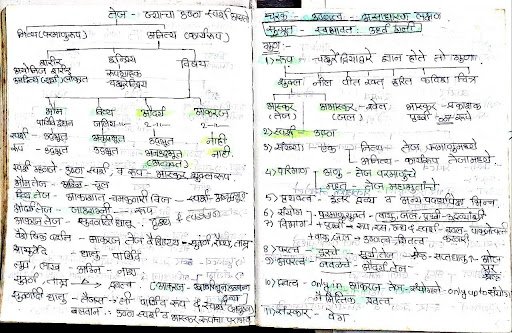
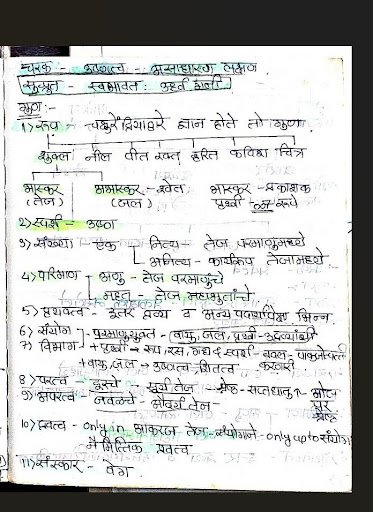
my hand written notes p. v. teja mahabhuta
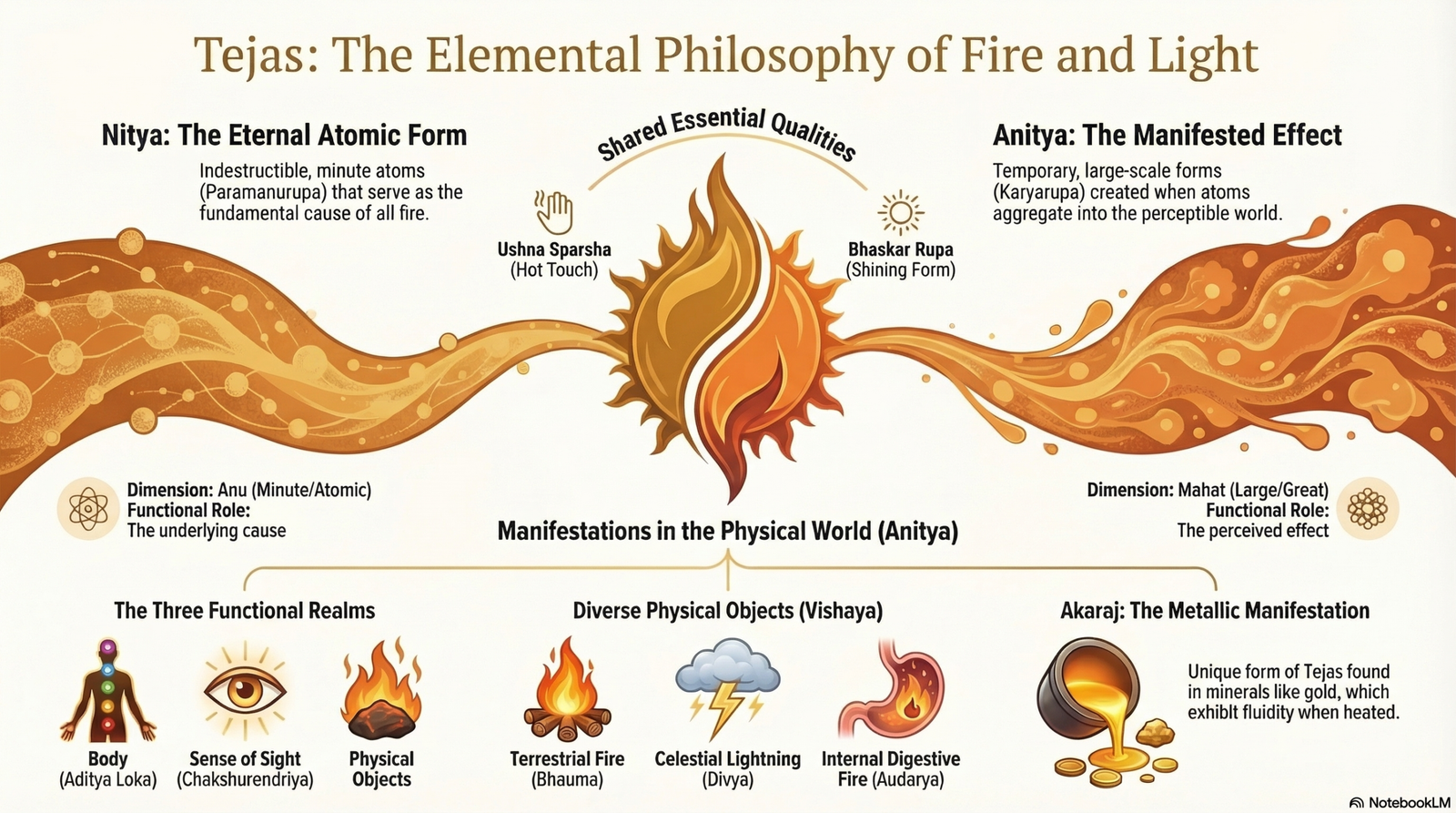
The Nitya state of Tejas is its causal essence. In this state, it is described as Paramanurupa—the atomic form. These are the “invisible causes” of the universe. Unlike the fire we can extinguish, these atoms are beyond the reach of time and destruction.
The three most critical attributes of Nitya Tejas are:
- Permanence: It is eternal (Nitya); it exists even when the manifest universe is dissolved.
- Atomic Form (Paramanurupa): It represents the smallest indivisible unit of the fire element.
- Minute Dimension (Anu): These atoms possess a dimension so subtle that they cannot be perceived by the human eye.
These minute, eternal atoms do not remain isolated; they undergo Samyoga (conjunction) with other Mahabhutas (Great Elements) to aggregate and create the “Great” forms of the perceptible world.
——————————————————————————–
3. The Manifestation: Anitya (Temporary) Tejas
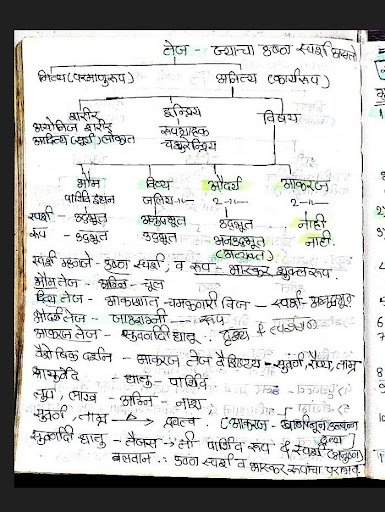
When these eternal atoms combine, they transition into the Anitya state, known as Karyarupa (the “effect form”). This is the fire we interact with. Unlike the Anu (minute) dimension of the atom, manifest fire is Mahat—it has a large, perceptible dimension. While these forms are temporary and subject to change (Anitya), they are the direct, visible expression of the underlying atomic reality.
Comparison: The Cause (Nitya) vs. The Effect (Anitya)
| Feature | Nitya (The Cause) | Anitya (The Effect) |
| Technical Name | Paramanurupa (Atomic) | Karyarupa (Manifest) |
| Dimension | Anu (Minute/Subtle) | Mahat (Large/Perceptible) |
| State of Existence | Eternal / Indestructible | Temporary / Changeable |
This “Effect form” of fire is not a singular entity but manifests through three distinct functional gateways in our physical experience.
——————————————————————————–
4. The Three Expressions of Manifested Fire
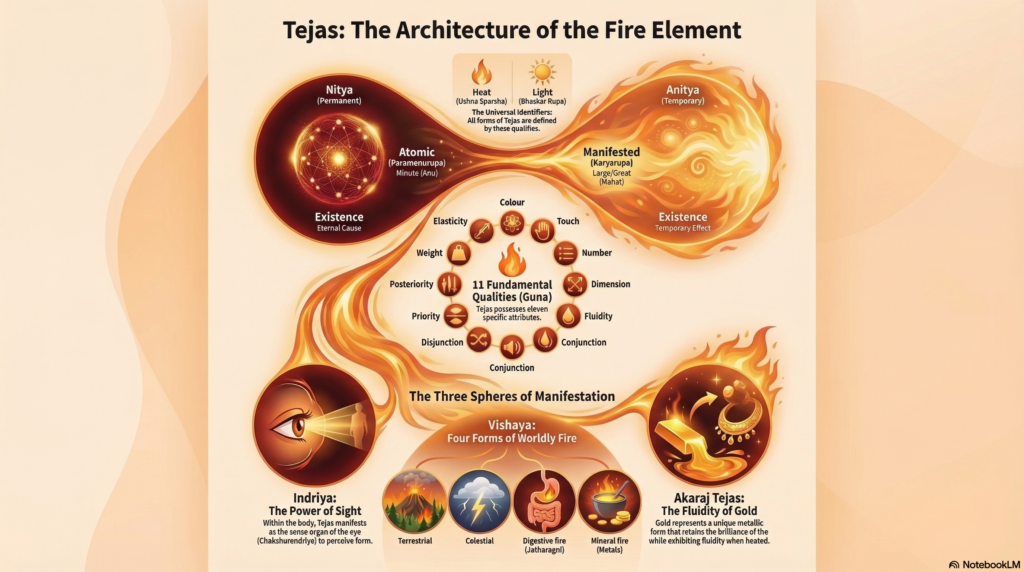
In the manifest world, Anitya Tejas expresses its power through three classifications:
- Sharira (Body): Tejas manifests as a “body” in the Aditya Loka (the solar realm). These are bodies born of fire rather than biological reproduction (Ayonija).
- Indriya (Sense Organ): This is the Chakshurendriya—the sense organ of sight. Located in the pupils, its function is the perception of Rupa (form and color). Without this internal fire, the external world would remain dark and formless.
- Vishaya (Objects): This refers to the objective fire found in the world around us, categorized by its source and behavior.
The “Vishaya” category is exceptionally diverse, and as advanced students, you must learn to distinguish between the various ways fire hides or reveals itself.
——————————————————————————–
5. Exploring the Four Types of Physical Fire (Vishaya)
Fire manifests across terrestrial and celestial planes in four specific ways. A critical nuance here is the concept of Udbhut (manifested/perceptible) versus Anudbhut (unmanifested/hidden) properties of Sparsha (touch/heat) and Rupa (form/color).
-
Bhauma (Terrestrial): Fire that requires earthly fuel (Parthiv Indhan), such as a stove (Chul) or a forest fire.
- Status: Both Udbhut Sparsha (you feel the heat) and Udbhut Rupa (you see the flame).
-
Divya (Celestial): Fire that is “water-based” (Jaliya Indhan), such as lightning (Vij) in the sky.
- Status: Anudbhut Sparsha (you do not feel the heat of lightning from the ground) but Udbhut Rupa (the light is visible).
-
Audarya (Digestive): The internal fire known as Jatharagni.
- Status: Udbhut Sparsha (the warmth of digestion is felt) but Anudbhut/Avyakta Rupa (the flame itself is not visible inside the stomach).
-
Akaraj (Mineral/Metallic): Fire found in the mines, manifesting as lustrous metals like Gold (Suvarna), Silver (Roupya), and Copper (Tamra).
- Status: In its solid, unheated state, both heat and form are considered suppressed or non-perceptible in the context of pure fire.
——————————————————————————–
6. The Immutable Essence: The 11 Gunas of Tejas
Regardless of its form, Tejas possesses 11 Gunas (qualities) that define its ontological nature: Rupa, Sparsha, Sankhya, Pariman, Prithaktva, Samyoga, Vibhag, Paratva, Aparatva, Dravatva, and Sanskar (Vega).
Of these, two are the primary “family traits”:
- Ushna Sparsha (Hot Touch): As the great sage Charaka taught, Ushnatva (heat) is the Asadharana Lakshana—the unique, non-common attribute of fire.
- Bhaskar Shukla Rupa (Brilliant White Form): The natural color of Tejas is a brilliant, lustrous white (Shukla). This brilliance is what we see in the sun and the shine of precious metals.
Furthermore, the sage Sushruta reminds us of the Urdhva Gati—the inherent nature of fire to always move upward.
——————————————————————————–
7. The Golden Exception: Akaraj Tejas and Fluidity
A fascinating point of discussion arises with Akaraj Tejas (metals like gold). You may wonder: if gold is a solid, why is it classified under the fire element?
Special Property: Naimittik Dravatva Gold possesses a unique quality called Naimittik Dravatva (conditional fluidity). While its natural state appears solid, it becomes liquid when in contact with heat. This fluidity is a “Tejas” trait that remains even when combined with Earthly properties.
The Philosophical Debate: It is important to note a distinction in our classical texts. While Vaisheshik Darshan classifies gold as Akaraj Tejas due to its indestructible luster and fluidity, Ayurveda often treats metals as Parthiv (Earth-based) in clinical practice, as they possess weight and stability. As a physician, you must respect both: the Tejas essence that gives gold its potency and the Parthiv nature that gives it substance.
——————————————————————————–
8. Summary: The Building Block Analogy
To solidify your understanding, return to the analogy of the gold smith.
Imagine Nitya Tejas as individual, indestructible gold atoms. They are eternal, minute (Anu), and invisible. Anitya Tejas is the gold ring fashioned from those atoms. While the ring is an “effect” (Karyarupa) that is temporary—it can be melted (Naimittik Dravatva) or reshaped—it never loses the essential “goldness” (the Ushna and Bhaskar qualities) of the permanent atoms from which it was built.
Student Takeaway: 3 Concepts to Remember
- Ontological Duality: Tejas exists as an eternal atomic cause (Nitya Paramanurupa) and a temporary manifest effect (Anitya Karyarupa).
- Perceptual Nuance: Not all fire is seen and felt equally. Remember the Udbhut and Anudbhut states, such as the invisible light of the digestive fire (Audarya).
- The 11 Gunas: While Tejas has eleven qualities, it is primarily defined by its heat (Ushna), its brilliant white luster (Shukla Rupa), and its upward movement (Urdhva Gati).