
Apple has officially closed the book on the “subdued titanium era.” After years of iterative, safe design choices that felt more like annual maintenance than innovation, the iPhone 17 series has arrived with a loud, aggressive aesthetic. Gone are the muted, “natural” tones of yesteryear; in their place is the “Cosmic Orange” colorway—a finish so vibrant it practically demands an audience.
Headlined by the new “Camera Plateau”—a body-wide bar that serves as much as a branding exercise as a thermal solution—the redesign feels like a high-tech midlife crisis. But beneath the flashy new clothes and the pivot back to an aluminum unibody, there is genuine functional substance. Apple is no longer chasing the “thin-at-all-costs” ghost of the iPhone 6; instead, it is leaning into a muscular, performance-heavy identity. Here are the five most surprising takeaways from this bold, slightly cynical refresh.
——————————————————————————–
1. The Unrivaled “Battery King”: Pro Max Dominance
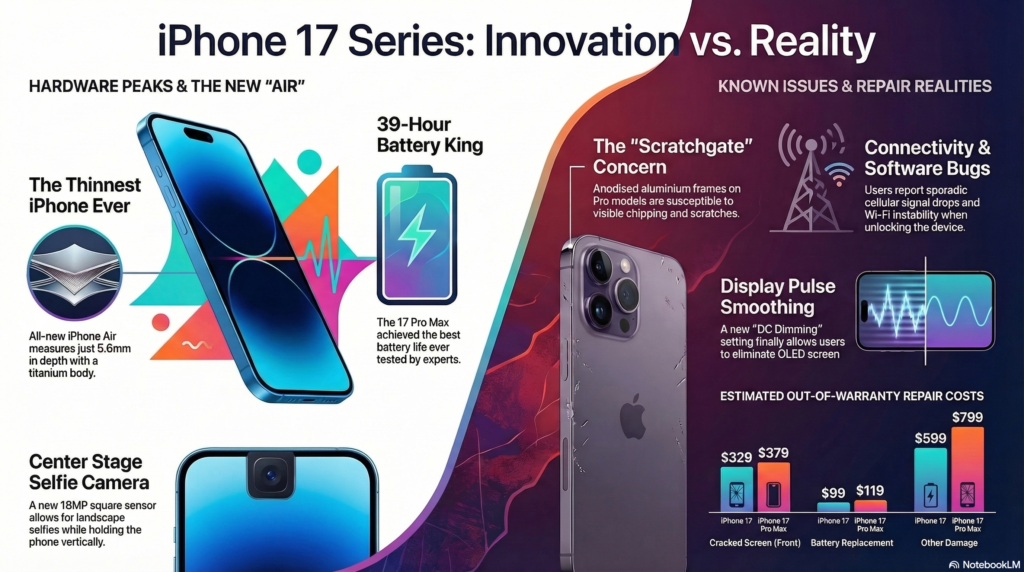
If the iPhone 17 Pro Max is having a midlife crisis, it’s handling it with record-breaking endurance. While the new iPhone Air (a razor-thin 5.64mm) sacrifices capacity for aesthetics, the Pro Max embraces “muscular” density.
Synthesized testing data confirms the Pro Max is the undisputed “Battery King,” powered by a massive 5,088 mAh cell—the largest ever in an iPhone. In standardized endurance testing, the results reset the industry bar:
- The 45-Minute Stress Test: While simultaneously handling video calls, gaming, and social feeds, the device lost a staggering 1% of its charge.
- The 3-Hour Streaming Marathon: At a blinding 3,000 nits peak brightness, the battery depleted by only 9%, tying the best scores ever recorded by flagship competitors.
This efficiency isn’t just about the size of the tank; it’s about the engine. The A19 Pro chip works in tandem with Apple’s first Vapor Chamber Cooling system. By channeling heat away from the silicon more effectively, Apple prevents the thermal throttling that plagued previous generations. As CNET rightly observed, the Pro Max has evolved into an “absolute unit” for power users who refuse to carry a MagSafe pack.
——————————————————————————–
2. “Scratchgate” and the PR Deflection
Apple’s switch from titanium back to an aluminum unibody was a tactical move for thermals, but it has birthed a cosmetic nightmare. “Scratchgate” has quickly become the primary grievance for early adopters, particularly those drawn to the darker finishes.
The anodized aluminum frame on the Pro models—and surprisingly, the black iPhone Air—is proving remarkably fragile. Users are reporting “Camera Bump Chipping” along the sharp edges of the Plateau from nothing more than contact with pocket change. Apple’s official response has been a masterclass in PR deflection, characterizing visible marks on retail units as “material transfer” from display stands that can supposedly be cleaned off.
However, for the actual chipping on consumer devices, the company has retreated to the “normal wear and tear” defense. It’s a classic trade-off: Apple gave us better cooling and striking colors like Deep Blue and Cosmic Orange, but they’ve wrapped them in a coating that feels more like “display-only” jewelry than a rugged daily driver.
——————————————————————————–
3. The “Center Stage” Vertical-Horizontal Magic
Apple finally pulled a rabbit out of the hat with the front-facing sensor. The new 18MP Center Stage camera isn’t just a resolution bump; it utilizes a unique square image sensor that fundamentally changes how we interact with social media.
This hardware allows for a specific bit of wizardry: the ability to capture landscape (horizontal) video while holding the phone vertically. By leveraging the square sensor’s extra real estate, creators can maintain a secure, one-handed vertical grip—the natural “TikTok” stance—while the software crops and stabilizes a perfect widescreen shot.
“The Center Stage camera with the ability to take landscape selfies vertically is sweet… [it ensures] everyone stays in the frame without needing to reposition the device.” — CNET
This is Apple finally acknowledging that the vertical-first world has won, providing the ergonomics for one-handed use without sacrificing the cinematic framing required for professional content.
——————————————————————————–
4. The 8-Year Wait: Ending PWM Flickering
In a move that serves as a massive, yet quiet, accessibility win, Apple has finally addressed Pulse Width Modulation (PWM) flickering. For the “sensitive” segment of the user base, OLED panels have been a source of eyestrain and headaches since the iPhone X debuted in 2017.
By implementing “Display Pulse Smoothing” (Apple’s version of DC Dimming), the iPhone 17 regulates brightness by reducing voltage rather than flickering the pixels on and off. It’s a pro-level health feature that took eight years to arrive, and it’s hidden deep in the software:
Settings > Accessibility > Display and Text Size > Display Pulse Smoothing.
There is, however, a “scout mindset” detail you won’t find in the marketing materials: the smoothing currently only activates when the screen is under 25% brightness. While it’s a godsend for late-night reading, it’s not a total cure-all for those who suffer at higher luminance levels.
——————————————————————————–
5. The Staggering Cost of “Other Damage”
The aggressive design of the “Camera Plateau” creates a literal high-stakes target for gravity. Because the plateau and the expansive unibody are so integrated, out-of-warranty repairs have reached eye-watering levels.
The financial reality is clear: the $799 “Other Damage” fee for a Pro Max is roughly 66% of the phone’s retail price.
| Repair Type | iPhone 17 | iPhone 17 Pro | iPhone 17 Pro Max |
| Cracked Screen (Front) | $329 | $329 | $379 |
| Rear Camera Repair | $169 | $249 | $249 |
| Other Damage | $599 | $749 | $799 |
| *With AppleCare+ ($29 per incident), these costs are significantly mitigated, making the insurance nearly mandatory for this generation. |
With the Plateau protruding so significantly and the anodized coating proving vulnerable to “Scratchgate,” the stakes for physical protection have never been higher. A case isn’t just a suggestion for the iPhone 17; it’s a financial hedge.
——————————————————————————–
Conclusion: A Peek at the 2026 Horizon
The iPhone 17 is a transitionary masterpiece—a blend of risky aesthetic pivots and record-breaking utility. But even as we digest the “Cosmic Orange” era, the 2026 horizon is already shimmering. Rumors of the “iPhone Fold” suggest a device that could be as thin as 4.5mm when unfolded, though it will likely demand a $2,000+ entry fee. We are also expecting the long-awaited under-display Face ID, which may finally kill the Dynamic Island in favor of a true “all-screen” slab.
Ultimately, the iPhone 17’s aggressive new personality raises a pivotal question: Is this a sign of Apple finally taking risks again, or just a flashy distraction from the hardware limitations we’re starting to hit? Whether you love or hate the Plateau, one thing is certain: for the first time in a decade, the iPhone is impossible to ignore.