1. Introduction: The Core Mandate of the APMC
The Agricultural Produce Market Committee (APMC) is a state-governed regulatory system designed to oversee the first sale of agricultural commodities. In the Indian constitutional framework, agriculture is a “State subject,” meaning each state enacts its own Agriculture Produce Marketing Regulation (APMR) Act to govern these markets.
Definition: The APMC is a statutory marketing board that regulates the trade of notified agricultural produce (cereals, pulses, oilseeds, and even livestock) within a specific geographic “market area,” ensuring transactions occur in controlled environments known as mandis or market yards.
The fundamental “Why” behind the creation of the APMC system was the mitigation of “Distress Sales.” Historically, small and marginal farmers were often coerced into selling their harvest at throwaway prices to local creditors to settle debts. The APMC serves as a protective legal shield, shifting power from the intermediary to the producer.
Primary Economic Goals:
- Fair Price Discovery: Utilizing open auctions to ensure prices reflect actual market demand rather than private, lopsided negotiations.
- Payment Security: Mandating same-day payments and requiring traders to provide bank guarantees to prevent defaults.
- Market Regulation: Professionalizing trade by standardizing weighing, grading, and licensing, thereby eliminating “Information Asymmetry” between the farmer and the buyer.
So What for the Learner? The APMC is not merely a physical location; it is an institutional mechanism for the financialization of rural commodities. For the student of economics, it represents the state’s intervention to correct a market failure where the producer lacks the bargaining power to capture the true value of their labor.
Transition: To understand the current complexity of the APMC, one must look back at its evolution from colonial-era regulations to post-independence state legislation.
——————————————————————————–
2. The Historical Genesis: From Banyan Trees to State Acts
The formalization of Indian marketplaces mirrors the evolution of its urban centers, transitioning from informal gatherings under banyan and neem trees to rigid statutory structures.
- 1886 Hyderabad Residency Order: The first coordinated effort at market regulation in India.
- 1928 Royal Commission on Agriculture: Formally recommended regulated markets to protect farmers from the exploitation of intermediaries.
- 1938 Model Bill: The central government’s first blueprint for state-level regulation.
- 1960s–1970s State APMR Acts: States began enacting formal laws (e.g., Maharashtra in 1963) to move trade from “farm-gate” transactions to professional, auction-based systems.
So What for the Learner? This historical trajectory signifies a shift from informal community brokerage to a state-monopolized regulatory regime. While this professionalized the rural economy, it also laid the groundwork for the geographic fragmentation we see today, where India operates not as one market, but as thousands of isolated silos.
——————————————————————————–
3. Inside the Mandi: Mechanism and Infrastructure
The operational heart of the APMC is the market yard (mandi). Modernizing these yards is now tied to the Viksit Bharat National Rural Infrastructure Stack, aligning physical assets with national priorities like PM Gati Shakti.
| Functional Requirement | Physical Amenity |
| Transparency & Bidding | Open Auction Halls, Digital Display Boards |
| Accuracy & Standards | Weighbridges, Soil-testing Labs, Assaying Facilities |
| Logistics & Storage | Godowns, Cold Storages, Covered Platforms |
| Farmer Welfare | Amenity Centers, Canteens, Bank Branches, Post Offices |
| National Integration | e-NAM Workstations, Sorting & Grading Units |
The Four Core Responsibilities of a Market Committee:
- Price Discovery: Orchestrating competitive bidding where licensed agents must compete openly.
- Licensing: Vetting “Commission Agents” (Arhtiyas) to ensure they adhere to statutory guidelines.
- Infrastructure: Reinvesting market fees into durable assets, such as drying yards and village roads.
- Dispute Resolution: Providing a quasi-judicial forum to mediate disagreements between producers and buyers.
Transition: While the physical structure is robust, the financial layers of taxes and fees within the mandi create significant economic distortions.
——————————————————————————–
4. The Economic Weight: Fees, Taxes, and Market Distortion
The APMC system imposes multiple levies that significantly inflate the final price of produce. A critical academic concern is that these fees are often collected like a tax but utilized as a private fund, bypassing the State legislature and public scrutiny.
Table 4.1: Levies and Price Impact on Rice (KMS 2013-14 Data) | State | Total Levies/Fees (% of MSP) | Price After Tax over MSP (₹1310/qtl) | | :— | :—: | :—: | | Andhra Pradesh | 19.5% | ₹1565.45 | | Punjab | 14.5% | ₹1499.95 | | Haryana | 11.5% | ₹1460.65 | | Odisha | 15.5% | ₹1513.05 | | Bihar | 6.5% | ₹1395.15 |
Professor’s Note on Andhra Pradesh (19.5%): The high levy in AP is a composite of Market Fee (1%), VAT (5%), RD Cess (5%), Driage (1%), Commission to Society (2.5%), Admin Charges (2.5%), and Maintenance/Interest (2.5%).
So What for the Learner? These levies create a “Cascading Effect.” High first-level taxes increase costs throughout the supply chain, resulting in higher consumer prices. Furthermore, because these revenues often bypass the state exchequer, they become a source of autonomous political power for the “village elite” who dominate market boards, rather than a transparent tool for rural development.
——————————————————————————–
5. Critical Analysis: Shortcomings of the Traditional System
The traditional system suffers from several systemic failures, often referred to as the “Shortcomings of the Status Quo”:
-
Monopoly Power & Entry Barriers: Prohibitive license fees and limited stall availability prevent new traders from entering.
- Farmer Impact: Reduced competition leads to lower bids for produce.
-
Cartelization: Licensed agents frequently coordinate to suppress auction prices.
- Farmer Impact: The producer receives a “manipulatively discovered price.”
-
Conflict of Interest: Market committees are often led by the very agents they regulate.
- Farmer Impact: Regulatory oversight is undermined by vested financial interests.
- Infrastructure Gaps: A persistent lack of scientific sorting and grading facilities prevents farmers from capturing quality premiums.
Professor’s Perspective: The resistance to reform is not merely economic; it is a defense of “cosy relationships” where APMC revenue is shielded from public audit.
——————————————————————————–
6. The Digital Frontier: e-NAM and the “Triad of Growth”
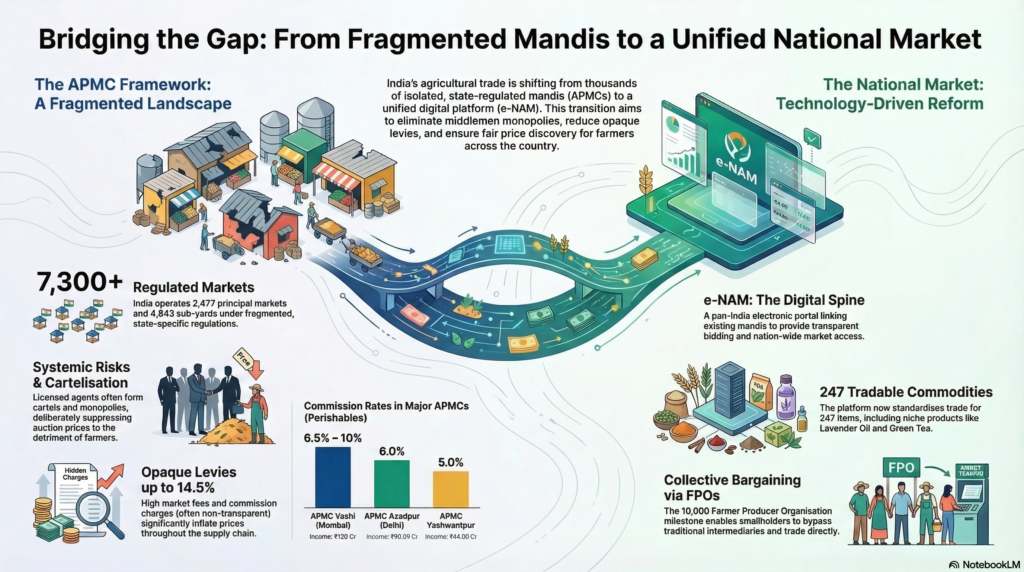
The National Agriculture Market (e-NAM) is the digital solution designed to bypass localized bottlenecks. As of October 2025, e-NAM integrated 247 commodities, including niche items like Lavender Oil, Green Tea, and Virgin Olive Oil.
The “Triad of Growth” (2025-2026 Strategy):
- e-NAM 2.0: Expanding tradable parameters through the Directorate of Marketing and Inspection (DMI).
- 10,000 FPOs: Reaching the milestone of 10,000 Farmer Producer Organizations to give small farmers collective bargaining power.
- Enhanced Credit: Raising the Kisan Credit Card (KCC) limit to ₹5 lakh for short-term needs.
Traditional Mandi vs. e-NAM Enabled Mandi | Feature | Traditional Mandi | e-NAM Enabled Mandi | | :— | :— | :— | | Price Discovery | Localized (Fragmented) | Pan-India (Unified) | | Bidding Process | Physical (Prone to Cartels) | Electronic (Transparent) | | Quality Control | Visual Inspection | Standardized Tradable Parameters | | Inter-state Trade | Regulatory Barriers | Digital Integration (Potential) |
A Critical Caveat: Despite the expansion, inter-state trade on e-NAM saw a 62% decline in Q1 FY26. This highlights that digital portals are not a “silver bullet”—they require physical logistics, standardized assaying, and the removal of state-level regulatory hurdles to succeed.
The VB-GRAM Act 2025 Complement: The new Viksit Bharat-GRAM Act supports the APMC system by mandating a 60-day “Agricultural Pause” during sowing and harvesting seasons. This prevents public works from competing with farmers for labor, ensuring rural labor availability for the mandi supply chain.
——————————————————————————–
7. Summary: The Path to a Unified National Market
The evolution of the APMC represents a journey from protective isolation to digital integration. The goal for 2026 is “One Nation, One Market,” where technology dissolves state-level fragmentation.
Learning Takeaways
- Regulatory Mandate: APMCs were created to eliminate “Distress Sales” and exploitation by intermediaries.
- Financial Distortion: Statutory levies (reaching 19.5% in AP) create cascading price effects and bypass the state exchequer.
- The Triad Strategy: Success depends on the synergy between e-NAM 2.0, 10,000 FPOs, and a ₹5 lakh KCC credit limit.
- Infrastructure Stack: Physical mandis are being integrated into the “Viksit Bharat National Rural Infrastructure Stack” to align with PM Gati Shakti.
- The Integration Challenge: While digital coverage is expanding, inter-state trade has struggled, dropping 62% in early 2026 due to persistent logistics and grading gaps.
Final Statement: The challenge for the modern rural economist is to balance the essential safety net of the APMC with the efficiency of a national digital market, ensuring that protection does not become a pretext for political monopoly.