1. The Leadership Paradigm Shift: From Autonomy to Integration
In the high-stakes premium smartphone sector, leadership stability serves as the primary hedge against brand volatility. The recent erosion of the autonomous sub-brand model at OnePlus, transitioning into a consolidated oversight structure, serves as the definitive proof of a collapsed independent governance model. For a brand that cultivated a “Never Settle” ethos to command a cult-like following, the dismantling of its localized leadership tier reflects a pivot from aggressive market expansion to defensive corporate survival.
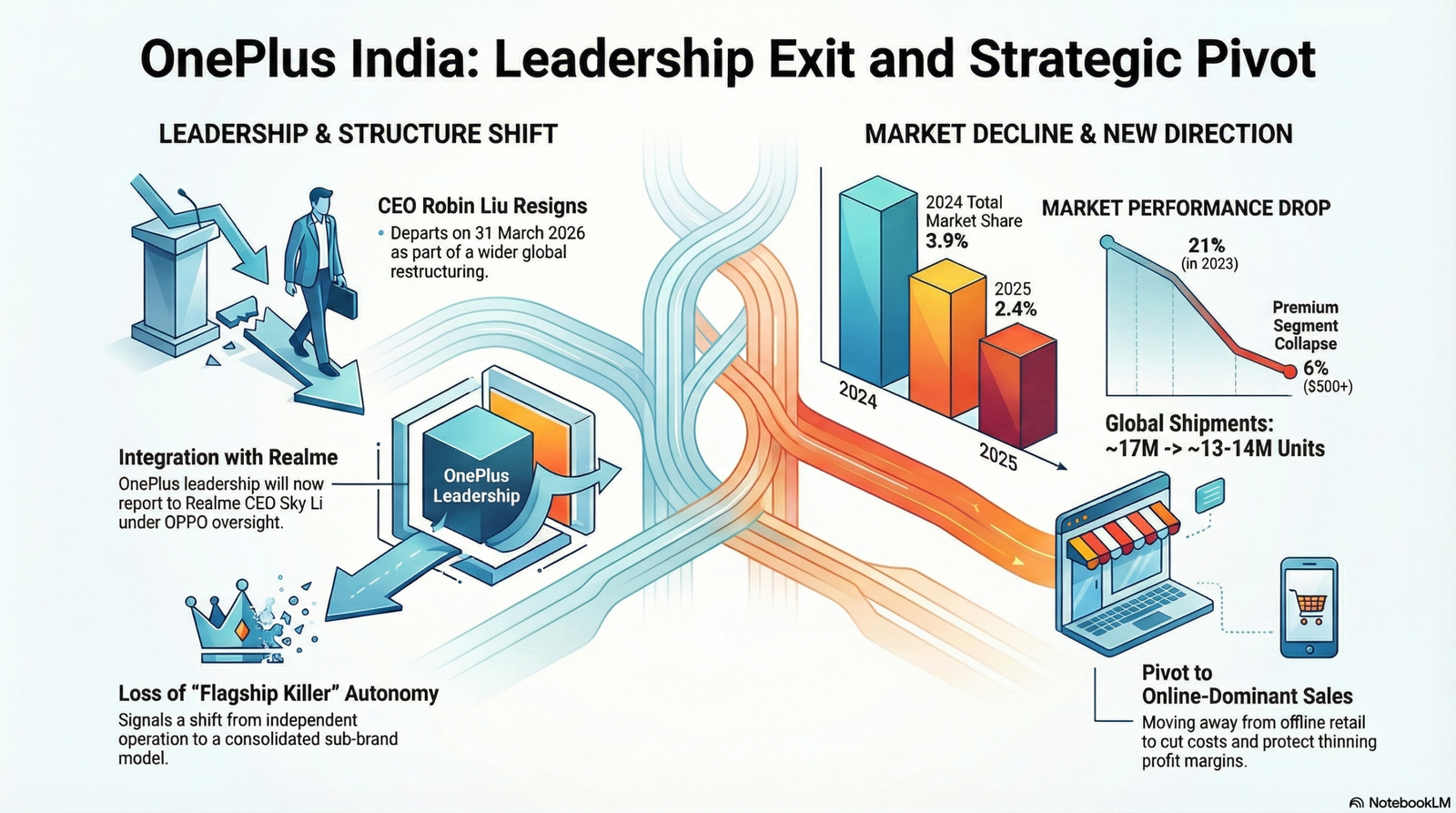
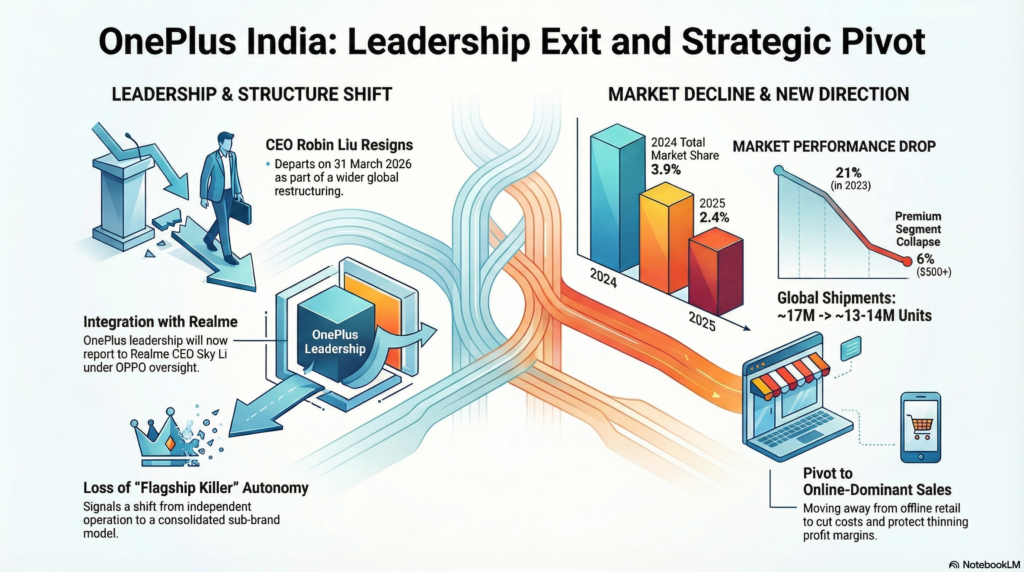
The resignation of OnePlus India CEO Robin Liu is the most visible casualty of this realignment. Liu, who joined in 2018 and was widely regarded by industry executives as the architect of the brand’s prior recovery, is currently serving a notice period through March 31, 2026. His departure coincides with a fundamental disruption of the organizational chart. The previous “peer relationship” between the CEOs of OnePlus and Realme has been terminated. In its place, Sky Li—a co-founder of OnePlus who subsequently led Realme—has been elevated to oversee the entire sub-brand portfolio. This creates a direct reporting line from OnePlus to a sister brand’s executive, effectively ending the era of parallel operations.
Industry insiders view Liu’s exit as a “significant blow,” specifically noting his role in repairing fractured retailer relationships that once threatened the brand’s presence in India. By losing its localized strategic lead, the company faces a leadership vacuum in its most critical global market. This collapse signals a transition from a sovereign brand entity to a managed asset within the OPPO group, prioritizing cost-containment over brand-specific innovation.
——————————————————————————–
2. Market Erosion and the Catalyst for Consolidation
The primary driver for organizational restructuring is the catastrophic loss of market share in the premium segment ($500+). Resource pooling is rarely a strategy of choice; it is a tactical necessity born from commercial failure. For OnePlus, the inability to defend its high-margin territory has necessitated an OPPO-driven “global restructuring” aimed at EBITDA protection.
OnePlus India Market Share Decline (2023–2025)
| Category | 2023 | 2024 | 2025 |
| Premium Segment Share ($500+) | 21% | 6% | — |
| Premium Share Decline (%) | — | 71% | — |
| Overall India Market Share | — | 3.9% | 2.4% |
| Single-Year Decline (2025) | — | — | 38.8% |
The strategic gravity of this decline is magnified by the broader market context: while the Indian premium segment grew by 11% in 2025, OnePlus experienced a 38.8% contraction—the sharpest in the industry. This trajectory is unsustainable when contrasted with Apple’s 28% value share dominance. Furthermore, Samsung’s financial stability—supported by a $436.39 billion market capitalization and a P/E ratio of 24.33—provides a level of public trust and capital depth that the private, opaque entities of the BBK group cannot match during a downturn. As Vivo secures volume leadership (20–23%), OnePlus has been relegated to the periphery, forcing a retreat into OPPO’s centralized resource umbrella.
——————————————————————————–
3. Operational Integration: Resource Pooling vs. Brand Autonomy
The strategic rationale for BBK Group consolidation is the elimination of the “autonomy tax”—the redundant costs associated with maintaining separate R&D and supply chains for sister brands. In a contracting global market, the group is prioritizing efficiency over brand distinctiveness.
The integration efforts target three operational pillars:
- Consolidation of R&D: Merging engineering resources with budget-focused entities like Realme speeds up product cycles but risks severe “Brand Dilution.”
- Mitigation of Input Costs: With global memory and chipset shortages predicted to persist until 2027, unified procurement is essential to negotiate pricing for high-cost components.
- Supply Chain Optimization: Centralizing logistics to navigate constrained global supplies.
However, the cost of efficiency is the erosion of the “flagship killer” ethos. By sharing R&D resources with budget-tier brands, the aspirational value of OnePlus is compromised. For a premium brand, the perception of shared DNA with lower-tier sister products is toxic to brand equity. This internal shift toward cost-containment has triggered immediate channel conflict, as the brand’s external distribution model is forced to adapt to a leaner operational reality.
——————————————————————————–
4. The Channel Pivot: Online Dominance and Retailer Alienation
To stabilize margins, OnePlus has executed a sharp pivot toward an “online-heavy model.” This is a classic retrenchment tactic: trade the high-cost, high-visibility of physical retail for the lower overhead of digital sales. While this may protect short-term profitability, it alienates the offline ecosystem that is vital for long-term brand accessibility in India.
The “retailer retreat” has seen approximately 4,500 stores cease stocking OnePlus devices. Retail partners cite a trio of systemic failures:
- Margin Compression: Profit yields have become too thin to justify physical shelf space.
- Operational Friction: Slow warranty processing and poor communication.
- Product Reliability: The recurring “green line” display issues have damaged the brand’s reputation at the point of sale.
This alienation creates a “Gray Market” death spiral. When official retail channels are bypassed, stock often leaks into unauthorized sales networks. This “stock leakage” results in a loss of pricing control, as gray market sellers undercut official MSRPs to move inventory. This destroys the brand’s ability to maintain its “premium” positioning and creates a fragmented customer experience. This pivot is not a growth strategy; it is a defensive contraction.
——————————————————————————–
5. Future Outlook: Retrenchment in a Contracting Market
The mid-term outlook for the Indian market remains grim, with a mid-single-digit contraction forecasted for 2026. In this environment, the following “red flags” serve as critical signals for analysts monitoring the brand’s potential exit:
- Succession Void: There is no named successor for Robin Liu, suggesting a lack of localized strategic intent.
- Product Surrender: The cancellation of high-end projects, specifically the OnePlus Open 2 and the 15s, indicates a withdrawal from the technological high ground.
- Regional Contraction: The closure of the Dallas HQ and the “unlikely” status of a OnePlus 16 launch in India suggest a brand in terminal retreat.
- Supply Constraints: Ongoing global memory shortages through 2027 will continue to squeeze the margins of value-oriented premium players.
The “So What?” for the business audience is clear: OnePlus is not facing an immediate “shutdown” but is undergoing a “strategic retrenchment.” While the brand maintains software update commitments and after-sales support to avoid legal and reputational fallout, its footprint is shrinking. By surrendering over 60% of its market share in two years and dismantling its independent leadership tier, OnePlus has transitioned from a market disruptor to a cost-optimized sub-label of OPPO. Its long-term sustainability as a distinct premium entity is now profoundly in doubt.