OMSAIRAM OK
On the night of March 24, 2026, the Mortgage Matchup Center in Phoenix was less of a basketball arena and more of a pressure cooker. In a game settled by a razor-thin 125-123 margin, the Denver Nuggets and Phoenix Suns didn’t just play a late-season thriller—they added a violent new chapter to a burgeoning rivalry. This is a matchup defined by the scars of the Suns’ 2021 sweep and the lingering bitterness of the 2022 hallway incident where words nearly turned to blows near the locker rooms.
As a senior analyst, I look past the final score to the underlying mechanics of the game. Here is why the Nuggets’ victory represents a definitive shift in the Western Conference hierarchy.
1. The Joker Rewrites the Record Books (Again)
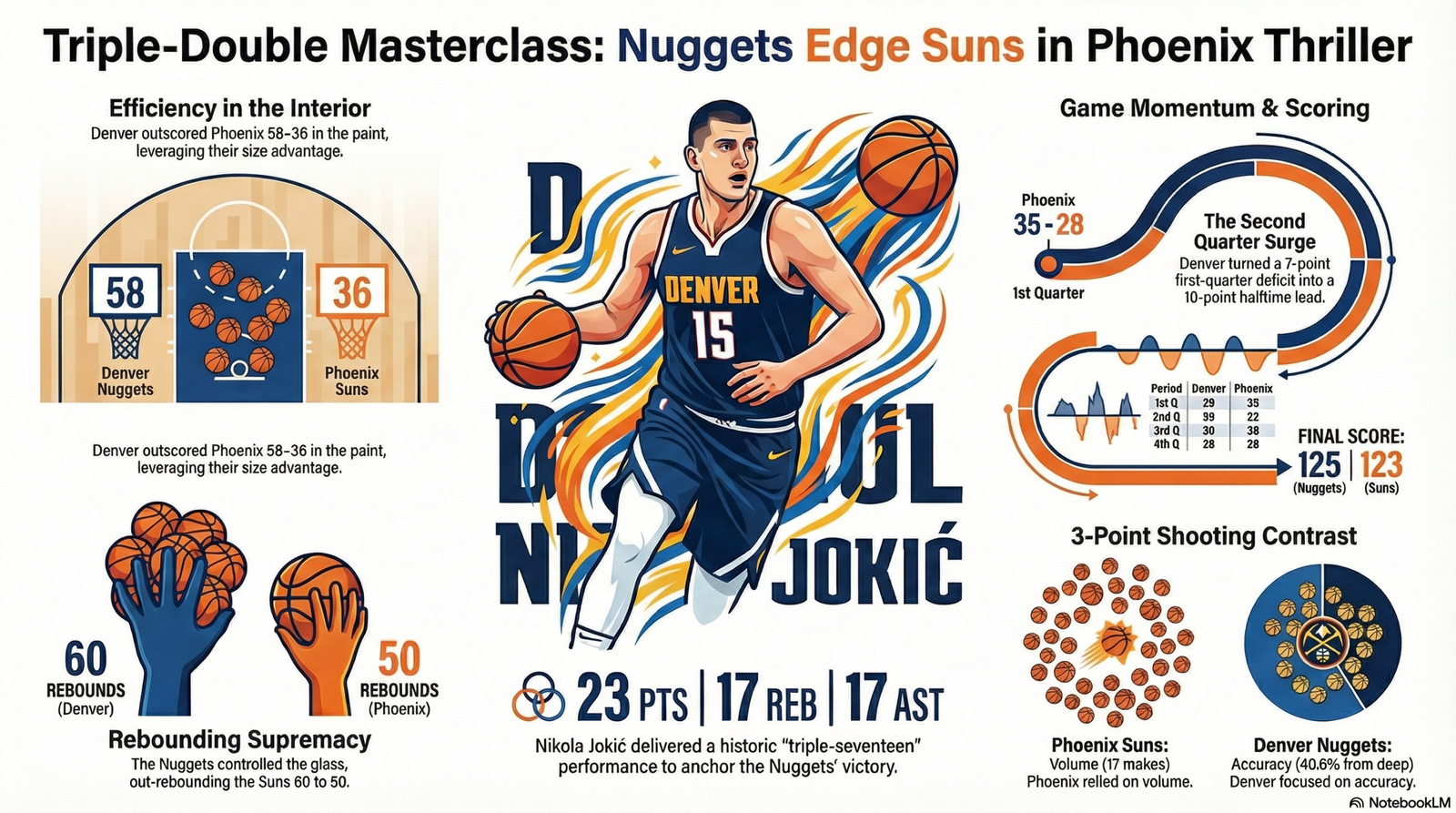
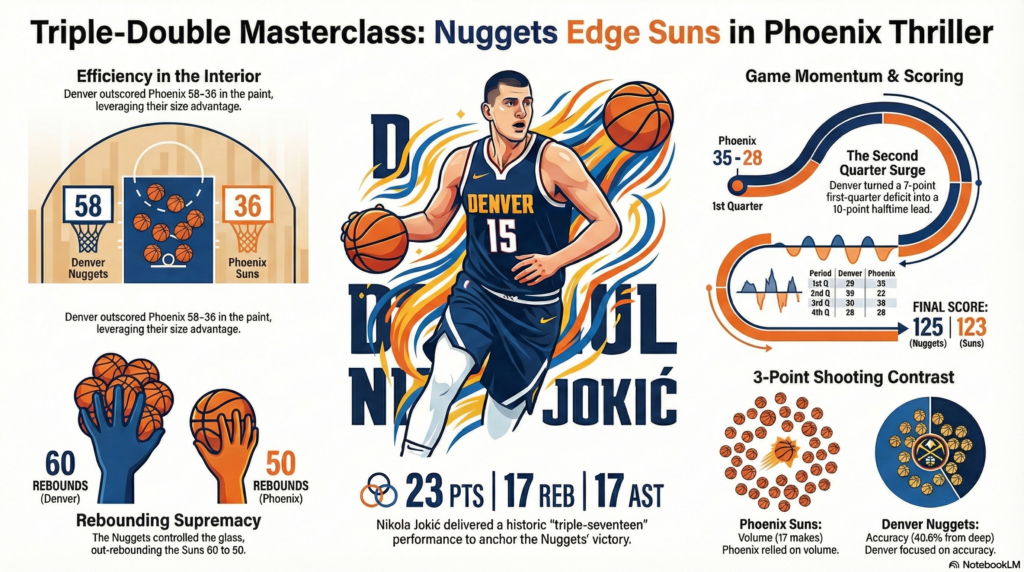
Nikola Jokić delivered a performance that exists outside the boundaries of conventional logic. The box score reads like a statistical glitch: 23 points, 17 rebounds, and 17 assists.
Critics have long struggled to reconcile Jokić’s lack of elite verticality with his absolute dominance, but this 17-17-23 line provides the answer: it is a paradox of processing speed. While he is perceived as “slow,” Jokić operates at a mental frame rate far higher than his peers. His positional mastery allows him to secure 17 rebounds without leaving the floor, while his “gravity” forces the defense into rotations that he dissects before they even materialize. As one analyst noted in the post-game wash-up:
“When Jokić had the ball in the end, it was like damn. Best player on the court sometimes just wins you the game.”
2. The Adelman Gamble: A Tactical Misfit?
Despite the win, Denver’s late-game execution under David Adelman felt like a departure from the Michael Malone era. With Denver up by eight and only three minutes remaining, Adelman employed a controversial “Hack-a-Shaq” strategy. The target was clear: Suns center Oso Ighodaro, who was struggling through a 3-of-7 night from the charity stripe.
The move backfired in the court of public opinion—and nearly on the scoreboard. By intentionally fouling, Adelman effectively traded Denver’s offensive rhythm for a math problem. Fan reaction across the league was scathing, with many suggesting the “rookie coach” was “playing not to lose” rather than letting his championship-caliber roster close the door. While Malone often operated on a trust-based autopilot in the clutch, Adelman’s decision “completely killed momentum,” allowing Phoenix to linger and nearly steal a game that Denver had been cruising through.
3. Reversing a Historical Trend
For years, Phoenix has been the hammer to Denver’s nail. The all-time series reflects a history of Suns dominance, with Phoenix holding a 105-94 regular-season lead. But history is being rewritten in real-time.
With this victory, the Nuggets have now secured five consecutive wins over the Suns, including a dominant 3-0 sweep of the 2025-26 season series thus far. This isn’t just a hot streak; it’s a systematic dismantling of a former tormentor. The animosity born in 2021 has fueled a Denver team that no longer just hopes to compete with Phoenix—they expect to win every time they step into the desert.
4. The Efficiency Gap: Why Grayson Allen’s 21 Points Were Hollow
Scoring is not the same as impact, a lesson Grayson Allen learned the hard way. Allen finished with 21 points on five triples, but his team-low -16 rating tells the true story. Allen required a team-high 19 shots to reach that total, a volume of “hollow scoring” that never truly disrupted Denver’s defensive shell.
In contrast, Royce O’Neale provided 17 points on a lean 5-of-8 from deep, finishing with a team-high +10. The difference lies in the Nuggets’ collective discipline. Denver recorded 35 assists to Phoenix’s 24 and dominated the interior, outscoring the Suns 58-36 in the paint. While Phoenix relied on individual bursts of volume, Denver exploited the Suns’ defensive lapses and “undisciplined fouling” to maintain control of the game’s tempo.
5. Animosity in the DNA: More Than Just a Game
The friction between these two squads is baked into the schedule. This game was “chippy” from the opening tip, though it’s important to distinguish between the two types of technicals we saw. Nikola Jokić was assessed an individual technical just seven minutes into the first quarter—a direct result of the physical, extracurricular play typical of this rivalry. Conversely, Julian Strawther’s technical in the second quarter was a “Defensive Three Seconds” violation—a technicality of the rules, not a lapse in temper.
Nuggets coach Michael Malone summarized the atmosphere perfectly:
“This is a team we have had a lot of close contests with and I think there is definitely some animosity, but that is what this time of year should be about.”
The fervor of the matchup was undeniable, even if the 8:15 PM local start time meant East Coast fans didn’t see the final buzzer sound until well past 1 AM EST.
Conclusion: Looking Toward the Postseason
This game was a classic that likely kept the entire Mile High City awake into the early hours of Wednesday morning. It confirmed that while the Suns have the individual firepower to keep things close, they currently lack an answer for the Nuggets’ collective IQ and interior force.
The forward-looking question is no longer about talent, but about the “Mental Edge.” If these two meet in a seven-game series, can Phoenix find a way to stop a man who puts up 17-17-23 at a walking pace? Or has the power shift officially moved from the Valley to the Mile High City? Based on this five-game winning streak, the answer seems written in the Arizona sand.