1. The Hook: Beyond the Physical
Before the first vibration of matter, there existed the Avyakta—the unmanifested potentiality. In the profound silence of Samkhya philosophy, the universe does not begin with an explosion of particles, but with a structured descent of consciousness. This sequence, known as Srishti Utpatti Krama, is the metaphysical blueprint of all existence. It suggests that the human body is not a random biological assembly but a precise evolutionary modification. To understand our own nature, we must look beyond the gross elements and contemplate the elegant dance between the seer (Purusha) and the seen (Prakriti).
2. Takeaway 1: The Cosmic Union of Consciousness and Nature
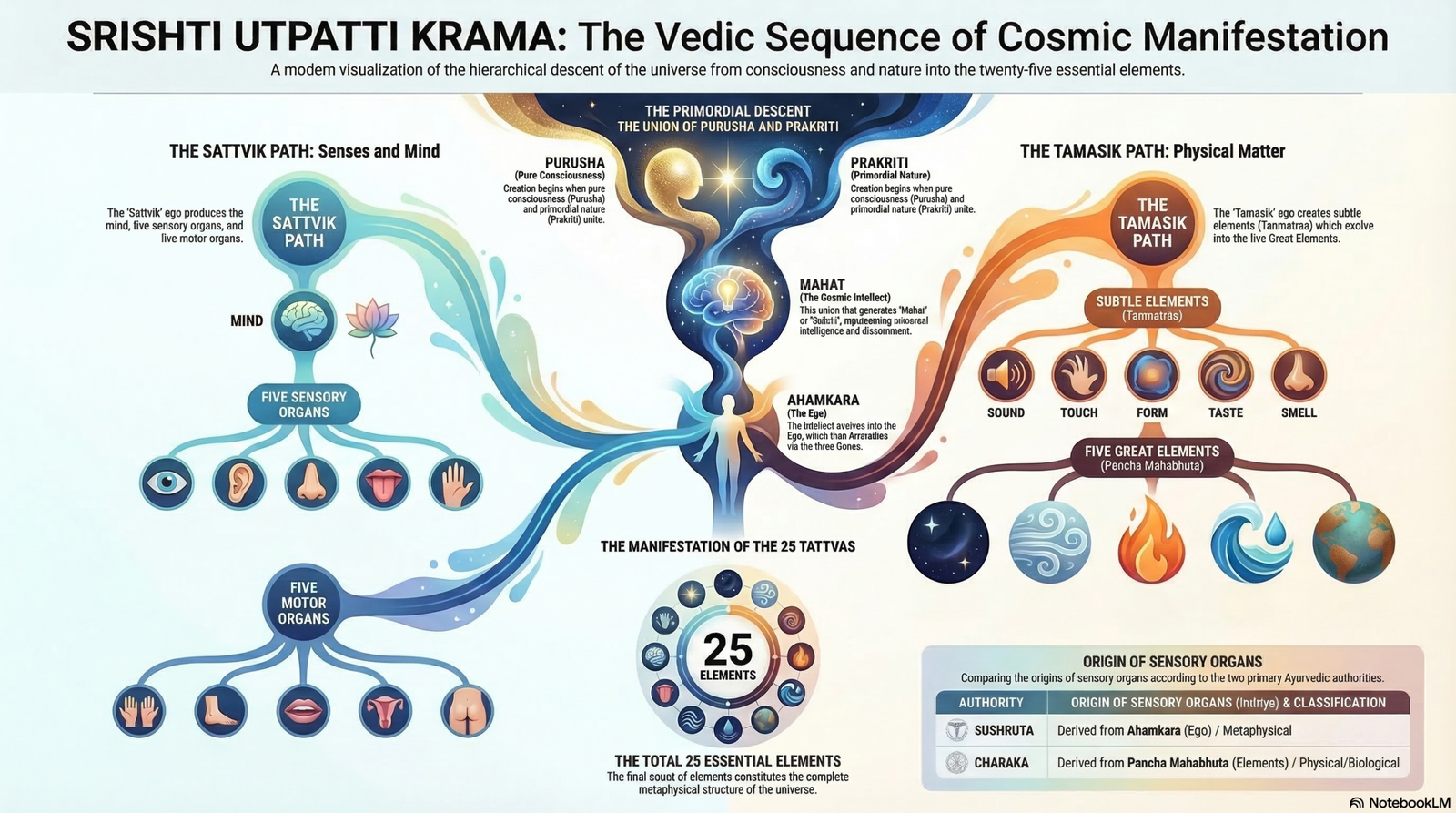
The genesis of reality lies in the intersection of two eternal principles: Purusha and Prakriti. Purusha is the silent witness, pure consciousness without action. Mula Prakriti is the root cause—the unmanifested, creative matrix. Their union is the catalyst that stirs the equilibrium of the cosmos, giving birth to Mahat (the Cosmic Intellect or Buddhi). This foundational duality challenges the materialist paradigm; it posits that intelligence is not a byproduct of matter, but its very predecessor.
“Mula Prakriti is the unmanifested root cause: Avikritih. It is the origin that takes birth from nothing else, yet serves as the foundation from which all manifest reality flows.”
3. Takeaway 2: The Ego as a Cosmic Architect
From the universal field of Mahat emerges Ahamkara, the principle of individuation or “Ego.” In Vedic scholarship, Ahamkara is not a psychological vanity but a necessary functional step that allows the one to become the many. The Ego branches into the three Gunas through specific lineages:
- Vaikarik (Sattvik): Assisted by the active force of Taijas (Rajas), this branch manifests the eleven internal instruments—the 5 Jnanendriya (sensory organs), the 5 Karmendriya (organs of action), and the Ubhayatmak Mana (the mind), which possesses the qualities of both perception and action.
- Bhutadi (Tamasik): Also assisted by Taijas, this branch descends into the 5 Tanmatras (subtle elements), which eventually solidify into the physical world.
This reveals a profound truth: our sense of “I” is the bridge connecting universal intellect to our specific sensory experience.
4. Takeaway 3: The Great Sensory Debate (Charaka vs. Sushruta)
Ancient Vedic scholars meticulously debated the origin of our senses, a distinction that fundamentally alters Ayurvedic clinical perspective:
- Sushruta’s Perspective: He posits that the sensory organs originate from Ahamkara (Ego). This frames our perception as an evolutionary, psychological manifestation of the self. Sushruta generally counts 24 Tattvas in the manifest sequence.
- Charaka’s Perspective: He argues that the sensory organs are Bhautik (physical), originating from the Pancha Mahabhuta (the five great elements).
While both agree on the 24-element count of manifestation, this debate is vital. For Charaka, a sensory disorder is a material imbalance of elements; for Sushruta, it is more closely tied to the subtle individuation of the Ego.
5. Takeaway 4: The Twenty-Five Elements of Being
The Samkhya tradition identifies 25 Tattvas (essential elements) that constitute the macrocosm and the microcosm. They are categorized by their causative power:
- Ashta Prakriti (The 8 Causative Elements): These include Mula Prakriti, Mahat, Ahamkara, and the 5 Tanmatras (Sound, Touch, Form, Taste, Smell). These are “Prakriti-Vikriti”—they are both products of a cause and producers of further elements.
- Shodash Vikar (The 16 Modifications): These are the final “Vikriti” that do not produce further elements. They consist of the 11 Indriyas (5 Jnanendriya, 5 Karmendriya, and the mind) and the Pancha Mahabhuta (Space, Air, Fire, Water, Earth).
- Purusha: The 25th element, the silent observer who is neither producer nor product.
“This structural map of 25 Tattvas allows the seeker to navigate the metaphysical composition of existence, tracing the journey from the dense earth back to the subtle root.”
6. Takeaway 5: The Unmanifested vs. The Modified
A critical distinction remains between the Avyakta (the unmanifested) and the Vikar (the modified). Mula Prakriti is the causeless cause; it is “no creation” because it exists prior to modification. At the other end of the spectrum is Vikriti, the final tangible modifications that allow us to interact with the world.
Standing apart from this chain is Purusha, defined as Na Prakriti Na Vikriti. It is neither a cause nor an effect. The elegance of this system lies in its circularity: it is only through the final modifications—our physical senses—that the consciousness (Purusha) can perceive the sequence and eventually trace its way back to its origin in the unmanifested root.
7. Conclusion: A Microcosmic Reflection
The Srishti Utpatti Krama reminds us that the human body is a perfect mirror of the cosmic descent. We are not merely skin and bone, but a sophisticated arrangement of 25 Tattvas evolving from a singular, divine intellect. We must ask ourselves: Are we truly experiencing the universe through our senses, or are our senses simply the final modification of a deeper, universal consciousness seeking to witness its own reflection? In the end, we are the silent Purusha observing the magnificent play of Prakriti.