1. Introduction: The Search for an Ancient Compass
We live in an era of profound moral vertigo. Despite our unprecedented access to information, we find ourselves paralyzed by a cacophony of choices, lost in the relentless hum of the algorithmic age. This modern condition—a mix of infinite options and an utter lack of ontological weight—leaves the soul adrift. When every path is curated for our consumption but none for our character, where do we find a direction that holds?
The answer resides in the 13th century, within the luminous verses of Saint Dnyaneshwar. His masterpiece, the Dnyaneshwari—a radical Marathi commentary on the Bhagavad Gita—serves as more than a historical artifact; it is a living map for the displaced spirit. Dnyaneshwar did not merely translate scripture; he infused it with a revolutionary gentleness and practical depth. By revisiting four of his most striking insights, we can reclaim a sense of grounded purpose in an increasingly fragmented world.
2. The Scripture as Mauli: A Nurturing Mother, Not a Punitive Arbiter
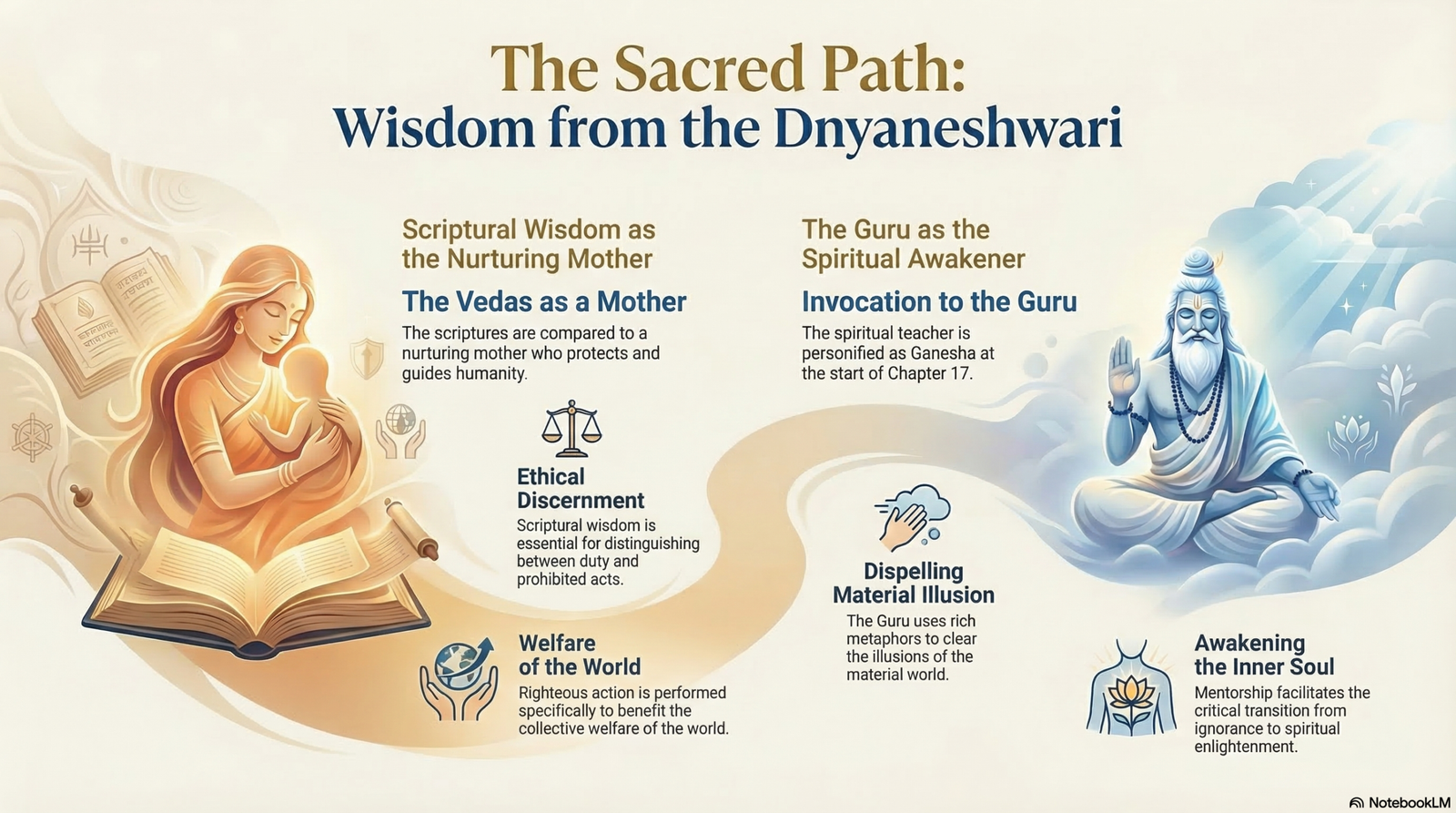
The modern mind often recoils at the word “scripture,” associating it with a stern, judgmental authority or a set of restrictive laws. Dnyaneshwar dismantles this perception entirely by introducing the concept of Mauli. In the cultural heart of Maharashtra, Mauli is a mother who anticipates her child’s needs before they are even felt—a protector whose care is instinctual and absolute.
In the Dnyaneshwari, the Vedas are not portrayed as a list of rules to be feared, but as this very maternal presence. This shift transforms spiritual study from a duty into an act of being nurtured. The scripture’s role is to shield humanity from its own destructive impulses, guiding the seeker toward welfare with the same tenderness a mother uses to guide a toddler away from fire.
“Even as the mother of the world (Mauli), she removes that which is harmful and increases that which is beneficial; there is no affection quite like that of the Shruti (scriptures).” (Verse 462)
By viewing ancient wisdom through this maternal lens, the pursuit of a righteous life ceases to be a burden of “good behavior” and becomes a journey of alignment with a force that seeks our ultimate protection.
3. Discernment: The Practical Art of Loka-sangraha
Dnyaneshwar argues that the necessity of scriptural wisdom lies in the art of discernment—the ability to distinguish between Karya (that which must be done) and Akarya (that which must be avoided). In our contemporary, hyper-individualistic culture, we often choose our path based on whim or personal gain. Dnyaneshwar’s directive to Arjuna (Verse 466) challenges this by insisting that our deeds must be tested against the “welfare of the world.”
This is the concept of Loka-sangraha—the holding together or stabilization of the world. Dnyaneshwar reminds us that we are not born merely for our own growth, but for the sake of Dharma. He suggests that the individual is a vital thread in a collective tapestry; if we act solely for ourselves, the fabric unravels. To live with discernment is to recognize that our private choices have public consequences. True spiritual maturity is found when we stop asking, “What do I want?” and begin asking, “What serves the stability of the whole?”
4. The Guru as the “Inner Ganesha” and the Breakout from Jivatvadurgi
In the stirring invocation of the seventeenth chapter, Dnyaneshwar personifies the Guru as the deity Ganesha. This is not a ritualistic formality but a profound psychological metaphor. The Guru is the force that dispels the “illusions of the material world” and awakens the inner soul by demolishing the Jivatvadurgi—the “fortress of the soul” or the prison of the ego.
Dnyaneshwar offers a startling paradox regarding the nature of the Guru as Vakratunda (the curved-trunk one). He notes that the path of wisdom appears “curved” or crooked to the ignorant, yet “straight” and simple to the wise (Verse 4). This reveals a piercing insight: the “crookedness” we perceive in the world or in spiritual teachings is often a reflection of our own internal distortion.
The Guru does not impose clarity from the outside; rather, he acts as a catalyst that straightens the seeker’s internal lens. When the soul is no longer fortified against the truth within its own Jivatvadurgi, the path that once seemed impossible and winding becomes a direct line to the divine.
5. Devotion and Ethics: The Ultimate Philosophical Synthesis
The ultimate synthesis of Dnyaneshwar’s thought is that spiritual enlightenment is not a retreat from the world, but a more profound way of engaging with it. He weaves together devotion and ethical conduct until they are indistinguishable. To Dnyaneshwar, one cannot be “enlightened” while neglecting their duties to others.
This synthesis is powered by what he calls the “grace of Nivrutti” (his own Guru and the representative of divine authority). Once the “Inner Ganesha” has cleared the ego from the path, ethics become effortless. They are no longer a set of constraints we must force ourselves to follow, but the natural expression of a soul that has realized its connection to the absolute. To live ethically is to live in a state of constant devotion; every act performed for the welfare of the world becomes an offering.
6. Conclusion: A Question for the Path Ahead
The Dnyaneshwari offers us a rare gift: a 13th-century lens through which to view 21st-century chaos. It invites us to trade our moral vertigo for maternal guidance, our individualism for Loka-sangraha, and our ego-fortresses for the “straight” path of the inner Guru.
As you move through the digital noise and the relentless demands of the modern day, pause to consider the lens through which you view your journey. If the path ahead looks crooked, perhaps it is not the road that is at fault. Is your path currently curved because of the world, or because of the lens of the ego through which you view it? Where will you seek your Mauli—that maternal wisdom—to guide you home?