While most of the world rings in the New Year with sugary treats or champagne toasts, millions in India begin their annual cycle with a deliberate, puckering dose of bitterness. This is Gudi Padwa—the Hindu New Year marking the arrival of Vasant Rutu (Spring) in the month of Chaitra.
To the uninitiated, starting a year of hope by chewing astringent neem leaves seems counterintuitive. However, as a holistic health strategist, I see this ritual as a masterclass in seasonal “bio-hacking.” It is a calculated “reset” designed to align the human biological clock with the shifting rhythms of the earth.
By examining the traditional symbols of Gudi Padwa and Ugadi through a modern scientific lens, we uncover a sophisticated blueprint for physical detoxification and psychological resilience. Here are six surprising lessons from the “Village Pharmacy” that offer a roadmap for modern wellness.
1. The “Village Pharmacy” on a Bamboo Stick
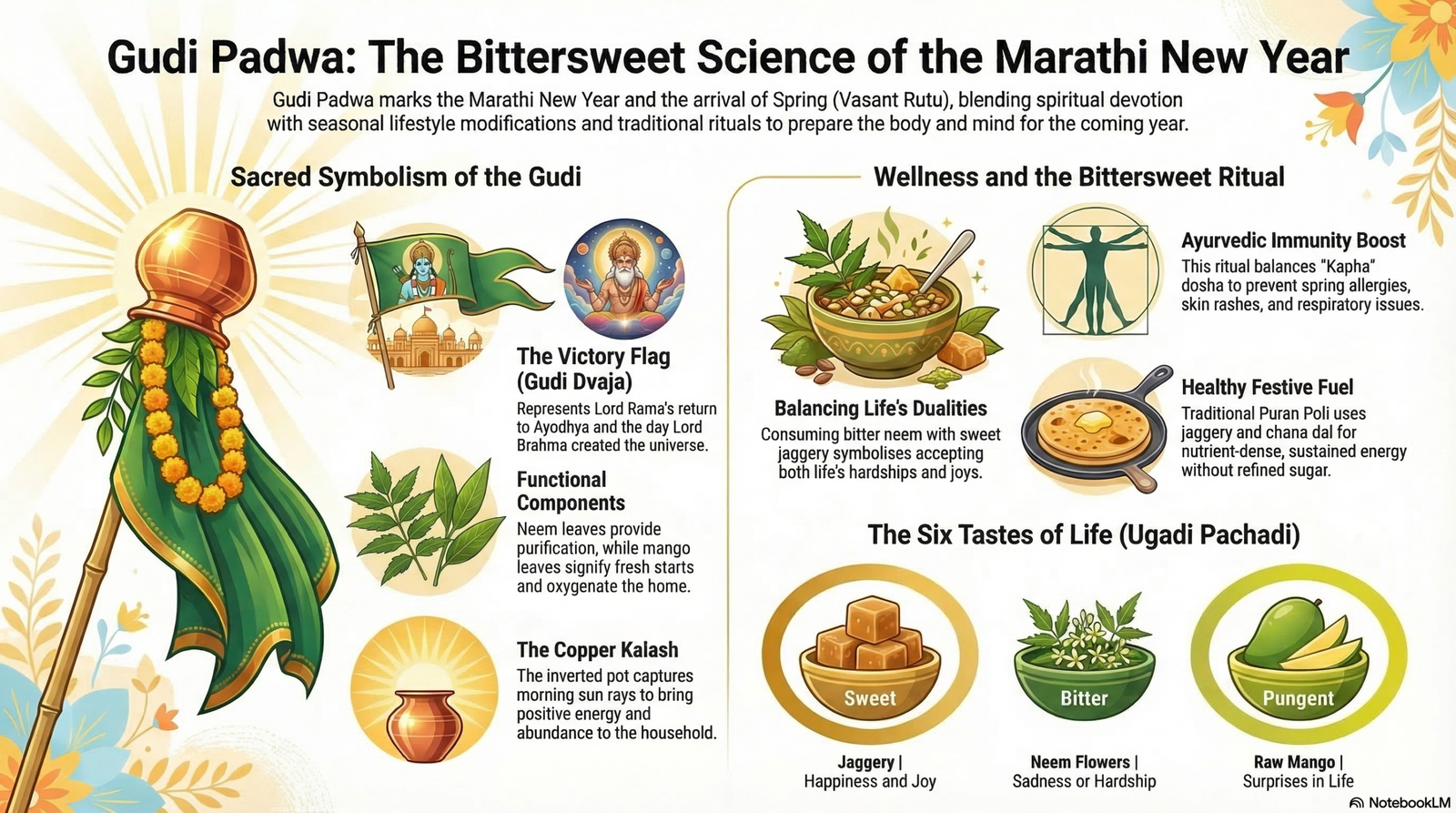
The central icon of the festival is the Gudi—a vibrant flag hoisted at the entrance of the home. This vertical assembly is far more than a decorative banner; it is a collection of biological tools. The inclusion of Neem and Mango leaves serves as a seasonal intervention against Kapha dosha imbalances. As the spring sun melts the “congestion” of winter, Ayurveda warns of respiratory issues and skin rashes.
Neem acts as the ultimate immune modulator. Modern biochemistry identifies its active compounds—specifically azadirachtin, nimbin, nimbidin, salannin, and the antioxidant quercetin—as potent agents with anti-bacterial and anti-fungal properties. By “decorating” the home with these leaves, families essentially install biological air purifiers that absorb carbon dioxide and release oxygen during festive gatherings.
The Sanskrit name for the neem tree is “Sarvaroga nivarini”, meaning “the remedy for all ailments.” This ancient wisdom was validated globally when the United Nations designated it the “Tree of the 21st Century” for its peerless therapeutic potential.
2. The Bittersweet Philosophy of the “Prasad”
Unlike most Indian celebrations that prioritize pure sweets, Gudi Padwa’s primary prasad is a mixture of bitter neem and sweet jaggery. This is a ritualized exercise in emotional intelligence, reminding us that the coming year will be a blend of success and hardship, both of which must be faced with equal vigor.
From a health strategy perspective, this mixture is a potent gastroprotective tool. The compounds in neem have been shown to kill harmful microorganisms (natural deworming) and strengthen the stomach’s defense against ulcers. When paired with jaggery, it flushes metabolic waste, purifies the blood, and provides a clean energy boost to kickstart the body’s springtime metabolism.
3. The Science Behind the Inverted Copper Pot
The Gudi is topped with an inverted copper pot, or Kalash, positioned at a height on the right side of the entrance. This placement has a specific scientific rationale: it is designed to catch the first ionizing rays of the morning sun.
As a strategist, I look at the “Oligodynamic effect”—the natural antimicrobial property of copper. The tradition of drinking the water held within that copper pot the following morning is a clever way to introduce trace minerals into the body that ward off infection. By capturing solar energy and utilizing copper’s natural sterilization properties, the ritual creates a “well-being shield” for the household.
4. A Celebration of Cosmic “Time Zero”
Gudi Padwa marks a moment of profound significance in the Hindu “cosmic calendar.” According to the Brahma Purana, this is the day Lord Brahma created the universe and initiated the flow of time, signaling the start of the Satya Yuga (the Era of Truth).
This “cosmic beginning” is mirrored by regional history. In Maharashtra, the celebrated warrior Chhatrapati Shivaji Maharaj popularized the hoisting of the Gudi to commemorate victory and unity. Whether viewed through the lens of spiritual creation or historical triumph, the festival functions as a “victory flag” for the soul, preparing the mind for a year of sovereignty and truth.
5. The Six Tastes of the Human Experience
In the southern tradition of Ugadi, the celebration centers on Ugadi Pachadi, a dish incorporating six distinct tastes. Each flavor is a culinary metaphor for the unpredictability of the year ahead:
- Sweet (Jaggery): Happiness
- Sour (Tamarind): Unpleasantness
- Salt (Salt): Fear of the unknown
- Pungent/Astringent (Raw Mango): Surprises
- Spice (Pepper/Chili): Anger
- Bitter (Neem): Sadness
Linking the Pungent taste of raw mango specifically to Surprise is a sophisticated psychological tool. By tasting the full spectrum at once, the ritual prepares the mind to accept the totality of the human experience without being overwhelmed by any single emotion.
6. The “Healthy” Holiday Hack: The Puran Poli Upgrade
The traditional centerpiece of the Gudi Padwa feast is Puran Poli, a sweet stuffed flatbread. To align this indulgence with a modern health strategy, one can implement a “metabolic win” through simple ingredient swaps:
- The Grain Swap: Replace refined flour with Jowar (Sorghum) or Bajra (Pearl Millet). This increases fiber content and lowers the glycemic index, preventing the typical festive “sugar crash.”
- The Sweetener Strategy: Use organic jaggery or coconut sugar. Unlike refined sugar, these provide essential minerals and a more complex nutritional profile.
- The Vegan Pivot: While ghee is traditional, using coconut oil offers a plant-based version that maintains the healthy fats necessary for fat-soluble vitamin absorption.
Pro-Tip: These modifications aren’t just about cutting calories; they are “lifestyle modifications” designed to help the body transition out of winter sluggishness and into spring vitality.
A Springboard for the Soul
Gudi Padwa and Ugadi are more than dates on a calendar; they are a comprehensive blueprint for holistic well-being. By integrating environmental purification, internal detoxification, and psychological preparation, these traditions ensure that the New Year begins on a foundation of resilience.
As the spring sun rises and the Gudi is hoisted, it invites us to consider a vital question: In our own lives, how can we better embrace the “bittersweet” to find true balance this year?