1. The Enigma of Shirdi
In 1858, a young man with a mysterious past walked into the rural village of Shirdi in Maharashtra. Wearing a simple head cloth and a torn kafni (robe), he took up residence in a dilapidated mosque. The villagers, bound by the social rigidities of the time, initially dismissed him as a “madman.” Yet, by the time of his Samadhi in 1918, this enigmatic figure had transformed Shirdi from a dusty hamlet into a global spiritual epicenter.
For the modern cultural historian, the legacy of Shirdi Sai Baba is a study in paradox. He was a Fakir who lived in poverty yet now sits on a throne of gold; a man who spoke in “paradoxical parables” to dismantle “rigid religious formalism.” Today, his influence has shifted from the mystical to the massive, powering a social engine that serves millions while navigating the complexities of the digital age.
2. The “Two-Paise” Philosophy: Currency of the Soul
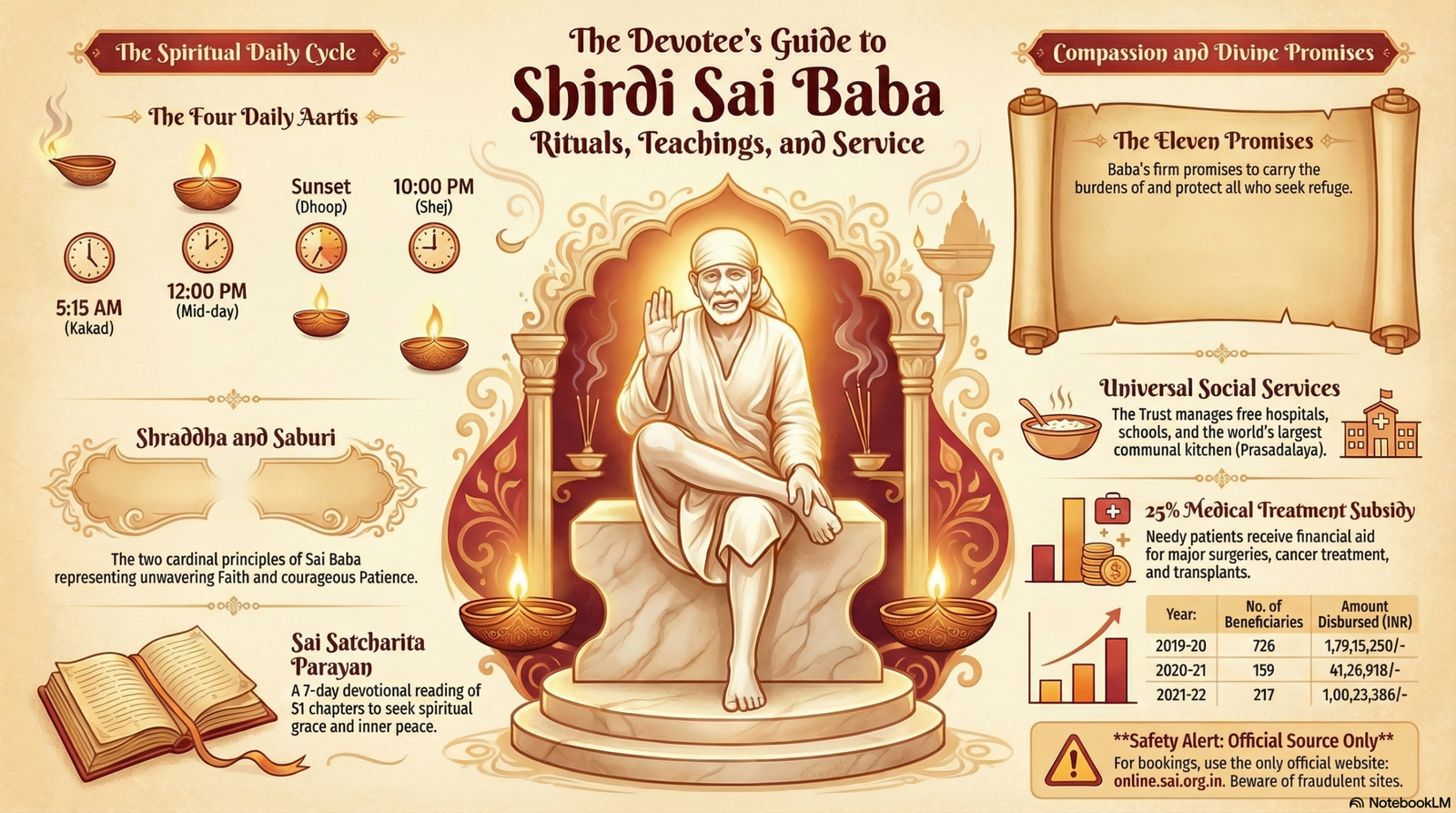
While many spiritual paths demand complex asceticism or expensive rituals, Sai Baba’s price of admission was deceptively simple. He asked his devotees for only “two paise”—not physical coins, but the spiritual qualities of Shraddha (faith) and Saburi (patience).
As a researcher of lineages, it is fascinating to note that this was not an arbitrary request. Sai Baba presented this as a “self-experiential instance,” explaining that his own Murshid (Master) had requested only these two coins from him. Shraddha is defined here not as blind belief, but as a divine inspiration that allows a person to accept all life events with “equanimity.” Saburi is the companion to that faith: the patient, steadfast trust that the Guru will lead the disciple through the “jungle of spiritual growth,” even when results are not immediate.
“Sai Baba explicitly asked for these two qualities in his devotees by giving his self-experiential instance that his ‘Murshid’ or Master asked from him only two Paise – one Shraddha and other the Saburi.”
By centering his philosophy on these “two coins,” he replaced the need for dogmatic ritual with a simplified moral code of love, forgiveness, and charity.
3. The Ritual of “Bedtime”: More Than Just an Aarti
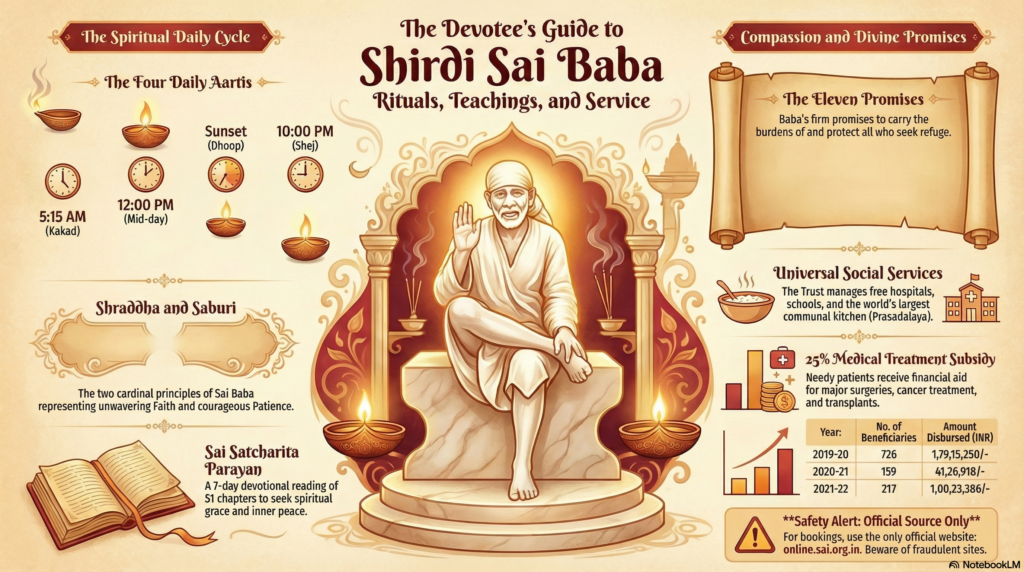
The daily rhythm of the Shirdi Samadhi Mandir is governed by four Aartis. To the casual observer, these are prayers; to the historian, they are physical anchors to Sai Baba’s historical presence, treating the spiritual master with the intimacy of a living person.
- Kakad Aarti (5:15 AM): The morning awakening, named after the kajal (eyeliner) used to decorate the idol.
- Madhyan Aarti (12:00 PM): The noon prayer. Crucially, the daily program begins earlier at 11:30 AM with the Dhuni Pooja in the Dwarkamai mosque, where rice and ghee are offered to the perpetual fire he kept burning.
- Dhoop Aarti (Sunset): Named for the dhoop (incense) that fills the air as evening falls.
- Shej Aarti (10:30 PM): The final ritual, where Shej literally means “bedtime,” symbolically putting the Master to rest.
This cycle, combined with the preservation of his Lendi gardens and the clothes he wore, reinforces the concept of a “Living Master” who still resides among his people.
“How can they be conscious of worldly objects and sensations, who utter my name, who worship me, who think of my stories and my life and who thus always remember me? I shall draw out my devotees from the jaws of death.”
4. A Hospital Without a Bill: The Massive Social Engine
The transition from an 1858 “madman” to a 21st-century social powerhouse is most evident in the Shree Saibaba Sansthan Trust’s medical infrastructure. Sai Baba’s teaching of “helping others” has been synthesized into a sophisticated, secular medical machine that provides relief on a staggering scale.
Data from the 2019-20 period reveals the depth of this commitment:
- Shri Sainath Hospital: Provided free treatment to 403,483 patients in a single year.
- Massive Investment: The Trust incurred expenses of Rs. 13,51,66,557 to provide this free care.
- Critical Care Subsidies: For surgeries performed externally, the Trust provides a 25% subsidy (up to Rs. 50,000) for highly specific and costly conditions, including Guillain Barre Syndrome, Cochlear Implants, and Transplant Surgeries.
This practical application of compassion proves that the “madman’s” parables have evolved into one of India’s most effective charitable engines.
5. The Sacred Space in a Digital Age: The Fight Against Fraud
In a surprising modern twist, the “Shraddha” of devotees is now being tested by digital predators. The Trust has had to move beyond spiritual guidance to provide “digital vigilance,” fighting a war against fraudulent websites that exploit the faith of the global Sai family.
Devotees are frequently targeted by fake Google Map listings and unauthorized YouTube channels claiming to collect money for Poojas. To protect the integrity of the pilgrimage, the Trust emphasizes that there are only two official portals: www.sai.org.in and online.sai.org.in.
The Modern Pilgrim’s Checklist:
- Official Helpline: 02423-258500.
-
Fraudulent Sites to Avoid:
saibababhaktaniwas.comandsaiashrambhaktiniwashotelbooking.co.in. - Warning: Any request for money via unofficial channels for “Aarti garments” or “live Darshan” (except through authorized partners like Tata Play) is considered illegal.
6. The Eleven Promises: A Protection That Transcends Death
The core of Shirdi’s draw remains the “Eleven Promises,” a set of claims that transcend the physical absence of the teacher. His most famous philosophy, “Sabka Malik Ek” (Everyone’s Master is One), allowed him to bridge the divide between Hinduism and Islam. Though he was a Fakir who lived in a mosque he named Dwarakamai, he is revered by many as an avatar of the Hindu god Dattatreya.
These promises assure the devotee of a reciprocal relationship: “I will render myself to you with the same intensity as your faith in me.” This spiritual loop is closed by the eleventh and final promise, which offers the ultimate goal of the path.
“Blessed is the person who has become one with me.”
7. Conclusion: The Living Legacy
Shirdi remains a rare space where the ancient and the modern collide without friction. It is a place where a ritual involving kajal and incense exists alongside a multi-crore medical system and a high-tech battle against cyber-fraud. The village has become a global center because it offers something both mystical and practical.
As our world continues to move at a breakneck digital pace, the message of the “madman” of Shirdi remains a stabilizing force. It invites us to pause and ask: In a world of constant movement, can we find the “Saburi” to wait for the answers to our own prayers?