1. The Enigma Under the Bitter Tree
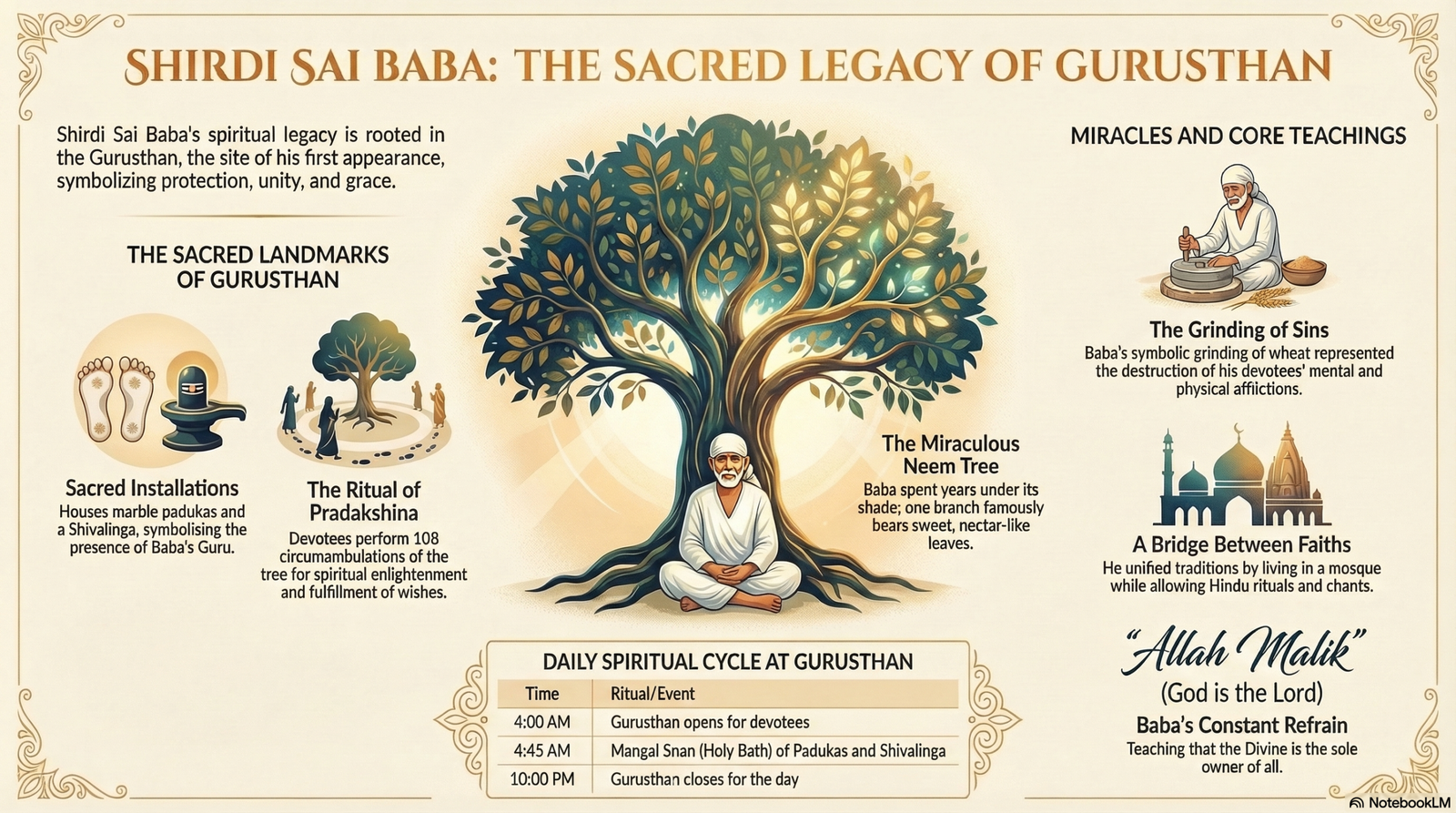
The history of the village of Shirdi, nestled in the Ahmednagar district, changed forever when a “young lad of sixteen” first manifested under the shade of a notoriously bitter Neem tree. To the villagers, he was a beautiful enigma: fair, smart, and practicing a level of “hard penance” that seemed impossible for one so young. He sat in meditative stillness, oblivious to the blistering Deccan sun or the seasonal rains, seeking neither shelter nor the hospitality of the local homes.
As a spiritual historian, one find’s the most compelling evidence of his mystery beneath the very earth he sat upon. When the devotee Khandoba allegedly “possessed” a villager to reveal the lad’s origins, a cellar was excavated beneath the tree. This 10’x10’x12′ chamber contained “cow-mouth shaped structures,” wooden boards, four burning lamps, and a Jaap Mala (rosary). Baba claimed this was the Watan (holy resting place) of his own Guru, where he had practiced penance for twelve years. This “simple” fakir was, from his first appearance, a bridge between the physical world and a hidden, sacred past, establishing the Neem tree not just as a landmark, but as a site surpassing even the legendary Kalpavriksha (wish-fulfilling tree) in its ability to bestow grace.
2. The Miracle of the Mill: Why He Ground Wheat to Stop an Epidemic
In 1910, a devastating cholera epidemic began to sweep through Shirdi. Baba’s “treatment” was characteristically unconventional and strikingly physical. He spread a sack on the floor of the mosque, set a hand-mill, and began grinding wheat into flour. When curious villagers and four bold women intervened—thinking the mendicant intended to bake bread—Baba allowed them to finish the task, only to command that the flour be spread along the village border limits.
While the literal result was the immediate subsidence of the epidemic, the Shri Sai Satcharitra provides a profound synthesis of this act. Baba was not merely processing grain; he was grinding away the Ahamkara (ego), sins, and mental afflictions of his followers. The mill served as a metaphor for the path to Self-realization:
“The two stones of His mill consisted of Karma and Bhakti, the former being the lower and the latter the upper one. The handle with which Baba worked the mill consisted of Jnana.”
In this framework, the “handle” is the knowledge that allows a devotee to hold fast to the center, avoiding the “grinding” agony of worldly existence.
3. The Great Unifier: “Allah’s Padukas” and the Shivalinga
Sai Baba’s existence was a living synthesis of Hindu and Muslim traditions, a fact encapsulated in his frequent refrain, “Allah Malik” (God is the sole owner). When devotees from Mumbai, including G.K. Dixit (not to be confused with the solicitor H.S. “Kakasaheb” Dixit), sought to install marble padukas (footprints) at Gurusthan to commemorate his arrival, Baba remarkably referred to them as “Allah’s padukas.” He sanctioned their installation on the full moon day of Shravan in 1912, even as they were carried in a procession that began at the Hindu Khandoba temple.
This unification was further evidenced by the presence of a Shivalinga at the site. Originally gifted by Baba to his devotee Megha—a Brahmin who saw Shiva within the Fakir—the Shivalinga was moved to Gurusthan after Megha’s death. The analytical insight here is crucial: according to Hindu custom, the tomb of a Guru required a Shivalinga for ritual sanctity. By integrating this into a space where he also promised that those who offered incense on Fridays (sacred to Muslims) would be blessed by Allah, Baba created a sanctuary that dissolved religious borders.
4. The Burden-Bearer: Taking on the “Bubos” of His Followers
One of the most impactful accounts of Baba’s life is his role as the “Inner Ruler” who physically absorbed the suffering of his devotees. He once famously thrust his own arm into the dhuni (sacred fire) to save a blacksmith’s child who had fallen into a furnace at a distant location. He later told his stunned followers, “I do not mind My arm being burnt, but I am glad that the life of the child is saved.”
This theme of sacrifice is most poignantly seen in the account of Mrs. Khaparde’s son, who was stricken with the bubonic plague. To still the mother’s terror, Baba lifted his robe to reveal four fully developed bubos (plague sores) on his own body, explaining that he bore the “brunt” of his devotees’ deeds so they might remain in safety.
“The sky is beset with clouds; but they will melt and pass off and everything will be smooth and clear… See, how I have to suffer for My devotees; their difficulties are Mine.”
This remains the central hook of his legacy: the Guru who stands in the fire so his children may rest in the “shade of the Neem tree.”
5. Radical Practicality: When a Saint Cuts His Own Tree
Despite the miraculous “sweetness” attributed to the Neem tree’s leaves by his grace, Baba possessed a strikingly pragmatic and unsentimental side. In the early 1900s, during the construction of the Sathe Wada, a long branch of the sacred tree obstructed the building. The villagers, paralyzed by superstitious fear after a boy had died previously while attempting to trim the tree, refused to touch it.
Baba’s response was a masterclass in radical practicality. He brushed aside the villagers’ “durbuddhi” (bad thoughts) and commanded them to cut the branch. To justify the pruning of the very tree that had sheltered him for years, he used a startling, visceral analogy:
“Even if it is our own foetus which is lying across the womb, we must cut it!”
When the villagers still hesitated, the saint climbed the tree himself and lopped off the branch. This moment reveals the true Baba: a figure who balanced the miraculous with a “down-to-earth” insistence that spiritual reverence should never become a barrier to necessary action.
6. Modern Legacy: Sacred Geometry and the Number 11
The 19th-century presence of Shirdi Sai Baba has evolved into a 21st-century feat of “parametric design.” A new temple complex, designed by Shilpa Architects, utilizes modern engineering and Agama-shastra (philosophical doctrine) to honor his affinity for specific mathematical order. The design is a physical manifestation of what Baba represented—a blend of the mystical and the precise.
Key parameters of the new temple design include:
- The Hendecagon: The main temple structure is an 11-sided polygon, reflecting the “Master Number” 11 central to the project’s numerological brief.
- The 11.11-Acre Scale: The temple itself is scaled to 11.11 acres within a larger 338-acre master plan.
- Recursive Geometry: Using an algorithmic process, the Garbhagriha (sanctum sanctorum) utilizes a looping system based on the 11 vertices of the hendecagon to guide visitors’ focus toward the deity.
- Environmental Integration: The polyhedron form was created through recursive division of curves to optimize daylight and solar heat gain, balancing sacred geometry with structural logic.
7. Conclusion: The Ever-Burning Lamp
Since the time of Shirdi Sai Baba, an “ever-burning lamp” has remained lit at his shrine, a symbol of a vigilance that never wavers. It is said of him that “while the world awoke, He slept; and while the world slept, He was vigilant.” He was a man who lived on alms yet distributed wealth, who spoke in enigmas yet acted with clinical practicality, and who saw the same divine light in the mosque as he did in the temple.
In a world increasingly divided by dogma, the life of the Shirdi Fakir offers a profound, lingering question: What can we learn from a teacher who saw no difference between the sinner and the saint, and whose shade was wide enough to shelter all of humanity? Perhaps the ultimate revelation is that the “bitterness” of life can only be turned “sweet” when we, like him, are willing to bear the brunt of each other’s burdens.