The Elemental Blueprint: Decoding the Hidden Physics of the Pancha Mahabhuta
1. Introduction: The Architecture of Existence
In our modern quest for the “fundamental building blocks” of the universe, we often look to the subatomic—the quarks and leptons defined by high-energy physics. However, thousands of years before the first particle accelerator, ancient Ayurvedic scientists established a different kind of blueprint for reality: the Pancha Mahabhuta.
While contemporary science focuses on the chemical composition of matter, this ancient framework prioritizes the functional intelligence of the cosmos. According to rediscovered notes on Padarth Vigyan (the science of matter), the universe is not just a collection of random particles, but a structured manifestation of five fundamental elements: Akasha (Space), Vayu (Air), Tejas (Fire), Jala (Water), and Prithvi (Earth). These elements serve as a sophisticated map, bridging the gap between metaphysical laws and the physical reality of human biology.
2. Takeaway 1: The Atomic vs. The Functional (Nitya vs. Anitya)
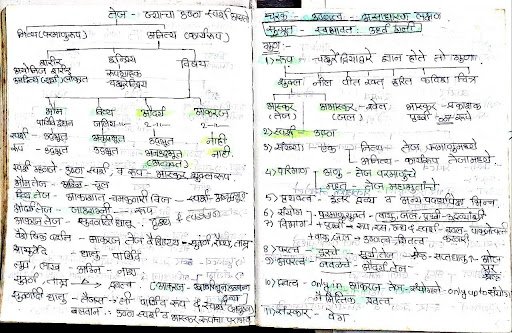
A profound distinction in Vedic science is the separation of an element into its “eternal” and “temporary” states. Matter is understood to exist in two primary forms: Nitya and Anitya.
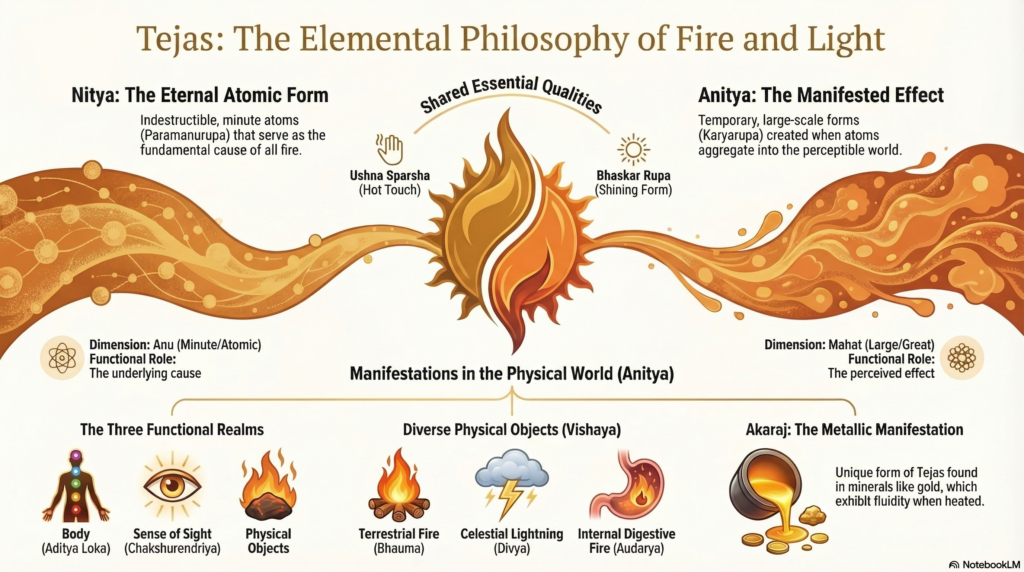
Nitya refers to the Paramanurupa, the eternal, indestructible atomic state. These are the fundamental units of existence that remain unchanged throughout the cycles of creation and destruction. In contrast, Anitya (or Karyarupa) is the “work-form”—the temporary, functional manifestation of these atoms in the world we perceive. The sources specify that this Anitya state expresses itself through a structured hierarchy: Sharir (the physical body), Indriya (the sensory apparatus), and Vishaya (the objective world of stones, plants, and minerals).
“Nitya is the eternal atomic form (Paramanurupa), while Anitya represents the temporary functional form (Karyarupa) that manifests as the bodies (Sharir), sense organs (Indriya), and objects (Vishaya) of our physical world.”
This mirrors the logic of modern physics—where unseen fundamental particles (the Nitya layer) serve as the invisible scaffolding for the temporary, visible structures (the Anitya layer) that define our lives.
3. Takeaway 2: Fire is More Than Flame (The Four Varieties of Tejas)
In the Ayurvedic tradition, Tejas (Fire) is the principle of energy, light, and transformation. The source material reveals a nuanced classification of Tejas based on its fuel source and location, categorized into four distinct types:
- Bhauma: Earthly fire, fueled by organic matter (Parthiv Indhan) such as wood or oil.
- Divya: Celestial fire, most notably seen in lightning. Intriguingly, it is described as Abindhan—fire fueled by water or moisture.
- Audarya: The metabolic or digestive fire (Jatharagni) responsible for processing nutrients within the human body.
- Akaraja: Metallic or mineral fire, specifically identified in gold and other lustrous minerals.
The classification of gold as a form of “fire” is a masterclass in ancient observation. Scholars identified gold as Tejas because of its Bhaswara Shukla Rupa (brilliant white luster) and its Naimittika Dravatva—a unique “incidental liquidity.” Unlike other substances that change their essence when heated, gold melts while retaining its fundamental brilliance, signifying its origin as a concentrated, stable form of elemental fire.
4. Takeaway 3: The Sensory Map of the Universe
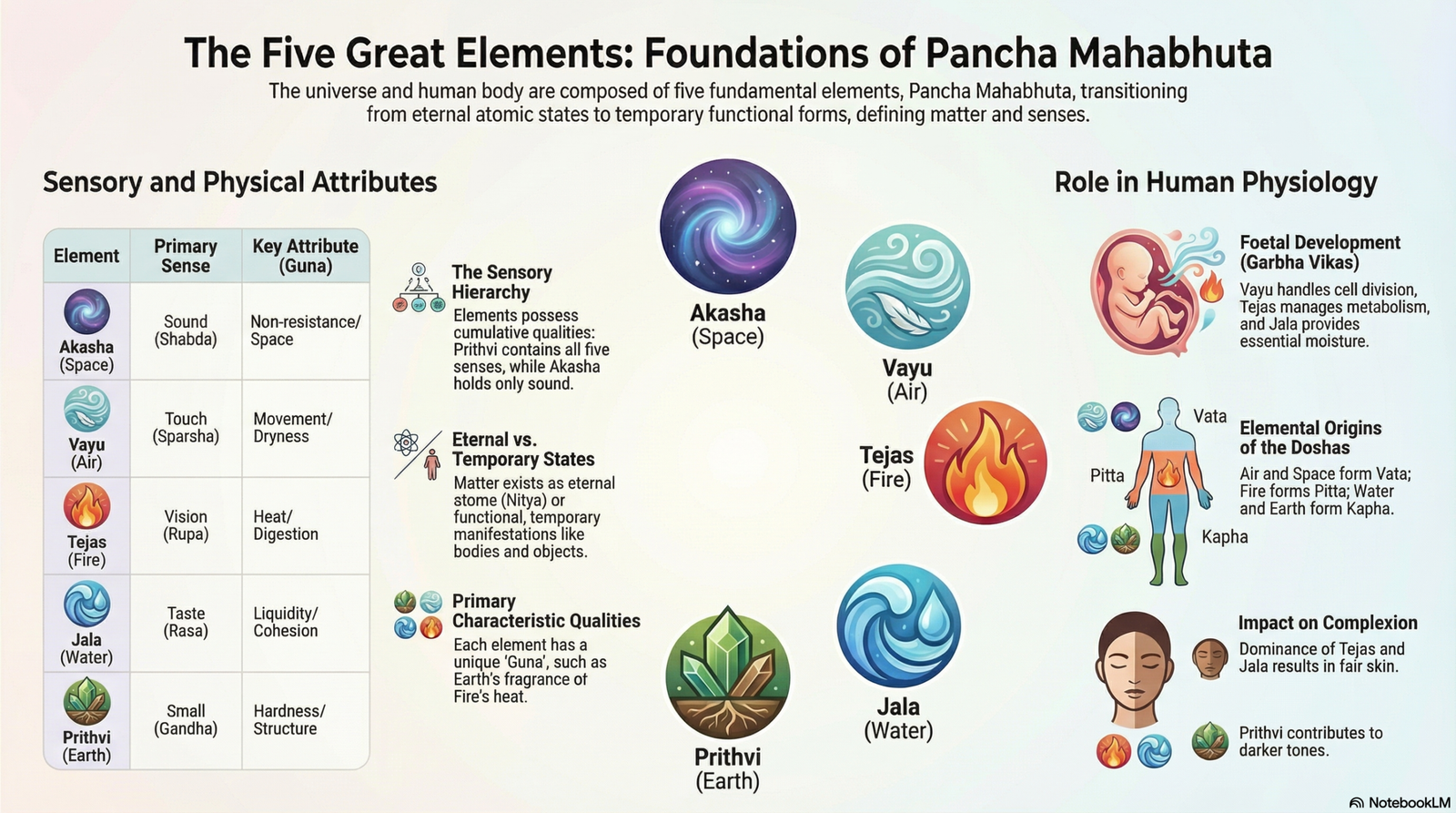
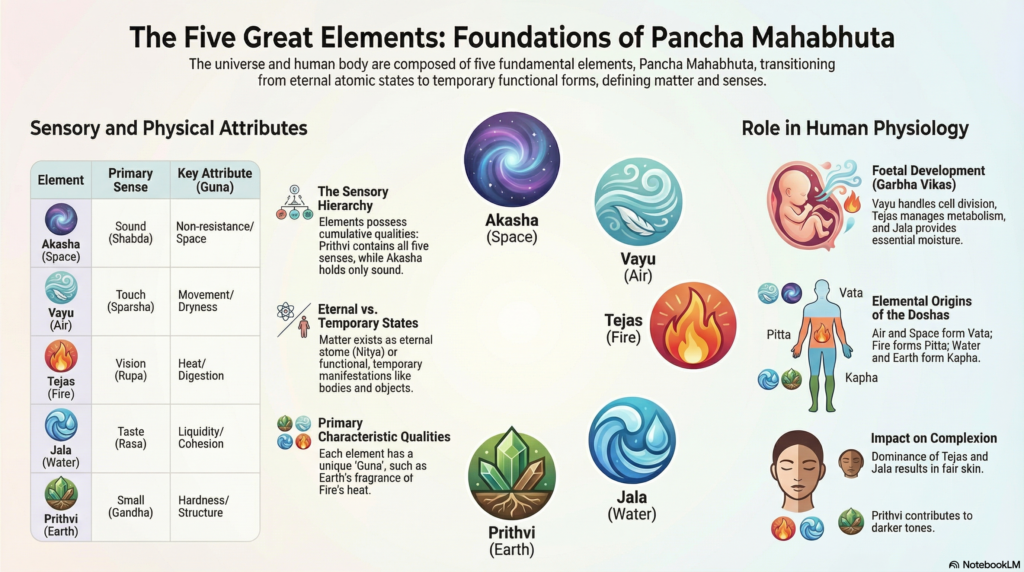
The Pancha Mahabhuta are defined by their sensory qualities (Gunas) and their energetic temperament (Mahagunas). As the elements “descend” from Space to Earth, they become increasingly dense, acquiring more sensory properties and a more complex extraordinary quality (Asadharan Lakshana).
- Akasha (Space): Defined by Sound (Shabda). Its quality is Apratighat (non-resistance/space), and its temperament is pure Sattva (clarity).
- Vayu (Air): Carries Sound + Touch (Sparsha). Its quality is Chalatva (mobility), driven by the Raja (activity) Guna.
- Tejas (Fire): Carries Sound + Touch + Sight (Rupa). Its quality is Ushnatva (heat), a balance of Sattva and Raja.
- Jala (Water): Carries Sound + Touch + Sight + Taste (Rasa). Its quality is Sneha (viscosity/cohesiveness), influenced by Sattva and Tamas.
- Prithvi (Earth): Carries all five, including Smell (Gandha). Its quality is Kharatva (hardness/density), dominated by Tamas (stability/inertia).
This hierarchy suggests that physicality increases as sensory complexity grows. Earth is the most tangible element because it engages all five senses, whereas Space remains the most subtle, defined only by the presence of sound and the absence of resistance.
5. Takeaway 4: The Alchemical Blueprint of Human Complexion
The ancient sources extend this physics into fetal development (Garbhavikas), suggesting that our physical appearance is a literal “alchemical” result of elemental dominance at birth. The ratio of elements determines the skin’s complexion (Varna) with mathematical precision:
- Tejas dominance: Results in a fair (Gaura) complexion.
- Prithvi dominance: Results in a dark (Krishna) complexion.
- Ap (Water) + Akasha: Creates a fair-dark (Gaura-Shyama) tone.
- Prithvi + Akasha: Creates a dark-fair (Krishna-Shyama) tone.
“Tejas is the primary cause of a fair complexion (Gaur varnache mukhya karan), serving as the transformative agent of light within the womb.”
In this view, the skin is not merely a genetic byproduct but a canvas reflecting the dominant chemistry of the Mahabhutas during the formation of the body.
6. Takeaway 5: The Four Layers of the Hydrosphere (States of Jala)
The ancient understanding of the water cycle was categorized into a sophisticated vertical mapping of Jala (Water), stretching from the subterranean to the cosmic:
Ambha The subtlest form of moisture, located in the vast space above the solar region. It represents the highest atmospheric state of water.
Marichi The water existing in the mid-atmosphere, between the sun and the earth. It is often associated with the solar rays and the essential moisture held within the air.
Mara The terrestrial water we interact with daily—the rivers, oceans, and lakes residing on the earth’s surface.
Mapra The deep subterranean water systems. This refers to the hidden reservoirs and groundwaters that reside beneath the earth’s crust.
7. Conclusion: A Question of Perspective
The Pancha Mahabhuta offers a unified field theory where chemistry, biology, and sensory perception are inextricably linked. By connecting the Doshas of the body to the Indriyas (senses) and the same elements that form the stars, this system invites us to view ourselves as an integral part of a living, breathing architecture.
If our very skin color, our metabolism, and our sensory experiences are products of the same elements that form the soil and the lightning, it forces a radical shift in perspective. If we are made of the same “eternal atoms” as the rest of the cosmos, where does the “self” end and the universe begin?