Beyond the Miracles: 5 Radical Lessons in Faith from the Life of Shirdi Sai Baba
1. Introduction: The Enigma of the Fakir
In the dusty, late 19th-century village of Shirdi, a penniless fakir took up residence in a dilapidated mosque. He owned nothing but a tin pot and a colonial-era brick, yet he became a gravitational center for thousands. In our modern age, defined by a frantic pursuit of absolute rationalism and a digital-age illusion of control, the figure of Shirdi Sai Baba presents a startling counter-narrative.
He was a man who challenged the very foundations of how we perceive security and spiritual progress. While popular tradition often emphasizes his “miracles,” a deeper look into the records—the maps of his daily interactions—reveals something far more profound: a psychological framework for finding inner peace. Baba invites us to look past the supernatural and examine the radical shifts in perspective required to navigate the human condition with grace.
2. Lesson 1: The Paradox of the “Two Pice” (Faith and Patience)
For a man who lived entirely on alms (Bhiksha), walking door-to-door with a cloth bag, Sai Baba had a strikingly specific way of asking for “payment” from his followers. He famously requested a Dakshina (gift) of two “pice” or coins. However, these were not monetary. He demanded Shraddha (Faith) and Saburi (Patience).
There is a deep paradox here: a beggar asking for coins that money cannot buy. In an era of instant gratification, where we view delay as a systemic failure, Baba’s insistence on Saburi is a radical departure. He suggested that the most meaningful changes in the human psyche cannot be manufactured; they must be matured.
“To cross this ocean of mundane existence, one must offer two coins: a heart full of trust (Shraddha) and a soul steeled with courageous patience (Saburi). Without these, the path remains closed, no matter what worldly wealth you bring.”
This “spiritual currency” implies that the primary obstacle to peace is not a lack of resources, but the agitated mind that lacks the endurance to wait for the internal storm to subside.
3. Lesson 2: Dwarka Mai and the Radical Inclusivity of Space
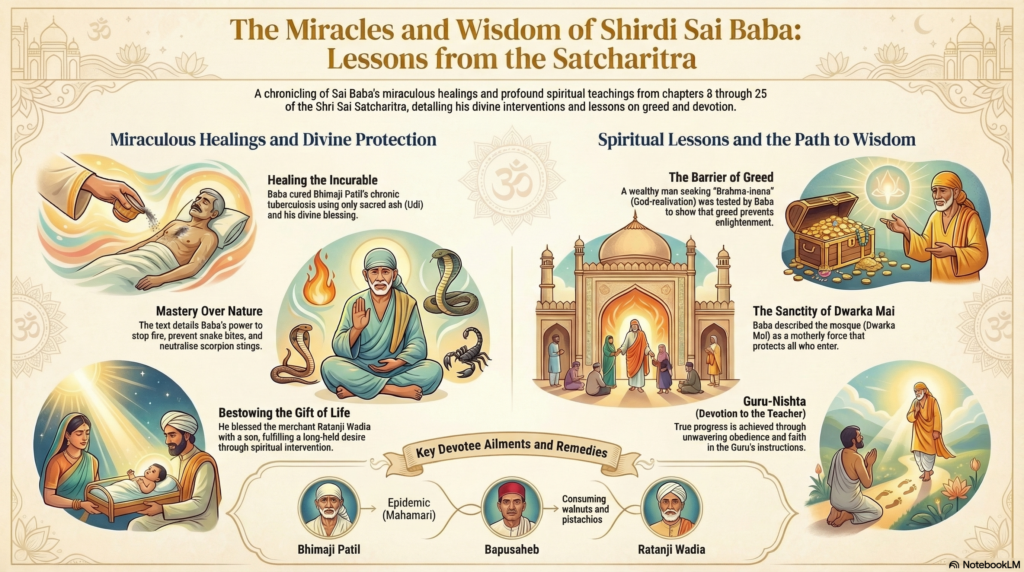
Sai Baba’s residence was perhaps his most provocative teaching. He lived in a mosque but named it “Dwarka Mai”—after the legendary Hindu city of Dwarka. As recorded in the Vimshati and Dwavimshati chapters, this was a profound statement on the transcendence of religious labels.
This sanctuary was a space where social barriers dissolved. It welcomed Ratanji Parsi, a wealthy merchant, alongside the orthodox Doctor Pandit. The source context notes that this “Masjid Mai” served as a literal shelter from physical dangers like snake bites (Ahidansha) and scorpion stings (Vruchika dansha).
Philosophically, this sanctuary represents a protection against “the toxins of life.” By naming a mosque with a Hindu identity, Baba forced his followers to confront their tribalism. He demonstrated that the “Divine” does not reside in sectarian architecture, but in the radical inclusivity of a heart that refuses to exclude any seeker based on their origin.
4. Lesson 3: Healing Through the Mundane
The records of Shirdi are filled with instances where conventional medicine reached its limits. When dealing with the plague (Mahamari) or chronic conditions, Baba often employed methods that were deceptively simple.
- The Case of Bhimaji Patil: Suffering from severe tuberculosis and a relentless cough (Kafakshaya), Patil found no relief in traditional cures. Baba’s “treatment” was the application of Udi (sacred ash from his perpetual fire).
- The Peanut Cure for Kaka: In a fascinating incident recorded in the 12th chapter, Baba used Bhui-mug (peanuts/groundnuts) to alleviate the agonizing gastric distress (Julab) suffered by Kaka Saheb.
Baba was not merely performing magic; he was treating the mind and spirit by using physical tokens to anchor the devotee’s belief. By using Udi—the residue of fire—he provided a tactile reminder of the temporary nature of the physical form. The healing was as much about the psychological shift from fear to surrender as it was about the ailment itself.
5. Lesson 4: The “Dakshina” Test and the Pathology of Greed
A pivotal moment in the Shodashi and Saptadarshi chapters involves Baba’s specific “money tests.” Transitioning from healing the body to diagnostic tests for the soul, Baba would often ask wealthy visitors for small amounts of money.
In one instance, a man arrived seeking Brahma-jnana (Supreme Knowledge). Baba repeatedly asked him for five rupees. The seeker hesitated, claiming he was a poor man, even though—as the source explicitly notes—he had “notes tucked away in his clothing” (nota asuni vastrantari).
Baba used this moment to expose the man’s Dhan-lobh (greed). The lesson was blunt: one cannot hold onto the “Supreme Knowledge” while their hands are tightly clenched around material wealth. Virakti (detachment) is not a requirement of poverty, but a requirement of clarity. You cannot receive with a closed fist.
6. Lesson 5: The Ethics of the Everyday (The Roasted Gram)
Spirituality is often wrongly categorized as something that happens only in quiet meditation. Baba contested this by finding lessons in the most ordinary social interactions. In the Chaturvimshati chapter, an incident involving Hemadpant and a handful of parched grains (futane/roasted gram) serves as a sharp lesson in social ethics.
When Baba chided Hemadpant during a minor disagreement about the snack, the lesson wasn’t about the food itself, but about the failure to share. Baba reminded him that consuming anything—an experience, a meal, or a thought—without offering it to those present is a spiritual failure.
High-level truths were never “high” to Baba; they were grounded in the communal act. He taught that mindfulness is not just an internal state, but a social responsibility. To eat alone while others are hungry is to be disconnected from the very “oneness” many seekers claim to find in prayer.
7. Conclusion: The Living Legacy of Shirdi
The legacy of Shirdi Sai Baba is not found in the display of supernatural power, but in a complete “re-orientation of the heart.” His life serves as a reminder that the path to inner stability does not require us to abandon the world, but to fundamentally change how we relate to it.
He taught that faith is not a blind belief in the impossible, but a radical trust in the process of life, even when it is as slow as the maturing of “two pice.” As we navigate our own modern complexities, we might ask ourselves: What is our own “Udi”? What small, daily reminder of our mortality and our shared humanity do we need to carry to stay grounded in a world that often feels weightless?