The Alchemy of Devotion: Lessons from Sai Baba’s Wheat Grinding Miracle
- Introduction: The Hook and the Significance of the Shirdi Narrative
In the remote, sun-baked area of early 20th-century Shirdi, a significant spiritual atmosphere was always present. To the casual observer, Sai Baba seemed like a simple beggar; however, those who understand his “Leelas” (divine plays) see them as meaningful lessons. These were not just displays of the supernatural but intentional actions meant to spark the emotional and spiritual growth of the community.
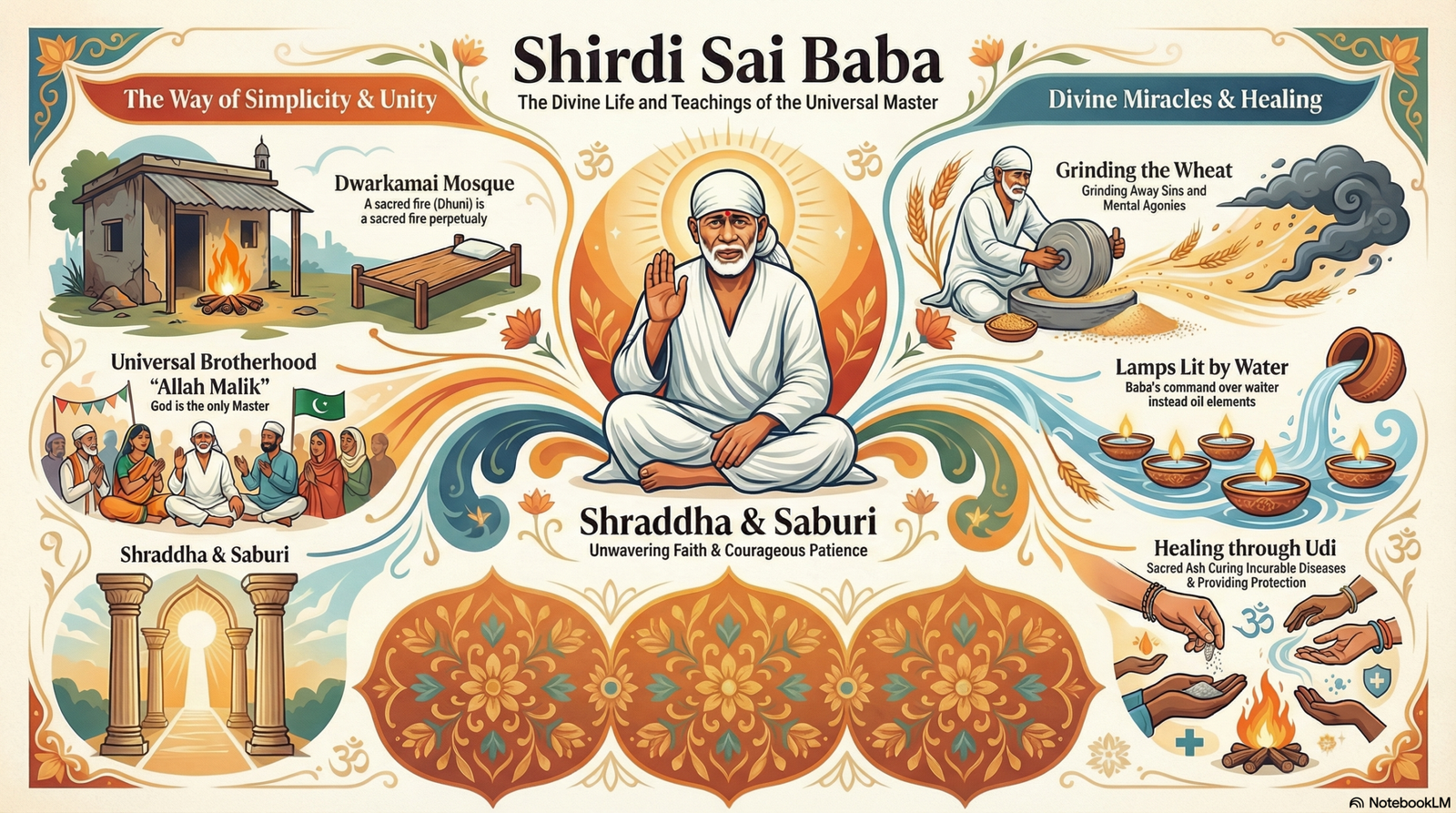
The most important of these stories took place on a dusty morning in 1910. Without any explanation, Sai Baba sat down at a hand-mill and started the hard, repetitive work of grinding wheat. For someone who depended entirely on alms and had no grain, this sudden shift to manual labor was shocking and confusing to the villagers.
This Leela illustrates a twofold transformation: a physical act of work served to shield the community from an impending epidemic, while also symbolically addressing the “wheat” of human ego. This event is the cornerstone of the Sai Satcharita, representing the shift from the Guru’s physical presence to his role as a constant protector.
- The Historical Event: Transmuting Labor into Protection
Understanding the historical background of any Leela is important for grasping the vital connection between a Guru and the well-being of his followers. A true Master does not work alone; he serves as a guardian for both the physical and spiritual health of those he watches over.
According to the Satcharita, Shirdi was facing a serious cholera outbreak at that time. When villagers saw Baba grinding wheat, they were initially puzzled by the simplicity of the task. The true significance of this action was only revealed after he finished. Instead of using the flour for food, Baba instructed that it be taken to the village outskirts and thrown into a stream. This was a “leela within a leela,” where Baba’s initial anger at the women who tried to help him was a calculated way to redirect their energy and turn a simple task into a protective barrier against disease.
Key Details of the Event:
- The Act of Grinding: Baba started the task alone, later joined by four women who helped turn the mill while singing his praises.
- The Strategic Fury: When the women attempted to share the flour, Baba grew angry, chastising them to shift their focus to his specific instructions.
- The Directive of Disposal: Baba clearly commanded that the flour be thrown at the village borders as a spiritual and physical boundary.
- The Communal Shield: Historical records show that the cholera outbreak ended shortly after this act, linking the end of the disease with the flour’s disposal.
This intervention demonstrates how the Guru connects the physical health of the village with the spiritual health of each devotee.
- The “So What?” Layer: Grinding the Ego and Mental Agonies
In the study of sacred stories, interpreting symbols is vital for understanding a Guru’s teachings. The act of “grinding” serves as a universal symbol for the purification needed to reach higher states of awareness—breaking down coarse attachments to achieve a refined essence.
As Hemadpant explained, Baba was not just processing grain; he was grinding the “sins and the emotional and physical struggles” of his many devotees. The “wheat” symbolizes the heavy burden of past actions and worldly concerns.
The Phases of Ego Elimination
The Satcharita describes a three-step transformation process:
- Preparation: Surrendering the “wheat” symbolizes a devotee’s readiness to present their worldly attachments and internal tendencies to the Guru.
- The Process: The challenges of spiritual practice (Sadhana). Under the Guru’s guidance, individuals face life’s trials and engage in spiritual discipline that wear down the hard shell of the ego.
- The Result: The creation of “fine flour,” which symbolizes a purified mind—an awareness ready for higher understanding and unity with the Divine.
The Hand-mill as a Symbol of the Mind
The hand-mill is a strong symbol of the mind and its dualities. In the context of the Leela, the “handle” of the mill, which the devotee must hold tightly, represents the knowledge and conviction necessary to drive the spiritual journey. Without the handle of solid faith, the stones of the mind remain still, and the wheat of the ego stays intact. This change can only occur with the Guru’s grace.
- The Essential Role of the Guru: Navigator and Protector
The Guru-Shishya (Master-Disciple) relationship is critical for the path described in the Satcharita. Spiritual growth is not something one does alone; it requires a guide who knows the challenging journey of human life.
Baba explained this need using the metaphor of a dangerous journey. He stated that a guide is crucial to “steer clear of tigers, foxes, and ditches” on the spiritual path. Without this protection, seekers may fall prey to the “foxes” of desire or find themselves stuck in the “ditches” of confusion and stagnation.
Path Without a Guru Path With a Guru
Perils: Exposure to tigers and foxes (internal or external dangers). Protection: The Guru acts as a strong shield.
Confusion: Wandering aimlessly in the “forest” of material life. Direct Route: A clear, guided path to the ultimate goal.
Obstacles: Falling into ditches (delusion and stagnation). Safety: Continuous guidance and correction from the Master.
Baba’s promise of being always present ensures he understands the hearts of every devotee. He guarantees that for those who “turn their attention” to him and call his name with love, he will meet their needs and offer a quicker path to happiness.
- Practical Wisdom: 5 Key Takeaways for the Modern Seeker
The Wheat Grinding Miracle presents five practical lessons for dealing with challenges in today’s life:
- Nishtha (Faith) and Saburi (Patience): The twin essentials for any transformation. One must have faith to surrender the grain and patience to endure the grinding.
- Service as Worship: Everyday tasks, done as offerings to the Guru, become powerful spiritual practices.
- Elimination of Vasanas: We must recognize our inner desires as the “wheat” needing processing. True peace arises only when the ego is turned to dust.
- Collective Protection: The Guru’s grace not only protects the individual but also shields the entire community from “epidemics,” whether physical, mental, or social.
- Humility: To receive grace, one must approach the path with deep respect. Only through true humility and letting go of pride can the Master’s protection be fully experienced.
- Conclusion: The Eternal Presence of Sai
The Wheat Grinding Miracle plays a vital role as the opening Leela of the Sai Satcharita. It emphasizes that the Guru’s grace is always accessible for those willing to focus their inner gaze on him. Baba’s message is clear: to achieve “limitless bliss,” one must “avoid the company of the irreligious and cruel,” and instead turn towards the spiritual center.
The legacy of Shirdi reminds us that the Master is always nearby, ready to take the handle of our life’s mill if we are prepared to provide the grain. Today, look within and pinpoint one specific Vasana—one lingering egoic tendency or negativity—that you are willing to surrender to the grinding stones of your spiritual path.
Om Sai Ram.