1. Introduction: The Ascetic and the Airport
In the mid-1850s, a youth of approximately sixteen years appeared under a neem tree in the village of Shirdi, perched in the Ahmednagar District of Maharashtra. He sat motionless in an asana, unperturbed by the biting cold or the searing sun. Historical accounts suggest a figure of surprising depth; he even claimed to have served with the army of Rani Lakshmibai of Jhansi during the pivotal Indian Rebellion of 1857. Today, this solitary figure—known as Shirdi Sai Baba—is the focus of a global movement so economically potent that a Delhi-based entrepreneur recently proposed constructing a Shirdi airport on a “Built, Operated, and Transfer” (B.O.T.) basis.
The transition from a 19th-century weaver-saint to a global icon capable of attracting billion-rupee infrastructure bids is a phenomenon that fascinates the cultural anthropologist. It is a story of how a “dilapidated mosque” transformed into a spiritual empire where ancient hagiography meets contemporary technical procurement.
2. The Billionaire’s Altar: Philanthropy at a Staggering Scale
The modern Shirdi Sai legacy is defined by a scale of philanthropy that seems to paradoxically honor the saint’s own life of begging for alms. While the historical Baba survived on the charity of villagers, the trust managing his legacy today oversees ventures funded by the titans of the digital age.
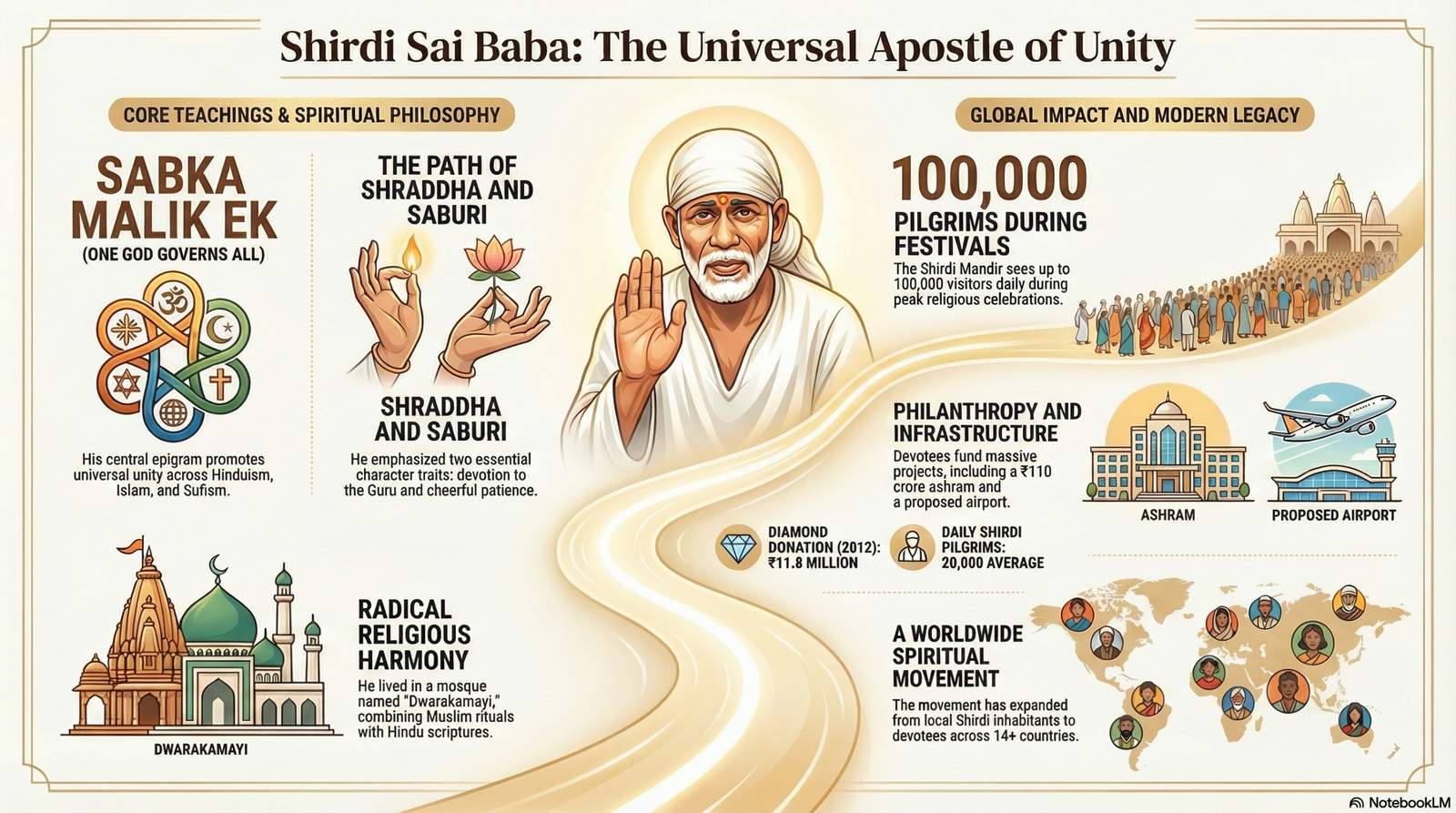
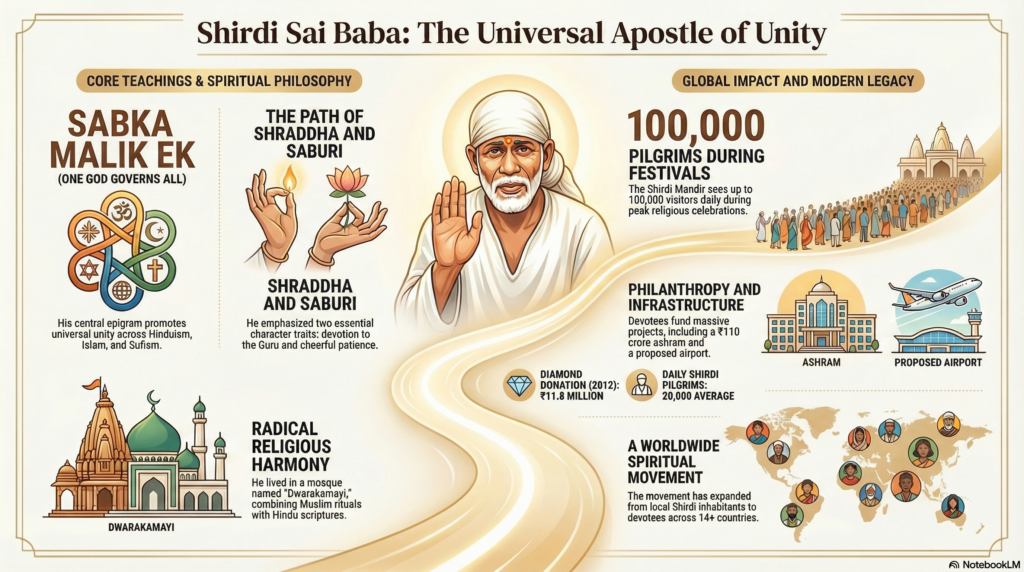
K.V. Ramani, the co-founder of Nasscom—the organization that sets the tone for India’s software industry—donated 110 crore INR to build and hand over the “Sai Ashram” to the Shri Saibaba Sansthan. Ramani has further pledged 80% of his total earnings to the Shirdi Sai Trust. In the high-volatility world of tech, the steadfastness of the Shirdi legacy perhaps offers a spiritual hedge against the ephemeral nature of silicon success. The offerings are not merely infrastructural:
- The Jeweled Legacy: In 2012, an unidentified devotee donated two diamonds valued at 11.8 million INR.
- The Silver Throne: A Mumbai entrepreneur provided a 40kg silver throne, worth 27 lakh INR, for the Chavadi where the saint once slept.
“His mission on earth was not solely to preach, but to awaken mankind through his message of love and righteousness.” — Shri Sai Satcharita
3. The Original Syncretist: A Mosque Named “Dwarakamayi”
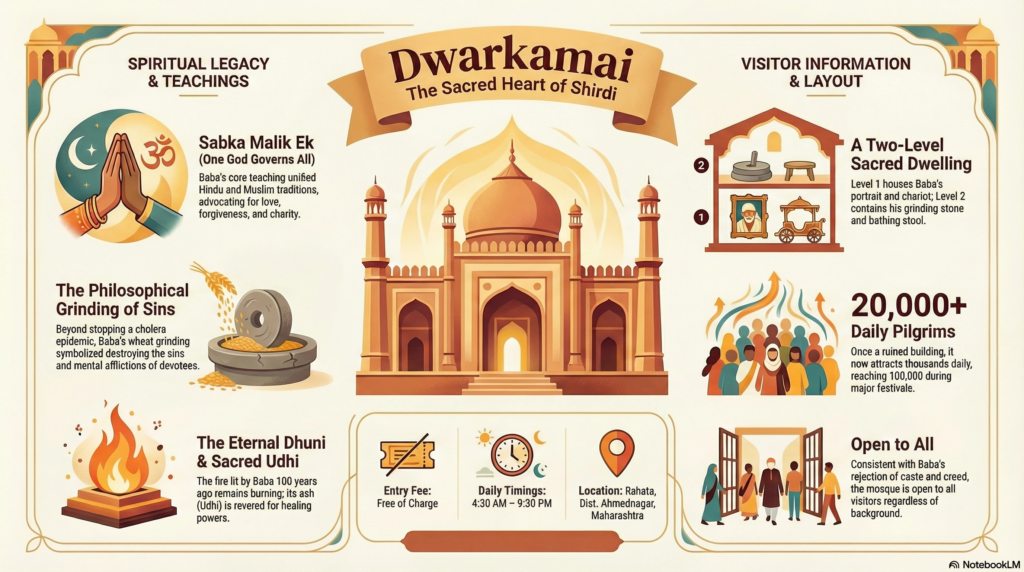
Long before modern diversity initiatives, Sai Baba was a radical bridge-builder between Hindu and Muslim traditions. He resided in a mosque yet gave it the Hindu name “Dwarakamayi.” He greeted visitors with the phrase “Allah Malik” (God is King) and practiced Muslim rituals, yet he was equally fluent in the philosophical nuances of Hindu scripture.
He encouraged a unique cross-pollination of faith, advising Muslims to study the Quran while urging Hindus to delve into the Ramayana, Bhagavad Gita, and the Yoga Vasishta. In today’s polarized landscape, his famous epigram “Sabka Malik Ek” (One God governs all) remains a powerful, counter-intuitive takeaway for the global citizen.
The Shirdi Moral Code:
- Shradda (Devotion): Total faith in the Guru.
- Saburi (Patience): Waiting with cheerfulness and love.
- Universal Charity: Helping others without discrimination of religion or caste.
- Dhikr and Japa: The indispensability of the unbroken remembrance of God’s name.
4. Beyond the Grave: The “Udi” and the Miracles of the Mosque
The persona of “Saint, Saviour of mankind” was built through parables and claimed miracles, from Khanda Yoga (the reported detachment and reattachment of limbs) to lighting lamps using water instead of oil. To the anthropologist, his most interesting “technical tool” was the “Udi”—sacred ash taken from the dhuni (perpetual fire) he maintained in the mosque.
Sai Baba functioned as a local hakim (physician), using this ash to treat the sick. The Udi served as the 19th-century pharmaceutical equivalent to the sophisticated medical facilities the trust manages today. It remains a potent symbol of his presence, believed to possess healing and apotropaic powers that continue to draw between 20,000 and 100,000 pilgrims to Shirdi daily.
“The people of the village were wonder-struck to see such a young lad practising hard penance, not minding heat or cold. By day he associated with no one, by night he was afraid of nobody.”
5. The Modern Footprint: From Spiritual Path to Technical Specifications
The “Sai” brand has permeated the very infrastructure of modern India, moving from the dhuni to the technical bid. Technical procurement documents, such as State Bank of India (SBI) Tender ID AHMSAO431, originate from offices in the “Sai Lilla Mall.” These documents demand rigorous commercial standards for works valued between Rs. 50 Lakh and 500 Lakh, proving that the saint is now bound by the precision of the contract.
The irony is stark: a saint who lived within “dilapidated mosque walls” is now the namesake for luxury Hyderabad real estate like “Sai Leela Apartment” in Kothapet, which features premium lifestyle amenities and Vaastu-compliant designs.
| The Ascetic Life (19th Century) | The Modern Footprint (21st Century) |
| Meditating under a Neem tree | Sai Leela Apartment: 883 sq. ft. luxury units |
| Surviving on begged alms | 110-crore INR donated Ashrams (K.V. Ramani) |
| 19th-century Hakim practices | SBI Tender AHMSAO431: Rs. 500 Lakh threshold |
| Smoke-filled dhuni (Sacred Fire) | Specifications: “Gyp steel ultra” & “BWR Plywood” |
| 45-day retreat in the jungle | 45-day completion period for SBI civil works |
| Dilapidated mosque walls | Vitrified tiles and 3% total security deposits |
6. The Prophet of Contentment: Why “Half a Loaf” Still Matters
Despite the billion-rupee environment, Sai Baba’s historical parables remain deeply skeptical of market speculation and greed. In 1895, a devotee named Damu Anna Kasar sought Baba’s blessing for a cotton speculation deal promising two lakh rupees in profit. Baba’s response was a sharp critique of the desire for “lakhs.”
Baba later warned Damu Anna against trading in grain, predicting a sudden fall in prices. While others stored grain hoping for a price hike, Baba’s rain prophecy proved true; abundant rain caused the market to collapse, and those who ignored the saint suffered severe losses. This 19th-century economic advice—favoring stability over speculation—remains strikingly relevant in today’s high-volatility financial world.
“The Sheth has gone mad… let him be content with the half loaf he has and not bother himself about lakhs.” — Sai Baba to Damu Anna
Conclusion: A Legacy Carved in Stone and Spirit
The Shirdi Sai movement has evolved from a small circle of village inhabitants into a global phenomenon. His presence is now firmly established in the United States, Australia, United Kingdom, United Arab Emirates, Germany, France, Canada, Nepal, Malaysia, Singapore, and the Caribbean.
It is a legacy that effortlessly bridges the gap between the 1857 Rebellion and 21st-century banking tenders. Yet, as we navigate through vitrified tiles, “Gyp steel” specifications, and billion-rupee donations, a singular question remains: Can the modern seeker still find the “solitary weaver” who sat motionless under the neem tree, or has he been entirely encased in the regalia of modern success?