1. Executive Launch Overview and Strategic Context
The 2026 smartphone landscape is characterized by high-stakes competition for the “affordable flagship” segment, where generative AI is the new baseline. In a significant tactical maneuvering, Google has accelerated its release cycle, moving the “A-series” launch to February and March—considerably earlier than the traditional late-spring window. This preemptive strike is designed to capture market share before the arrival of Apple’s iPhone 17e and Samsung’s Galaxy S26 series. Crucially, Google has maintained price stability at $499, a notable achievement for a Senior Product Strategist to highlight given the industry-wide RAM shortage and rising component costs that have forced price hikes among its primary rivals.
Core Launch Summary
- Announcement Date: February 18, 2026
- Official Sale Date: March 5, 2026
- Primary Value Proposition: Premium Gemini AI integration and flagship-tier durability at a sub-$500 entry point.
- Key Commercial Weapon: Aggressive price stability ($499) despite rising supply chain pressures.
This accelerated timeline signals Google’s intent to dominate the mid-range conversation through immediate hardware availability and localized AI dominance, beginning with a fundamental shift in the device’s physical profile.
——————————————————————————–
2. Design Evolution and Display Engineering
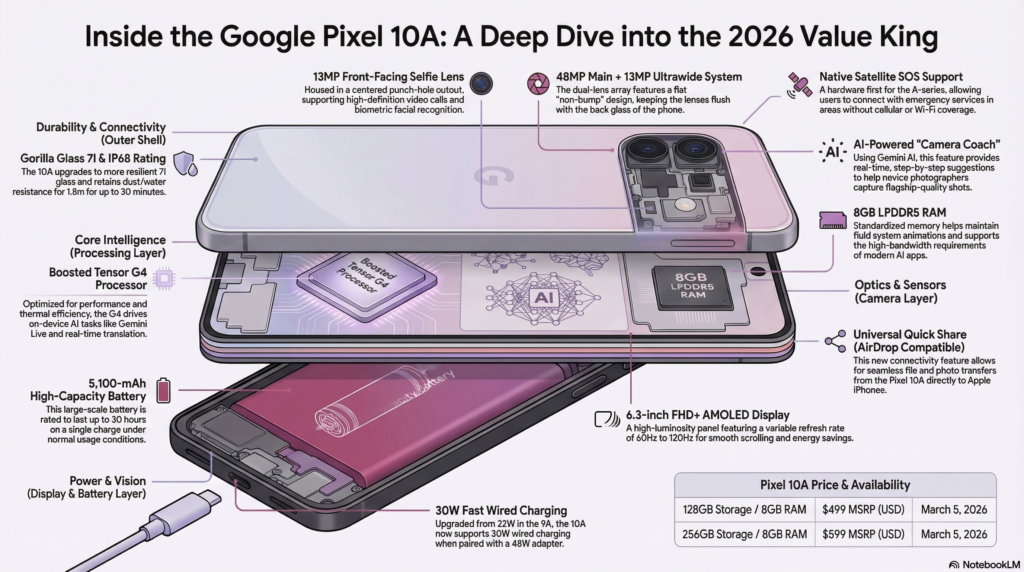
The Pixel 10A adopts a “minimalist-than-minimal” design philosophy, representing a departure from the aggressive aesthetic of the flagship line. The most prominent change is the transition to a “flat” camera island. By moving away from the iconic “visor” array to a housing that is nearly flush with the rear casing, Google has significantly improved device ergonomics. This flush design eliminates the traditional “wobble” associated with camera bumps, offering a streamlined, snag-free profile that prioritizes utility and pocketability.
Industrial Design and Display Specifications
- Display Type: 6.3-inch Actua display (2,424 x 1,080 resolution).
- Durability Leap: Implementation of Corning Gorilla Glass 7i, providing a massive increase in scratch and drop resistance over the Gorilla Glass 3 used in the Pixel 9A.
- Color Palette: Available in Obsidian, Berry, Fog, and Lavender.
- Weather Protection: Maintained IP68 rating for dust and water resistance.
Industrial Design Implications The move to a flush camera design is a calculated differentiator in a market where “camera bumps” have become an accepted, if cumbersome, necessity. For the professional user, this “smooth slab” aesthetic offers a sophisticated alternative to the lens-forward designs of its competitors. This exterior refinement is supported by an internal architecture optimized for the sustained thermal demands of on-device AI.
——————————————————————————–
3. Hardware Architecture and Performance Benchmarks
Google’s hardware strategy for the 10A focuses on the “democratization” of its flagship silicon. The device utilizes the Tensor G4 processor, identical to the chip in the 9A but “boosted” through software optimization to manage thermal efficiency more effectively. This ensures that intensive AI tasks can run without the throttling issues that historically hampered mid-range performance.
Core Performance Specifications
| Component | Specification | Strategic Impact |
| Processor | Tensor G4 (Boosted) | Facilitates on-device AI while maintaining peak thermal efficiency. |
| Battery | 5,100-mAh | Provides up to 30 hours of endurance for high-utility professional use. |
| Wired Charging | 30-watt (via 45W adapter) | A 30% speed increase over the 9A’s 23W, reducing critical downtime. |
| Wireless Charging | 10-watt | Standard convenience for desk-based charging cycles. |
Battery and Thermal Performance Analysis In standard drain scenarios, the Pixel 10A’s 5,100-mAh battery achieved parity with premium flagships like the $1,300 Samsung Galaxy S26 Ultra. However, professional buyers should note that the 10A trails the baseline Pixel 10 and iPhone 16e in high-intensity endurance tests. While the 10A is a reliable “all-day” performer, its strength lies in efficiency rather than raw capacity. These hardware optimizations provide the necessary headroom for Google’s expansive generative AI suite.
——————————————————————————–
4. Advanced Imaging and Gemini AI Integration
The Pixel 10A serves as a showcase for “software-defined photography.” While Google has opted to retain the proven 48MP main and 13MP ultrawide hardware, the strategic value is unlocked through updated neural models. This approach allows Google to maintain a lower price point while delivering imaging results that challenge hardware-heavy competitors through superior computational processing.
Gemini AI and Imaging Features
- Camera Coach: This tool utilizes Gemini AI to provide real-time suggestions for framing and lighting. By democratizing professional photography techniques, it pushes even experienced users out of their comfort zones to engage more professionally with mobile composition.
- Gemini Live: Offers a multimodal assistant experience where the AI can “see” through the lens to identify objects or assist in organizing physical spaces through natural conversation.
- Screenshot Gallery: A sophisticated organizational tool that automatically categorizes screenshots into eight distinct folders (e.g., Barcodes, Receipts, QR codes), solving a primary pain point for professional information management.
These features transform the 10A from a capture tool into a contextual assistant, a philosophy that extends to its newfound cross-platform capabilities.
——————————————————————————–
5. Connectivity, Safety, and Cross-Platform Interoperability
In a major strategic “olive branch,” Google has introduced AirDrop interoperability for Quick Share. This feature, which debuted on the flagship Pixel 10 line, is now being democratized to the A-series. This allows the 10A to act as a “bridge device” in mixed-OS households and workplaces, removing a significant barrier to switching from iOS.
Safety and Connectivity Evolution
| Feature | Pixel 10A (2026) | Pixel 9A (2025) |
| Satellite SOS | Native Hardware Support | No Native Support (Texting Only via T-Satellite) |
| Interoperability | Quick Share/AirDrop Compatible | Android-Only Quick Share |
| Wired Charging | 30W Fast Charging | 23W Charging |
A critical distinction for the 2026 model is the inclusion of native hardware support for Satellite SOS. While the Pixel 9A relied on T-Satellite for basic texting, the 10A provides an integrated emergency lifeline. This is supplemented by the optional T-Satellite eSIM service ($10/month), which allows for non-emergency texting in cellular dead zones.
——————————————————————————–
6. Pricing Models and Competitive Market Analysis
The Pixel 10A’s most potent commercial asset is its $499 entry price. Against the backdrop of a global RAM shortage that has pushed competitors toward the $600+ threshold, Google’s price stability creates a formidable value lead at the entry tier.
Market Value Comparison
- Google Pixel 10A (499):** 128GB entry / **599 (256GB). Includes dual-lens system and flagship AI.
- Apple iPhone 17e ($599): Starts at 256GB. Includes Ceramic Shield 2 and MagSafe but lacks an ultrawide lens.
Analysts must note that while Google leads on entry price, the value advantage hits a “price-per-gigabyte” equilibrium at the $599 tier. Apple’s decision to double starting storage to 256GB for 599 matches the 256GB Pixel 10A exactly. Google’s true “Value Advantage” is now concentrated at the sub-500 entry level for users who do not require expanded local storage.
——————————————————————————–
7. Preorder Logistics and Carrier Incentives
The go-to-market strategy for the 10A focuses on aggressive early-adopter incentives to blunted the momentum of upcoming rival launches.
Primary Incentives:
- AT&T: Promotional $4/month financing with a limited-time bonus of free Pixel Buds 2A.
- Verizon: $0 offer (full bill credit) for new lines on Unlimited Welcome or higher tiers.
- Google Store: Direct promo codes ranging from $50 to $150 for early registrants.
Final Verdict: Strategic Takeaways
For the professional buyer deciding between the Pixel 10A and a discounted 9A, the 10A is the definitive “future-proofed bridge” due to three factors:
- Native Safety: The transition from T-Satellite texting to integrated Satellite SOS hardware is a mandatory upgrade for field workers and remote travelers.
- Operational Efficiency: The move to 30W charging and Gorilla Glass 7i provides the durability and speed required for a multi-year lifecycle.
- Ecosystem Fluidity: AirDrop compatibility via Quick Share makes the 10A the first “affordable” Android device that does not isolate the user from an iOS-dominant professional environment.
The Google Pixel 10A has evolved beyond its budget roots to become a mid-range powerhouse, successfully leveraging AI democratization and strategic price stability to redefine the value flagship category.