For the better part of a decade, the smartphone industry has been trapped in a “glass slab” monotony. Every September and February, we were told the future was entirely in the cloud, buried in neural engines, or hidden behind the latest generative AI filter. But as we cross into 2026, a distinct sense of AI fatigue has set in. The signal within the noise is clear: the cloud is fickle, but glass and silicon are forever.
The 2026 landscape has pulled a sharp U-turn away from software gimmicks and back toward brutalist, hardware-level excellence. While AI remains a background hum, the latest releases from Apple, Samsung, and Google prioritize tactile innovation—physical privacy, unprecedented durability, and “Hell Froze Over” levels of cross-platform compatibility. Hardware is officially back in the driver’s seat.
Privacy as a Power Move: The Rise of Flex Magic Pixel
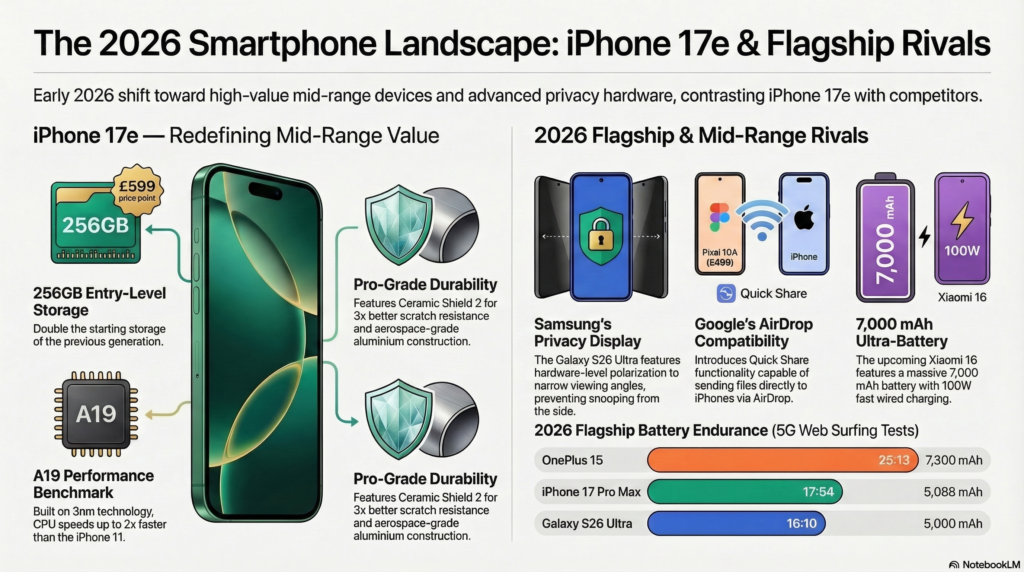
The most significant “peacocking” of 2026 doesn’t come from a folding screen, but from the Samsung Galaxy S26 Ultra’s “Privacy Display.” Originally developed under the name Flex Magic Pixel, this isn’t a mere software filter or a dimming trick. It is a masterclass in hardware-level polarization integrated directly into the display panel during manufacturing.
This tech allows the user to physically narrow the viewing angle, rendering the screen a black void to anyone looking at it from the side. Crucially, the S26 Ultra allows for localized application; you can set the hardware to black out only specific areas, such as notification pop-ups or banking data, while keeping the rest of the 6.9-inch screen visible to a companion. For a $1,300 flagship, it’s the ultimate return to hardware-driven status.
“In 2026, amid a sea of smartphone monotony, my version of smartphone peacocking is flaunting the Privacy Display feature… Any chance I get, I enthusiastically pull the phone out of my pocket, slowly tilt the screen away from my captive audience, and watch their jaws drop as all or portions of the screen disappear from view.” — CNET
The Mid-Range Storage Revolution: 256GB is the New Floor
While the S26 Ultra caters to the luxury “peacock,” Apple is quietly dismantling the value argument of its competitors. The iPhone 17e marks a watershed moment for consumer transparency. For the first time, Apple has set the entry-level storage at 256GB while anchoring the price at a aggressive $599.
This is four times the capacity offered by the iPhone 12 at launch. By doubling the floor without touching the price tag, Apple is shifting the narrative from “incremental update” to “long-term investment.” Kaiann Drance, Apple’s VP of Worldwide iPhone Product Marketing, noted the intent was to create a device that remains “valuable for years to come,” signaling that in a post-AI world, physical capacity is the most honest metric of a phone’s worth.
Breaking the Walled Garden: The AirDrop Olive Branch
If there is a “Hell Froze Over” moment for 2026, it belongs to the Google Pixel 10A. In a move that suggests regulatory pressure and consumer demand have finally punctured the “walled garden” strategy, Google’s $499 budget hero has introduced Quick Share compatibility with AirDrop.
For the first time, a budget-friendly Google phone can send high-resolution files directly to an iPhone without the “green vs. blue bubble” friction. By stripping away the software-enforced silos, Google is betting that hardware convenience—allowing users to exist in a multi-platform world—is a more potent sales tool than ecosystem lock-in.
Horizon Lock: The End of the External Gimbal
Samsung’s S26 series has also effectively killed the need for external stabilizers with its new “Horizontal Lock” feature. Driven by the ProVisual Engine, this is a technical feat of sensor-cropping and hardware-software synthesis.
Unlike the minor “Super Steady” tweaks of previous years, Horizontal Lock allows a user to rotate the phone a full 360 degrees while the video remains perfectly level with the horizon. For adventurous creators, the $1,300 S26 Ultra provides a gimbal-like quality that fits in a pocket, proving that specialized hardware engines can still outperform generic software stabilization.
Ceramic Shield 2: Ending the “Micro-Scratch” Era
Durability in 2026 is no longer just about surviving a drop; it’s about surviving the pocket. The iPhone 17e debuts “Ceramic Shield 2,” which Apple claims is tougher than any smartphone glass currently on the market.
The breakthrough here is two-fold: a 3x improvement in scratch resistance and a specialized anti-reflection coating. While previous generations struggled in direct sunlight, this new hardware coating significantly reduces glare, making the 1200-nit Super Retina XDR display usable in the harshest outdoor conditions. It is a tactile, physical win for usability that no AI update could replicate.
The Efficiency Gambit: Why mAh No Longer Matters
The most counter-intuitive finding of 2026 is what we’re calling the “Power Paradox.” The flagship race has proven that battery size (mAh) is a deceptive metric. The real winner is efficiency.
Despite having the same 5,000 mAh capacity as its predecessor, the S26 Ultra lasts 16 hours and 10 minutes in continuous 5G web surfing—nearly two hours longer than the Google Pixel 10 Pro XL, which actually carries a larger 5,200 mAh cell. This is thanks to the Snapdragon 8 Elite Gen 5, which boasts 35% higher CPU efficiency and 16% better overall power management.
- OnePlus 15: 25:13 (7,300 mAh)
- iPhone 17 Pro Max: 17:54 (5,088 mAh)
- Samsung Galaxy S26 Ultra: 16:10 (5,000 mAh)
- Google Pixel 10 Pro XL: 14:20 (5,200 mAh)
- Google Pixel 10A: 30:00 (Mixed-use estimate)
Conclusion: A Return to Hardware Excellence
The script has flipped. If 2025 was the year we were told AI would solve everything, 2026 is the year we remembered that we hold these devices in our hands, not just our heads. We are seeing a renaissance of physical innovation: displays that guard our privacy, glass that defies scratches, and silicon that squeezes every drop of life out of the battery.
The most incredible value is no longer at the top of the pyramid. Between the $499 Pixel 10A’s 30-hour battery and AirDrop compatibility and the $599 iPhone 17e’s 256GB storage floor, the mid-range has become the new flagship.
As you consider your next move, the question is no longer about which phone is “smarter.” The real question is: are you ready to trade the fickle magic of the cloud for the security of physical privacy and brutalist durability? This year, the industry is betting you are.