The Search for the Missing “?”
In our modern “spiritual supermarket,” we are inundated with a renaissance of ideas, yet many of us still grapple with a persistent, quiet sense of lack. We navigate life with material comfort and shelves of sacred texts, but the “? factor”—the elusive variable that makes life’s equation balance—remains unsolved. Sri Babuji noted that much of our seeking is actually imitative; we superimpose artificial goals upon ourselves because we see others searching, rather than following a “burning” personal need.
True seeking only begins when we stop mimicking and start asking the heavy, pragmatic questions: “Where lies my sorrow? What is my real, personal lack?” When we peel back the layers of ready-made concepts, we find that spirituality is not about adopting exotic labels, but about tackling our frustration exactly where it lives. It is an invitation to move beyond the abstract and step into the mystery of our own existence.
The Paradox of the Familiar Stranger
The relationship between a seeker and a Sadguru is defined by a unique, counter-intuitive friction. Sri Babuji described the Master as a “familiar stranger”—someone who feels inexplicably intimate, yet remains profoundly unknown. While the heart feels an immediate, ancient familiarity that floods the being with love, the mind experiences a deep and widening “strangeness.”
In ordinary life, the more we know someone, the less strange they become. In the presence of a Master, the opposite occurs: the more you learn, the more the mystery expands, creating the “pull of the magnet” that brings the seeker into a higher orbit. This paradox is the very trigger of spiritual seeking, acting as the bridge where our abstract longing begins to take a concrete form.
“The glance he gives you floods you with love. That is the content, the value, the governor’s signature on our currency.”
The Art of the Tenth Stone
We often view spiritual effort as a scientific calculation—a transaction where a specific amount of meditation yields a specific result of enlightenment. However, Sri Babuji reframed spiritual practice as an “art” of refinement rather than a “science” of labor. He illustrated this through the analogy of the mango orchard: you throw nine stones and miss, but the tenth stone finally knocks the fruit down.
The tenth stone did the work, but the previous nine were not failures; they taught you the “art of throwing.” Consider a badminton player: they do not calculate mass, wind speed, or the surface area of the racquet before they strike. They simply know how to hit the shuttlecock through practice and intuition. Similarly, spiritual effort is about developing a spontaneous receptivity.
Key Takeaway: Effort does not “achieve” realization; it is the art of practice that makes the seeker receptive to grace, which alone delivers the final hit.
The Bliss of Being Topsy-Turvy
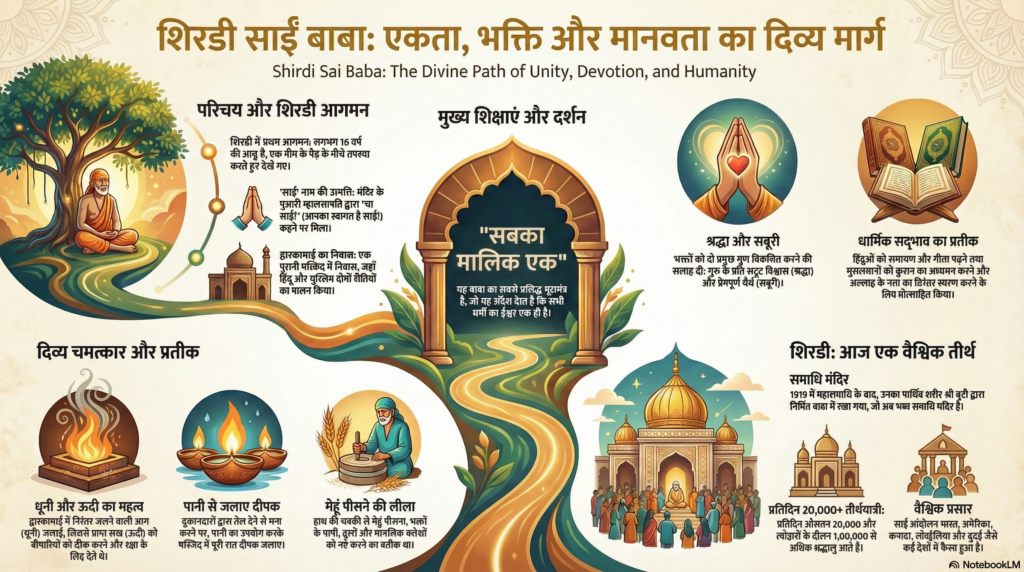
Sai Baba of Shirdi once recounted a striking allegory of his early training involving his Guru, a tradesman or Vanjari. The Guru hung Baba upside down over a well, suspended just three feet above the water, and left him there for hours. Rather than fear, Baba reported experiencing “bliss supreme,” a state where all his vital forces and senses became concentrated in his sight.
Sri Babuji interpreted this “topsy-turvy” state as a radical deconditioning of the mind. The “well” represents the immense depths of our own being, while the upside-down position symbolizes the shattering of habitual mental patterns. To experience the bliss Baba described, our “so-called knowledge” and rigid ways of perceiving must be turned on their heads to reveal the reality underneath.
“My Guru made me see the depths of my own being—there all my so-called knowledge, patterns and ways of knowing became topsy-turvy—and I had a glimpse of bliss.”
Boring into Boredom
Modern life is largely an exercise in “killing time,” an escape from the unbearable reality of the self. We seek spice through “pastimes”—from newspapers and movies to the artificial high of extreme sports like skydiving or bungee jumping. Sri Babuji, however, suggested that boredom is a “wonderful experience” if we have the courage to explore it rather than flee.
By “boring into boredom”—investigating the feeling itself as one would a physical object—we find the hidden gateway to the mind’s thrilling mysteries. When we stop trying to “pass the time,” we find that the very thing we were running from contains “living waters.” This exploration turns a dull psychological state into a profound source of insight and discovery.
- Escapism: Using TV, drugs, or extreme sports to create an artificial “spice” and avoid the self.
- Exploration: Staying with the experience of boredom to reveal the “thrilling mysteries” of the mind.
Ritual as a Psychological Trigger
For the modern seeker, rituals can seem like empty, mechanical chores, yet they serve a necessary psychological function. Sri Babuji used the example of a father coming home to his child: even if he doesn’t feel an immediate surge of love, the act of holding and kissing the child triggers the emotion. Action triggers emotion, providing the “new habit” necessary to displace the old ones that keep us stuck.
This follows the principle often cited by Ramana Maharshi: using one thorn to remove another before throwing both away. Rituals like lighting incense or meditation are simply tools for deconditioning the heart until the “new habit” becomes a spontaneous expression. Eventually, the practiced action gives way to a natural flow of devotion that requires no external structure.
“Any act becomes a puja if it is an expression of love.”
The Unending Love Story
Spirituality is not a static destination or a station where one “gets off” the train of existence. Sri Babuji pointed to the etymology of the word Brahman, which comes from the Sanskrit root Brh, meaning “to grow.” This suggests that absolute reality is a process of infinite unfolding, a state that is endlessly expanding into ever-new forms of beauty.
Consider an artist whose painting is never truly complete; if it were, the art would become stale and dry. Fulfillment is dynamic, not a fixed point of arrival, but a ceaseless odyssey of discovery. The path itself, with all its paradoxes and mysteries, is a thrilling narrative of expansion that has no final ending.
Are we ready to let the mystery be a thrill rather than a problem to be solved?