
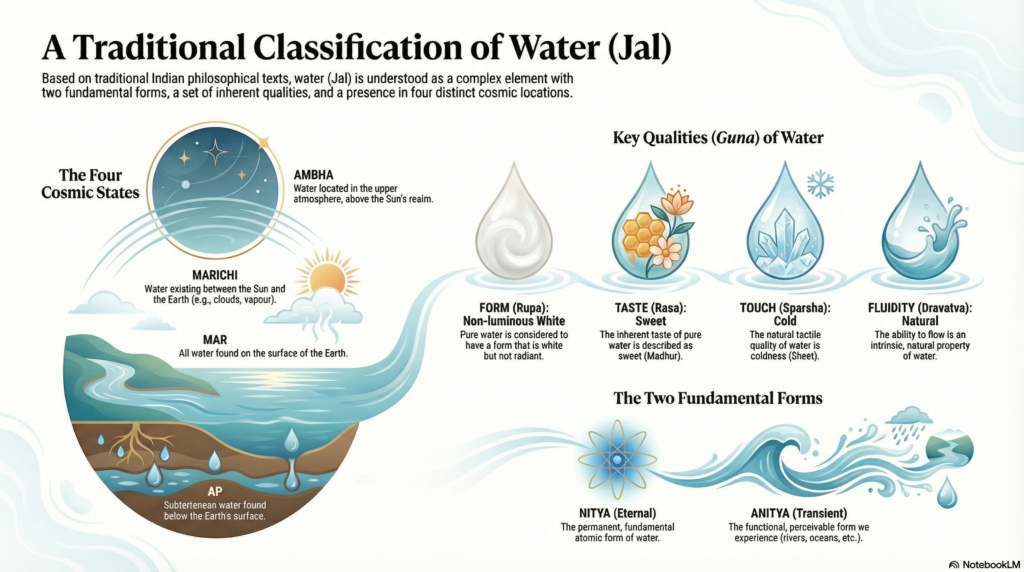
Our contemporary relationship with water is largely a matter of utility—a chemical formula (H2O), a metric of hydration, or a resource to be managed. We have mastered the liquid’s behavior while perhaps losing sight of its essence. However, a set of remarkable handwritten notes from March 2026, titled The Elemental Philosophy of Jala, invites us to reclaim a more profound perspective. These manuscripts present a rigorous synthesis of traditional Indian knowledge and metaphysical inquiry, revealing a “Hidden Physics” where water is not merely a substance, but a cosmic protagonist with a sophisticated, multi-dimensional nature.
1. The “Atomic” Secret: Water is Both Eternal and Fleeting
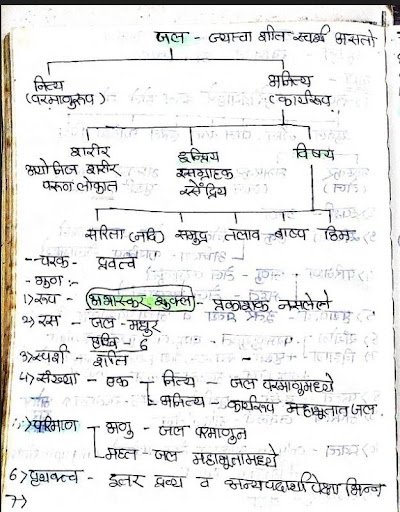
Within the 2026 manuscripts, water is presented through a striking ontological distinction that mirrors the modern movement toward quantum field theory. The philosophy categorizes Jala into two primary states of existence: the eternal essence and the manifested world of effects.
The Ontological Status of Jala
- Nitya (Eternal): Existing in the indestructible “atomic form” known as Paramanu. This is the fundamental, causal reality of water that exists beyond time.
- Anitya (Non-eternal): The “functional form” or Karya-rupa. This is the world of effects—the rivers, oceans, and clouds that appear, transform, and eventually vanish.
By framing water as Paramanu, the ancient synthesizers recognized an eternal building block that remains constant even as its physical manifestations (Karya-rupa) shift through the cycles of the environment. It is a sophisticated view of an element as both a permanent blueprint and a temporary physical body.
2. The “Sweet” Truth: Why Pure Water is Inherently Delicious
Modern science typically defines pure water as a “tasteless” solvent. The philosophy of Jala offers a provocative counter-argument: pure water possesses an inherent property of Rasa (Taste) that is specifically Jala-Madhura, or “sweet.”
In this system, while the Earth element is a complex vessel for six distinct tastes, water’s primary property is a singular, primordial sweetness. In the context of this synthesizer’s persona, “sweetness” here does not denote a saccharine or sugary quality; rather, it refers to a state of absolute equilibrium and satisfaction. It suggests that the “refreshing” sensation of hydration is not the absence of flavor, but the subtle presence of water’s most fundamental, satisfying character—a sensory reminder of the element’s life-sustaining purity.
3. The Cosmic “Glue”: Water as the Source of Cohesion

Perhaps the most evocative mechanical insight in these notes is the property of Sneha, traditionally translated as viscosity or cohesion, but carrying a deeper meaning of “bonding.” The philosophy identifies Sneha as the essential force that allows for Pindibhava—the cohesion of disparate particles.
“Within the margins of the 2026 manuscripts, we find the concept of Sneha—an evocative term that suggests more than mere viscosity; it implies a cosmic intimacy. It is the ‘glue’ that brings separate particles together, transforming vit (brick), mati (clay), and churn (dust/powder) into solid, unified forms.”
Where modern physics explains this through hydrogen bonding and surface tension, the philosophy of Jala views it as an inherent “affection” within the element. Without Sneha, our physical reality would literally crumble into disconnected dust; water is the invisible force that holds the material world in a state of coherent form.
4. The Four Dimensions of the Hydrosphere
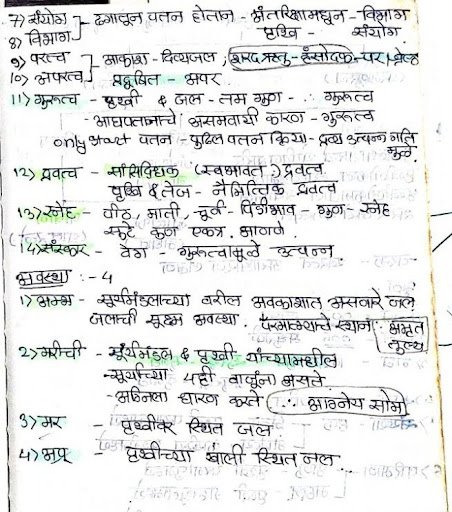
Moving beyond the simple three phases of matter (solid, liquid, gas), the Jala philosophy offers a “spatial-cosmic” classification of water’s journey through the universe. It identifies four distinct Avastha (States) based on their vertical location in the cosmos:
- Ambha: The subtle celestial vapors situated above the solar system. This is described as Amrut-tulya—nectar-like in its purity and metaphysical potency.
- Marichi: The water occupying the vast space between the sun and the earth. This state is defined by the Agneya Soma (Fire-Moon) duality; it is a region of intense solar fire and lunar coolness that acts as a carrier for celestial impurities.
- Mara: The “waters of the world” found directly upon the Earth’s surface (rivers, lakes, and oceans).
- Mapu: The hidden reservoirs residing beneath the Earth’s surface.
This framework replaces our utilitarian view of the “water cycle” with a map of water as a vertical continuum, bridging the deep subterranean world with the highest reaches of the celestial heavens.
5. The Weight of Motion: Gravity as an Inherent Property
The intersection between this ancient wisdom and classical physics is nowhere more apparent than in the discussion of Gurutva (Weight) and Samskara (Velocity). In these notes, gravity is not merely an external force acting upon a liquid; it is an inherent property of the element itself.
The manuscripts describe Gurutva as the Adyapatanache asamavayi karan—the “non-inherent cause of the initial fall.” This is a remarkably precise distinction: Gurutva (weight) provides the necessary impulse for water to begin its downward descent (Patana), while Samskara (velocity or the impression of movement) is the force that sustains that motion once it has begun. It is a nuanced understanding of the transition from potential to kinetic energy, identifying weight as the “unseen cause” of water’s eternal downward flow.
Conclusion: A New Way to Look at the Rain
The philosophy of Jala reveals that water is defined by a rigorous set of 14 specific properties—ranging from its Abhaswara Shukla color (a non-illuminating white that signifies transparency and distinguishes it from the brilliant light of fire) to its Samsiddhika Dravatva (its inherent, natural fluidity). These notes from March 2026 remind us that every drop of rain is more than a chemical compound; it is a carrier of sweetness, a binder of matter, and a traveler through celestial dimensions.
If we began to view water not just as a resource, but as a sweet, cohesive, and celestial element, how would our treatment of our planet’s most precious liquid change?
OMSAIRAM OK