1. Introduction: The Enigma under the Neem Tree
Amidst the dust of 19th-century Maharashtra, a figure emerged who defied the rigid religious and social taxonomies of the British Raj. In the mid-1850s, a mysterious sixteen-year-old lad arrived in the village of Shirdi, possessing no wealth and practicing an intense, silent penance. He sat motionless in an asana under a local neem tree, indifferent to the biting cold or the scorching heat. The villagers were wonder-struck; the local priest, Mhalsapati, recognized a divine spark within the youth, greeting him with the words, “Ya Sai!” (Welcome, Saint).
How did this man—who owned nothing, lived in a dilapidated, abandoned mosque, and survived by begging for his daily bread—eventually become a global icon of peace? The answer lies in the sanctuary he created: a ruined building he gave the Hindu name “Dwarkamai.” Known as the “Mother of Mercy,” this mosque became a site where religious boundaries dissolved. For the contemporary seeker, Sai Baba’s life offers more than historical curiosity; it provides a blueprint for finding “universal truths” in an age of fragmentation.
2. Lesson 1: The Great Grinding—How Wheat Flour Stopped an Epidemic
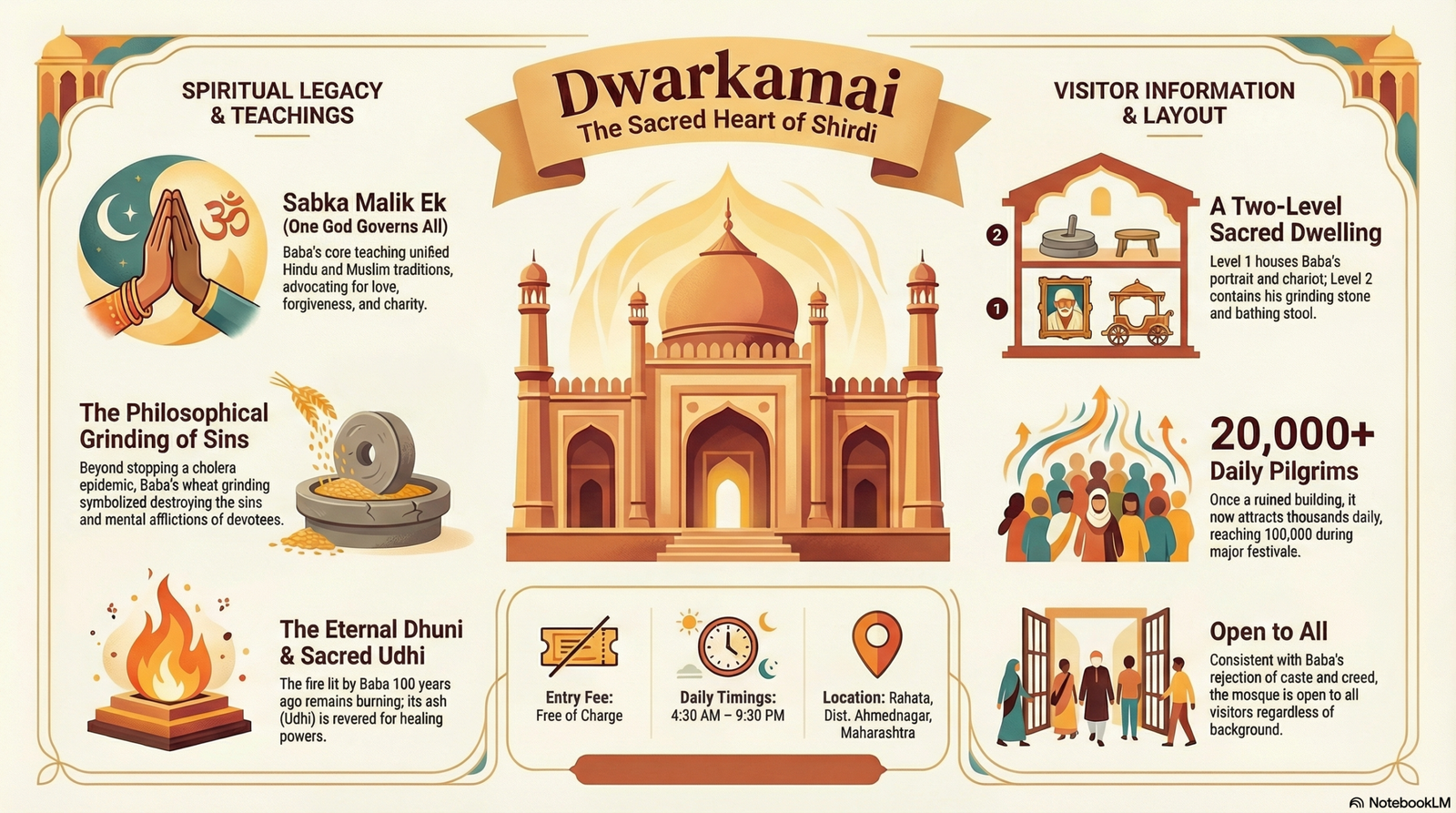
In 1910, a cholera epidemic ravaged Shirdi. Amidst the mounting fear, Sai Baba began a task that seemed nonsensical to the local observers: he spread a sack on the floor of Dwarkamai and began grinding wheat on a hand-mill. Because the Saint lived on alms and stored no food, the villagers were puzzled by this sudden industry. When four women forcibly took over the task, thinking they were helping him prepare bread, Baba instructed them to take the flour and throw it on the village border limits.
The villagers soon realized that this was not a culinary act, but a spiritual intervention. As the source material records:
“It was not wheat that was ground but the Cholera itself was ground to pieces and pushed out of the village.”
For the spiritual historian, the “Great Grinding” serves as a profound metaphor for the internal life. The “grinding” represented the destruction of the devotees’ sins and the Ahamkara (ego). In this spiritual mill, the two stones are identified as Karma (action) and Bhakti (devotion), while the handle of the mill is Jnana (knowledge). To reach self-realization, the Saint taught that one must first grind away the three gunas—the fundamental qualities of Sattva, Rajas, and Tamas—that bind the soul to worldly existence.
3. Lesson 2: The Jungle Guide—Why You Can’t Walk the Path Alone
Modern culture often prizes “free will” and the idea that we can navigate our destiny through sheer personal cleverness. However, a famous dialogue between Sai Baba and his devotee Kakasaheb Dixit suggests that the spiritual path is too treacherous for the unescorted. Use of the “jungle” metaphor in the Shri Sai Satcharita describes the path to the Divine as a trek through a dense forest filled with “tigers, wolves, and ditches.”
While a traveler might attempt to find their own way, they face the constant danger of being lost. Baba’s lesson was that to reach the destination safely, one needs a guide (Guru) who has already traversed the path. This perspective challenges the contemporary ideal of absolute independence. It was during this very debate regarding the necessity of a Guru that the author of Baba’s biography, Govind Raghunath Dabholkar, received the prophetic and slightly mocking title of Hemadpant. The name was a reference to a learned 13th-century minister, intended to prick Dabholkar’s intellectual pride and remind him that “man proposes, but God disposes.” Baba sided with the weight of “Destiny,” suggesting that true progress requires the humility to accept a guide.
4. Lesson 3: Radical Inclusivity—The Mosque with a Hindu Name
Perhaps the most surprising takeaway for a modern audience is Sai Baba’s radical syncretism. Though he was a Fakir who practiced Muslim rituals and constantly uttered “Allah Malik” (God is King), he was the primary opponent of religious orthodoxy in any form. He turned his mosque into a living bridge, allowing Hindu temple bells to ring within its walls while he recommended that his Muslim followers study the Koran.
This “middle path” was a direct challenge to the sectarianism of his time. Inside Dwarkamai, Baba maintained the Dhuni, a sacred fire common in Hindu tradition that has been kept alive for over a century. He encouraged Hindus to study the Bhagavad Gita and the Ramayana, yet he lived as a mendicant in a style associated with Sufi saints. This lifelong refusal to be categorized is summarized by his most famous epigram:
“Sabka Malik Ek” (“One God governs all”).
By bestowing the name of a Hindu pilgrimage site (Dwarka) upon a Muslim place of worship, he demonstrated that the Divine transcends the labels we use to contain it.
5. Lesson 4: The Awareness of the Divine—A Cup of Sugarless Tea
Sai Baba taught that the Divine is not a distant judge, but an all-pervasive witness to even our smallest personal sacrifices. This is beautifully illustrated by the story of Mr. Cholkar, a poor man who was a candidate in the Civil Courts in Thana. Cholkar vowed that if he passed his departmental examination and secured a permanent post, he would travel to Shirdi. To afford the trip, he secretly gave up sugar, drinking only “sugarless tea” for months to save every pice.
When he finally arrived at Shirdi, he told no one of his private penance. Yet, as he sat in the mosque, Sai Baba turned to the host and gave a pointed instruction: to give the guest “tea fully saturated with sugar.” In that “aha!” moment, Cholkar realized that his silent sacrifice had been witnessed from the very beginning. For the modern seeker, this serves as a reminder that sincerity in spiritual practice is never invisible, regardless of how small the gesture may seem to the rest of the world.
6. Lesson 5: Practical Divinity—Miracles with a Social Purpose
Sai Baba’s “miracles” were rarely performed for spectacle; they almost always served a community function or provided a lesson in empathy. When local shopkeepers refused to give him oil for his lamps, he reportedly used water to keep them burning, teaching a lesson in truthfulness. In a more visceral incident, Baba once thrust his arm into the logs of the burning Dhuni fire. He later explained that, at that very moment, a blacksmith’s child at a distance had fallen into a furnace. Baba had reached into the fire to save the child, preferring to let his own arm be scorched than let the infant perish.
He became known as the “Doctor of doctors,” utilizing the Udhi (sacred ash) from his eternal fire as an apotropaic and healing tool for the sick. Even his omniscience had a practical edge; though he never saw a railway train nor traveled by one, he was known to know the exact timing of the arrival and departure of all trains, often using this knowledge to protect his devotees from mishaps. These acts were not meant to establish him as a magician, but as an embodiment of extreme empathy.
7. Conclusion: The Legacy of the “Mother of Mercy”
Today, the small, dusty village of Shirdi has been transformed into a global pilgrimage center, receiving between 20,000 and 100,000 visitors daily. The “ruined building” of Dwarkamai remains the heart of this movement, still offering the “sacred ash” to those seeking healing.
At the core of Sai Baba’s legacy are two qualities he advocated for above all else: Shradda (devotion) and Saburi (patience). He taught that while the world may be a place of constant struggle, we can navigate it if we keep our hearts fixed on the truth and our minds steady with patience. In a world characterized by constant “grinding” noise and social division, Sai Baba’s life offers a final, lingering question: What would happen if we looked at our daily struggles not as burdens, but as the grain meant to be ground into the flour of wisdom?